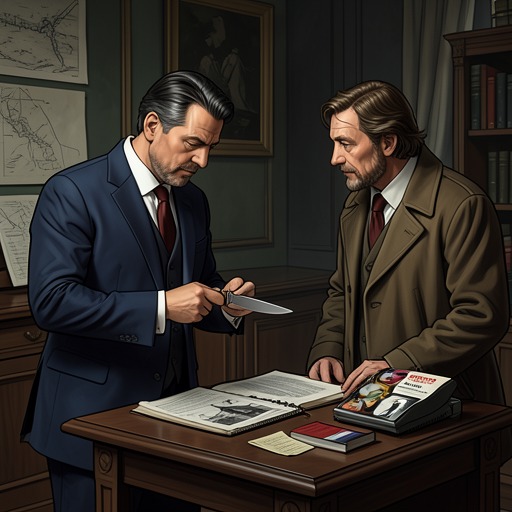
Clarke’s final confrontation
The A.B.C. MurdersHercule Poirot’s final confrontation with Franklin Clarke resolves the novel’s central deception: the apparent serial killer’s letters are not the work of a homicidal madman, but a calculated performance designed to conceal a murder for inheritance and leave Alexander Bonaparte Cust to take the blame. Poirot recasts the crimes as a single, purposeful plot, names Clarke as its author and perpetrator, and supports the accusation with evidence that Clarke cannot explain away.
The Letters Reconsidered
Poirot says that he had sensed something wrong with the letters from the beginning, but initially attributed their artificial quality to the mind of a madman. On reviewing them from a different point of view, he reaches the opposite conclusion: they are false precisely because a sane person constructed them to resemble the communications of a homicidal lunatic. The letters’ show of irrationality is therefore not a disclosure of the writer’s state of mind; it is a disguise.
That reversal changes the organizing question of the investigation. Rather than treating the murders as the work of one conspicuous serial killer, Poirot asks what purpose the conspicuous pattern serves. The letters direct public and police attention toward a group of related killings, making each individual murder less noticeable within the series. He likens the effect to overlooking a pin in a pin-cushion: the conspicuous whole hides the crucial individual crime.
The public spectacle had helped sustain that misdirection. The murders had been bracketed together, and the belief at Scotland Yard was that extensive publicity offered the best chance of catching the killer. Newspapers circulated purported clues and images, while the public joined the search. Against this backdrop, the letters did more than announce a criminal persona: they helped fix attention on the alphabetical campaign rather than the person who benefited from one particular death.
From Pattern to Motive
Once he recognizes the letters as a purposeful fake, Poirot reviews the possible perpetrators of the separate crimes rather than assuming that the apparent serial killer must be Cust. He considers Franz Ascher in the Andover murder but finds it difficult to reconcile him with the elaborate plan and premeditated killing. For the Bexhill murder, Donald Fraser appears possible: he has ability and a methodical cast of mind. But jealousy offers a weak explanation for careful premeditation, and Fraser’s early-August holiday makes his connection to the Churston murder unlikely.
The Churston murder, by contrast, brings the investigation to the strongest motive. Sir Carmichael Clarke was immensely wealthy. His dying wife held a life interest in the money, after which it would pass to his brother, Franklin Clarke. The inheritance gives Franklin a reason for Sir Carmichael’s death that the alphabetical pattern can obscure. Poirot’s decisive shift is from asking who fits the imagined profile of a mad killer to asking who could gain from the murder at the centre of the series.
Poirot matches that motive against the man he has encountered. He identifies Franklin’s adventurous, roving character, his easy manner with women, his methodical habits, and the boyish quality reflected in the letters and railway guide. He also connects the alleged writer’s jeer at foreigners with Franklin’s partiality for England. In the library at Combeside, a copy of The Railway Children by E. Nesbit supplies another detail consistent with the boyish character Poirot has inferred. The clues do not stand alone: together, Poirot argues, they make Franklin and A B C the same person.
Cust as the Diversion
The accusation meets an immediate objection. Franklin points to Cust, caught with blood on his coat and a knife hidden in his lodgings, and treats those apparent incriminating facts as proof that Poirot’s account cannot be right. The exchange brings the design of the framing into view: the evidence against Cust is not simply a mistaken reading of the crimes but part of the means by which suspicion is directed away from the person with the motive.
Poirot says that Franklin was safe so long as nobody suspected him; once suspicion turned his way, evidence could be found. The statement marks a change in the balance of the confrontation. Franklin’s apparent defence depends on Cust already having been made to look guilty, whereas Poirot now treats the case against Franklin as something that can be established independently.
Evidence and Exposure
Poirot lays out several strands of corroboration. In a cupboard at Combeside, he found the stick used in the Andover and Churston murders: an ordinary-looking stick with a thick knob handle, altered by removing part of the wood and filling the space with melted lead. Its concealed construction links a familiar object to the two killings.
Identification evidence places Franklin at crucial scenes. Two witnesses selected his photograph from a group of six after seeing him leave a cinema when he was supposed to be at the Doncaster race-course. Milly Higley and a girl from the Scarlet Runner Roadhouse identified him in connection with Bexhill; the latter place was where he had taken Betty Barnard to dine on the evening she was killed. These identifications connect Franklin to the geographical and chronological pattern that his supposed campaign was intended to dominate.
The final piece is a fingerprint on Cust’s typewriter. Poirot presents it as especially damaging because an innocent Franklin, on the account he advances, could never have handled the machine. The typewriter thus connects the man accused of writing the letters to the instrument associated with their ostensible author. The stick, the identifications, the race-course discrepancy, and the fingerprint turn Poirot’s reading of the pattern into a converging evidentiary case.
The Confrontation’s Outcome
Franklin calls Poirot’s theory absurd, but Poirot answers with the evidence rather than retreating into inference alone. After sitting still for a minute, Franklin concedes that Poirot has won, while insisting that the attempt was worth making. His response closes the contest between the false identity of A B C and the person Poirot has exposed behind it.
The confrontation resolves the apparent conflict between two explanations of the murders. Cust’s conspicuous position as suspect had encouraged the belief that one serial killer committed every crime; Poirot’s account instead makes that figure a deliberate decoy. The alphabetical murders and their letters remain part of the plan, but their meaning changes: they concealed the targeted killing of Sir Carmichael Clarke and helped protect Franklin by making a staged pattern more visible than the motive behind it.