Lady Clarke’s chronic illness
The A.B.C. MurdersLady Clarke’s chronic illness is both a lived bodily ordeal and a force that alters the relationships around her: pain narrows her attention, while fatigue and medication are used to account for her suspicions and decisions. Her illness helps explain the household’s strain without making every conflict reducible to it.
Symptoms and Daily Experience
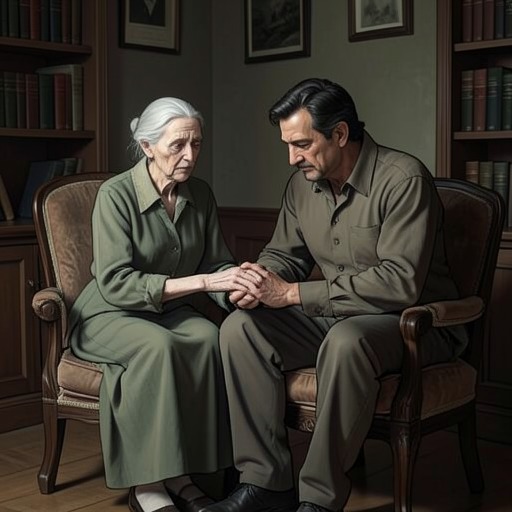
Lady Clarke describes her body as a nuisance when it takes control. In conversation with Hercule Poirot, she says that everything seems dim and that, when pain dominates, she can think of little beyond whether it will ease. The limitation is not merely physical: she feels it makes her stupid and leaves her unable to remember what she had wanted to tell him. Her account conveys illness as an interruption of attention and memory, constricting the present to the next interval of pain.
That debility is visible in the need for others to manage the limits of her strength. When she becomes animated while discussing Thora Grey, Nurse Capstick intervenes, warning her not to excite herself or become tired. Lady Clarke continues, but the nurse’s repeated efforts to calm her make the illness part of the scene’s power relations: Lady Clarke speaks from within the household, yet her capacity to speak at length is treated as something that must be monitored.
Effects on the Household
Lady Clarke recalls that she disliked Thora, whom her husband, Sir Carmichael Clarke, valued as a capable secretary and regarded with affection. She resented the suggestion that Thora might remain to comfort her, and says that she dismissed her despite Franklin Clarke’s proposal to pay her three months’ salary. The episode shows Lady Clarke exercising authority while ill; she presents her decision as decisive, not as something she was unable to make. Her illness forms part of the context, but her own account also makes clear that personal dislike and jealousy mattered.
Franklin later offers Hercule Poirot a different emphasis. He says that his sister-in-law became jealous when the question arose of Thora staying on after Sir Carmichael’s death, and attributes her ideas partly to illness and morphia, citing Nurse Capstick’s view that the household should not blame her. This is Franklin’s explanation, not a neutral diagnosis. Set beside Lady Clarke’s own recollection, it reveals how illness becomes a contested interpretation: it may help explain her suspicions, but it also risks diminishing her agency by making her judgments seem only symptoms.
Illness, Interpretation, and Responsibility
The novel places Lady Clarke’s condition among other accounts of bodily and neurological vulnerability. A young man rejects the idea that he can simply refuse to accept war, comparing it to diseases and cancer that happen regardless of personal preference. Elsewhere, Dr Thompson discusses the possibility that a person with epilepsy might perform an action while somnambulistic and remain unaware of it, while arguing that the letters in the case show planning. These episodes do not establish that Lady Clarke’s illness is equivalent to epilepsy or determine what caused her behavior. They do, however, set her experience within a broader narrative concern with the limits illness places on will, memory, and other people’s judgments.
Lady Clarke’s chronic illness therefore has a double presence in the story. It is concrete in her pain, fatigue, and difficulty sustaining thought, and social in the way Nurse Capstick and Franklin interpret her conduct through it. That distinction matters: the condition shapes what Lady Clarke can bear, but the novel does not make it a complete explanation for her antagonism toward Thora or a simple verdict on her character.