Speech is an invention of man’s to prevent him from thinking
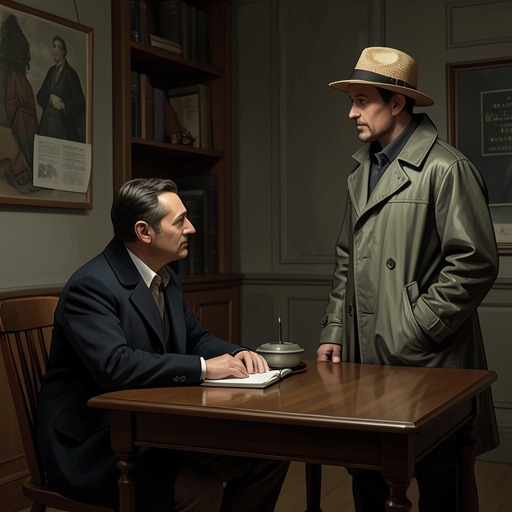
The A.B.C. MurdersSpeech is an invention of man’s to prevent him from thinking is a maxim Hercule Poirot invokes to explain why conversation can expose what a person wishes to conceal. Its significance lies in the reversal it proposes: speech may seem to express a controlled account, yet the act of talking can disclose personality and undermine that control. In the investigation, the maxim becomes a practical method, set against the uncertainty of testimony and the gap between what witnesses see and what they infer.
The maxim as an investigative method
Poirot develops the thought while explaining how he intends to confront A B C. He says that conversation is dangerous to anyone with something to hide because people cannot resist using it to express themselves; in doing so, they give themselves away. The point is not merely that a speaker may make a factual mistake. A person’s manner of answering can reveal more than the answer was meant to disclose.
Poirot’s confidence in this method takes a pointed form when he predicts that Cust will tell him a lie. Rather than treating that lie as an obstacle, Poirot expects it to help him recognize the truth. The maxim thus describes an active interrogation strategy: speech is useful not because every statement is reliable, but because the effort to manage a statement can itself become revealing.
Testimony and the shaping of accounts
The investigation also demonstrates why conversation cannot be accepted at face value. When witnesses are invited to describe a short, dark man, an exchange among a stout woman, her lank husband, and a hoarse-voiced shop-boy produces several such sightings, as well as a report of a tall, fair man without a beard. The conflicting descriptions multiply rather than settle the question. Poirot and Hastings leave without correcting the falsehoods that prompted the discussion, allowing the episode to expose how readily talk can accumulate uncertain identifications.
Other statements show how the form of a question may shape what a witness claims to remember. At a cinema inquiry, Mr Leadbetter first gives a vivid but mistaken account of a supposed groan, which he invents through the force of his imagination. Later, when asked whether the man he saw was dark or fair, he hesitates before settling on an uncertain impression; prompted about a limp, he then agrees that the man may have limped. Mary Stroud offers a more specific description—medium-sized, stooped, wearing glasses, a dark suit, and a shabby Homburg hat—but her account, too, is one piece of testimony to assess rather than a complete identification by itself.
From spoken fragments to a pattern
Poirot’s maxim does not mean that every offhand remark immediately yields certainty. A police statement from a young man named Hill records that he heard a man talking to himself after leaving the Torquay Palladium. The man said, “That’s an idea.” Inspector Crome later connects the remark with the film Not a Sparrow, which had also been showing at the Regal in Doncaster, and considers whether the idea for the next crime’s method occurred to the suspect then. On its own, the fragment had seemed to amount to nothing; in relation to other descriptions and circumstances, it acquires possible significance.
This distinction gives the maxim its investigative force and its limits. Conversation supplies fragments—some mistaken, some prompted, some initially trivial—that must be compared with other evidence. Poirot listens for what a speaker reveals inadvertently, but the inquiry also depends on sorting observation from interpretation and testing one account against another.
The maxim confronted with Cust
The final confrontation brings the principle to a disturbing point. Poirot tells Cust that he knows he committed the murders. Cust agrees, appearing at peace, but when Poirot asks whether he knows why he committed them, Cust shakes his head. His answer separates acknowledgment from explanation: he accepts responsibility as he understands it, yet cannot supply the motive that would make sense of it.
That exchange complicates any simple faith in conversation as a route to complete knowledge. Cust’s words reveal what he believes, but they do not resolve the question of why. Across the investigation, speech can betray, mislead, or preserve a fragment for later comparison; it becomes illuminating only when Poirot listens closely and weighs what has been said against what else is known.