Agnes Lozelle sells Marlowe the location of Mona Mars
The Big SleepAgnes Lozelle sells Philip Marlowe the location of Mona Mars’s hideout in exchange for two hundred dollars. Her account traces Mona and Lash Canino to a frame house near a foothill road, giving Marlowe a concrete lead in the investigation and exposing Joe Brody’s role in watching the pair. The transaction joins the novel’s scattered clues about missing people, concealment, and violence to a precise place that Marlowe can pursue.
Background and Stakes
By the time Agnes offers the information, the investigation has linked Rusty Regan’s disappearance to the disappearance of Eddie Mars’s wife. Captain Gregory has told Marlowe that Regan left on September 16, when the chauffeur was off duty and nobody saw him take a car. The car was found four days later in a garage at Casa de Oro, a bungalow court near the Sunset Towers. Police learned that Mona had been living there and had left within two days of Regan; someone resembling Regan had reportedly been seen with her, but the identification was uncertain. This overlap of departures had encouraged suspicion of an elopement without establishing what happened.
Agnes’s later disclosure supplies a different, more specific account of Mona’s whereabouts. She does not claim to know what became of Regan. Instead, she identifies a place where Mona had been staying with Canino, a man Marlowe already has reason to treat as dangerous. The distinction matters: her information resolves a question about Mona’s location, but it does not by itself settle the larger mystery of Regan’s disappearance.
The Deal
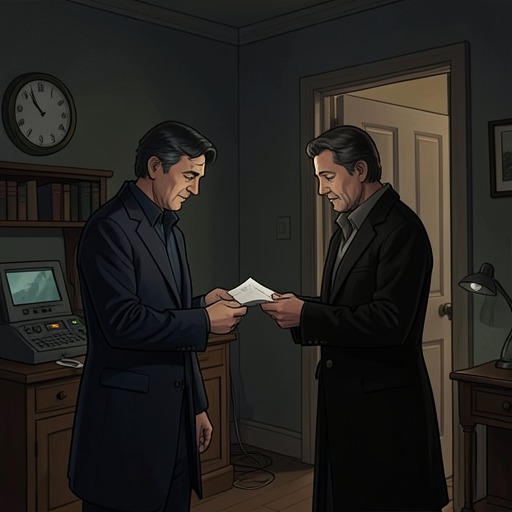
Marlowe approaches Agnes through Harry Jones and makes the offer directly. When she asks whether Harry is there, Marlowe tells her he is not; he then explains that he has come to pay two hundred dollars in return for certain information, and that the money is ready. Agnes asks whether Harry told him where she was. He answers that Harry did not. The exchange places Agnes in the position of choosing what to reveal, rather than merely passing along an account already known to Marlowe.
The payment gives the disclosure a clear practical context. Agnes is preparing to leave and later describes the cash as money for a getaway. Her urgency is evident in her questions about Harry and in her wish that Marlowe luck would go with her, but the evidence does not establish every reason she wants to leave. She accepts the money and provides what she has to sell: the location where she says Mona was being kept.
Agnes’s Account of the Hideout
Agnes dates the observation to the Sunday before last. She and Joe Brody were driving along Foothill Boulevard late at night when they passed a brown coupe driven by a blonde woman, with a short, dark-haired man beside her. Agnes recognized the woman as Eddie Mars’s wife and the man as Canino. Joe followed the coupe, keeping ahead of it; Agnes characterizes him as good at that kind of surveillance. Her account therefore makes the lead depend on both her recognition and Joe’s pursuit of the car.
About a mile east of Realito, the coupe turned from the highway onto a road running toward the foothills. Agnes identifies the surrounding area by its contrast: orange country lay to the south, while the land northward was bare against the hills. A cyanide plant stood a couple of miles farther on. Near the turnoff was a small garage and paintshop operated by Art Huck, which Agnes suggests might serve as a hot-car drop. Beyond it stood a frame house, with the foothills, a bare stone outcrop, and the plant farther on. These landmarks turn her account into a route Marlowe can follow rather than a vague report of a sighting.
After the coupe turned toward the house, Joe doubled back with Agnes. They watched the passing traffic for half an hour without seeing the car return. When it was dark, Joe went closer to inspect the property. He saw lights inside, heard a radio, and found the coupe as the only car in front. Agnes and Joe then left. The observation supports the claim that Mona and Canino had gone to the house and were still there at the time of the surveillance; it does not establish whether they remained there afterward. Marlowe recognizes this limitation and remarks that they may have changed quarters, while insisting that the location is still what Agnes has to sell.
Consequences and Significance
Agnes’s account transforms an uncertain pattern into a usable lead. The police evidence about Casa de Oro had placed Mona’s departure close to Regan’s, while Agnes’s evidence places her later with Canino near Realito. That contrast complicates the apparent story of Mona and Regan leaving together: the reported companion at the hideout is Canino, not Regan. The disclosure does not explain Regan’s fate, but it weakens the idea that the shared timing of Mona’s and Regan’s departures proves they went away together.
The revelation also makes the investigation’s spaces consequential. The story moves from the city’s roads and residences toward a secluded foothill house, reached by a turn off the highway and watched under cover of darkness. Agnes’s knowledge comes from following a car, identifying its occupants, and having Joe inspect the destination; the information is valuable because surveillance has converted a remote place into a specific address in the investigation. Marlowe can act on the lead, but the warning that Mona may have moved preserves the uncertainty inherent in information sold after the fact.
Agnes leaves with the two hundred dollars, bidding Marlowe goodbye and saying she hopes he wishes her luck. He rejects her claim that she has been treated unfairly, and she drives away. Her disclosure therefore closes as a transaction, not a reconciliation: she has supplied a consequential fact, secured the money she wanted, and removed herself from Marlowe’s immediate pursuit, while he is left to test the location she named.