Art Huck's garage
The Big SleepArt Huck's garage is a roadside repair shop whose mundane function becomes a trap: Lash Canino and the mechanic Art use a tire repair to overpower Philip Marlowe, but the garage also provides the setting from which Marlowe escapes and returns armed. Tucked beside an isolated house and reached from a rain-dark highway, it brings the investigation’s network of hiding places down to a close, lethal interior where tools and routine work conceal violence.
Setting and Approach
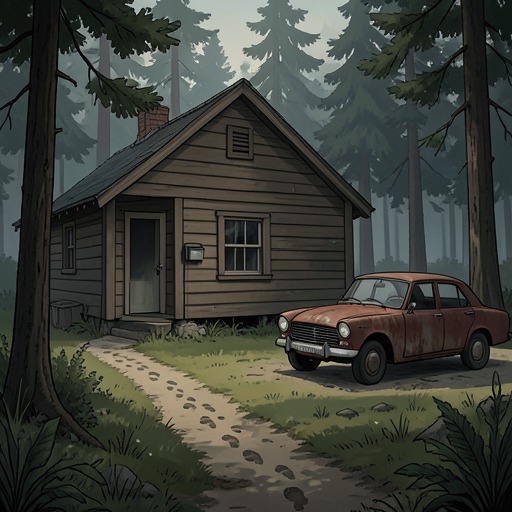
The garage stands about a hundred yards from the highway, presenting passing traffic with a blank side wall. Its sign identifies it as “Art Huck—Auto Repairs and Painting.” A narrow side road leads to it, and a frame house stands next door behind a thin clump of trees. From the road, Marlowe sees light leaking beneath the shut garage doors and a car in the house’s gravel drive that he recognizes as belonging to Canino. The garage and house form a paired hideout: one offers an apparently legitimate place of work, the other a secluded domestic setting.
The site belongs to a wider geography of concealed wealth and danger. At the Sternwood estate, a manicured lawn leads toward a white garage and the foothills; below the estate, old oil derricks mark the source of the family fortune. On Laverne Terrace, the houses lie below a narrow, rain-slick road, screened by hedges and shrubs. Farther out, the Cypress Club at Las Olindas occupies a decaying mansion among wind-twisted cypresses. Art Huck's garage is a more openly utilitarian stop in this landscape, but its blank wall and remote approach make it no less private. Its separation from the highway helps its occupants control who enters and what can be seen.
The Garage as an Ambush
Marlowe approaches after following clues through the rain to the garage and the neighboring house. He knows Canino’s car is nearby and suspects that the house shelters the woman who has not run away with Rusty Regan. When Marlowe bangs on the garage door, a voice first tells him to try Realito, a mile west. Another voice orders Art to open up. The exchange turns the garage threshold into a test: Marlowe insists on entry, while the men inside try to keep control of the encounter.
As the door opens, a flash of light catches a gaunt face before a gun knocks the flashlight from Marlowe’s hand. The garage lights then reveal a tall man in coveralls backing away with a gun leveled at him. Marlowe steps inside and shuts the door. The air smells of hot pyroxylin paint, a concrete detail that establishes the shop as a working repair space even as the armed men convert it into a place of confinement. Art’s claim that a bank job has just taken place at Realito supplies a false explanation for the commotion; Marlowe answers that he is a stranger and did not rob it.
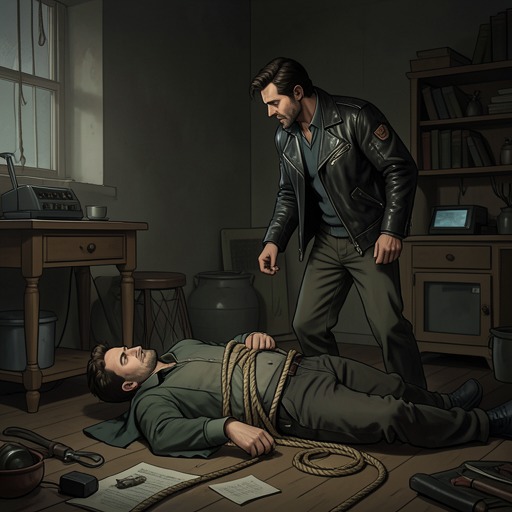
The attack grows out of the garage’s work routine. Art removes his rubber coat and sou’wester, repairs a tire tube, inflates it with an air hose, and tests it. While Canino waits nearby, the ordinary sequence of patching and checking gives Art an opportunity to strike: he swings the stiffened tube down over Marlowe’s head and shoulders, then pins his arms by leaning his weight onto the rubber. The tire is both a repair object and an improvised restraint. The apparently unremarkable teamwork between the two men makes the violence more effective because it arrives through coordinated labor rather than an announced assault.
Captivity, Escape, and Return
After escaping the garage, Marlowe finds the convertible’s tires repaired and mounted, evidence that his captors had anticipated the car’s possible use. Handcuffed and unable to button his raincoat, he retrieves a second gun from the hidden compartment beneath the steering wheel and returns toward the house and garage. The repaired tires have restored his mobility, but the concealment of the weapon gives him a means to challenge Canino’s control. The garage’s work, like its earlier violence, has altered what the car can do in the scene.
The garage thus belongs to a chain of places in which access, visibility, and movement are continually negotiated. The Sternwood estate’s terraces, fence, and gates separate private wealth from the oil field below; a hedged house hides its entrance; the garage’s blank wall conceals activity from the highway. In each case, physical boundaries shape what Marlowe can observe and how he can act. Here that spatial control becomes most immediate: the closed doors and armed men make the shop a trap, while the repair work and the car’s hidden compartment help make escape possible.
Narrative Significance
Art Huck's garage turns the novel’s recurring contrast between respectable surfaces and hidden violence into a physical scene. A named auto-repair business, tools, a tire, and an air hose belong to ordinary work; inside, they serve an armed ambush. The garage does not merely shelter criminals. Its practical functions are absorbed into their methods, so that the same labor can immobilize Marlowe and, through the repaired car, leave him a route back.
Its location also connects the violence to the novel’s broader geography of Los Angeles and its outskirts. The plot moves from a wealthy estate and commercial storefronts toward isolated roads, concealed houses, and former oil country. At the garage, the border between city infrastructure and remote refuge is only a hundred yards of road away, but that distance is enough to make the encounter difficult to witness. The shop’s ordinary name and outward-facing repair business offer a thin cover for a place where access is guarded and violence is carried out of public view.