Arthur Geiger is murdered
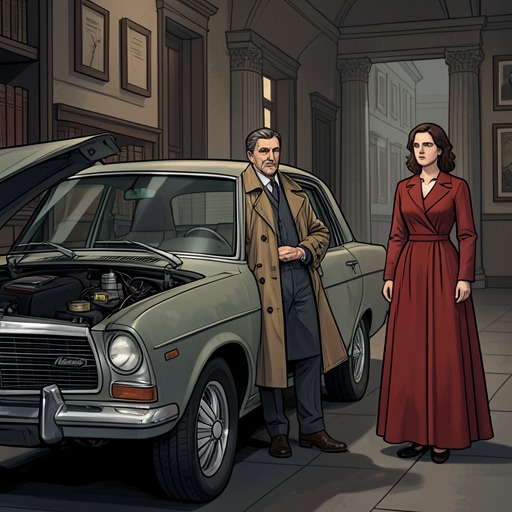
The Big SleepArthur Geiger is murdered at his house in Laurel Canyon after Owen Taylor, the Sternwood family’s chauffeur, discovers him photographing Carmen Sternwood without her clothes. The crime links Geiger’s illicit operation to the Sternwood family’s vulnerability, but it also begins a chain of concealment: Carmen is found at the scene, Geiger’s body disappears, and the official narrative later assigns the killing to someone else. Marlowe’s delayed report protects his client in the short term while helping the case become harder to tell truthfully.
Background and Setting
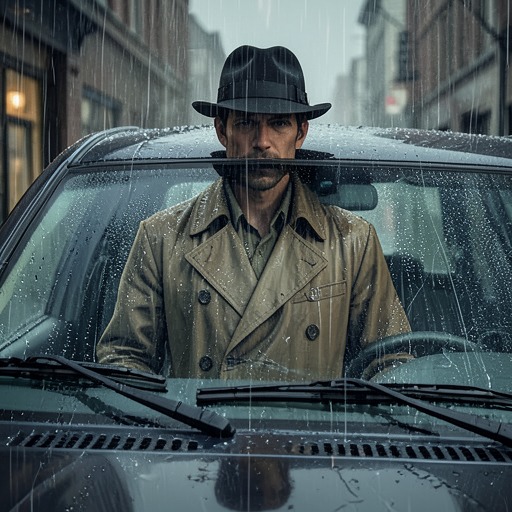
Marlowe reaches Geiger’s house by following him through a rainstorm into Laurel Canyon. The route leaves the public boulevard for a narrow, curving road lined with cabin-like houses, hedges, and shrubs that screen their entrances. Geiger’s own front door is concealed by a box hedge; the back entrance can be reached from wooden steps rising from the lower street. This secluded arrangement gives visitors a way in and out while making the house difficult to observe from the road.
The violence occurs inside a domestic space arranged around Geiger’s private business. When Marlowe enters, one person is dead and another is present but does not respond to his arrival. Geiger lies on the floor beside a carved object that proves to be a concealed camera, aimed at Carmen. The blackened flashbulb accounts for the hard flash Marlowe saw from outside. The camera makes the purpose of the scene legible: Carmen has been photographed, and Geiger’s covert surveillance is not merely suspected but materially exposed.
The Killing and Its Reconstruction
Before the shots, a car has stopped outside Geiger’s house and a woman has entered. Marlowe identifies the car as a maroon Packard registered to Carmen. At about seven-twenty, a flash comes from the house, followed by a scream. As Marlowe reaches the entrance, three shots sound inside; he then hears footsteps retreating and a car starting below the house. The sequence leaves him outside the violence until he forces his way through a French window.
Inside, Marlowe finds Geiger dead and Carmen still in the room. He sees that the camera was directed at Carmen and that the flashbulb has burned out. His later reconstruction supplies the motive and identifies the shooter: Owen Taylor was devoted to Carmen and objected to Geiger’s treatment of her. Taylor entered by the back way with a jimmy and a gun, caught Geiger taking the photograph, and fired. He escaped with the photographic negative.
That account is presented as Marlowe’s considered explanation, not as a witnessed account of the shooting. He did not see Taylor fire. But the circumstances fit the evidence he has gathered: Taylor had access to the family’s cars, an emotional reason to confront Geiger, and the opportunity to enter the house. Marlowe argues that the shooting was an impulsive response to the photograph, rather than a commercial attempt to take over Geiger’s business. His distinction matters because it separates Taylor’s motive from the later efforts by others to exploit the crime.
The Missing Body and Disputed Evidence
After leaving the house, Marlowe returns later and finds that Geiger’s body has been removed. Strips of embroidered silk are missing from the wall, and a second rug has been laid where the body had been. The rest of the room appears undisturbed. Two parallel marks on the floor seem to indicate that someone dragged the body toward the front door. The crime scene has therefore been altered, though Marlowe cannot establish who removed Geiger or where the body was taken at that moment.
The disappearance complicates the investigation and separates the physical crime from the evidence later used to explain it. Taylor leaves with the photographic negative; Joe Brody subsequently obtains the photograph from him. Brody admits to Marlowe that he followed Taylor after the shooting, overpowered him, and took the photographic material. That admission places Brody in possession of evidence from the scene but does not, in Marlowe’s judgment, make him Geiger’s killer.
Marlowe later defends this distinction to the authorities. He considers it physically possible that Brody killed Geiger and planted evidence on Taylor, but judges it inconsistent with Brody’s conduct and aims. Brody wanted a share of Geiger’s illicit book business, Marlowe reasons; Taylor had the motive to react violently to the nude photograph and the opportunity to do so. The case thus turns not only on objects recovered or moved, but on how those objects fit the participants’ known purposes.
Concealment and Official Account
Marlowe does not promptly report the murder. He explains that he was protecting his client and had no reason to expect that Geiger’s associate would go after Brody. Captain Cronjager later rebukes him: had the death been reported, the books could not have been moved from Geiger’s store to Brody’s apartment, and the chain of events leading to Brody’s death might have been interrupted. Marlowe acknowledges that he did wrong, while maintaining that he had not anticipated the later violence.
The morning papers offer a sharply different account. They do not connect Taylor, described as a wealthy family’s chauffeur, to the killing at Geiger’s house. Instead, they report that Brody shot Geiger and that Carol Lundgren killed Brody in revenge, presenting Lundgren’s confession as part of the solution. The story gives Cronjager credit for solving both killings and treats Taylor’s death as a suicide, while omitting Marlowe and the Sternwoods. Its confident sequence conceals the actual relationship between Taylor, Carmen, and Geiger.
The murder’s significance therefore extends beyond the death itself. It reveals that Geiger’s business depends on photographing Carmen and using the resulting material as leverage; it also shows how the transfer or suppression of evidence can produce a public account that is orderly but false. Marlowe’s failure to report the crime immediately places him inside that process of concealment, even as he later insists on a distinction between what can be imagined and what the evidence and character of the people involved support.