Carmen Sternwood
The Big SleepCarmen Sternwood is the younger daughter of General Guy Sternwood, and her role joins the family’s private vulnerabilities to the novel’s sequence of blackmail, murder, and concealment. She is at once a target of exploitation, a recurring source of danger, and the person whose crime explains Rusty Regan’s disappearance. The account of her is filtered through Philip Marlowe’s observations: he encounters her in a state of apparent mental disturbance, sees how others try to turn her image into leverage, and eventually identifies her as Regan’s killer. The truth does not lead to public justice. Marlowe and Vivian Regan instead face the question of how to protect Carmen and the fragile family she could expose.
Identity and First Encounters
Carmen is introduced at the Sternwood estate as Miss Sternwood, a daughter whose behavior strikes Marlowe as immature and unsettling. When the butler announces her, Marlowe responds that she looks old enough to be weaned. The exchange establishes his dismissive, sardonic manner toward her, but also the uneasy imbalance that recurs throughout their encounters: she is a member of an enormously wealthy household, yet Marlowe sees her as someone requiring supervision rather than as an equal participant in adult affairs.
The family’s surroundings frame this vulnerability without explaining it away. From the estate, the Sternwoods can still see the oil wells from which their fortune came, although most of the field has become public park and the family has moved up the hill. The old source of wealth remains visible from a protected distance, much as the family’s troubled history persists beneath its cultivated surface. Carmen’s behavior eventually makes that history impossible to keep entirely private.
At Geiger’s House
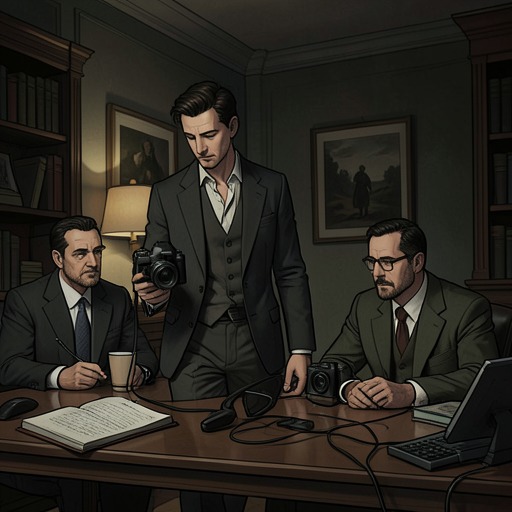
Marlowe finds Carmen at Arthur Geiger’s house after Geiger has been shot. She sits upright on a chair on a low dais, wearing jade earrings and an orange shawl, but otherwise unclothed. Her expression is fixed, her eyes appear unfocused, and a chuckling sound comes from her without an accompanying change in expression. Marlowe judges her to be unconscious or otherwise disconnected from the immediate scene. He brings her away from the house, but she cannot provide a reliable explanation of what she remembers.
The encounter places Carmen inside a chain of events in which other people seek to control the evidence surrounding her. Geiger’s illicit business has made her photographs a means of threatening the Sternwood family. Yet, in the immediate aftermath of his death, Carmen is not the person who can clarify what has happened: Marlowe must manage the scene and her removal while the possibility of scandal hangs over the investigation. Her presence is consequential even when her own account is unavailable.
Later, Marlowe confronts her with the fact that he was the person who took her home from Geiger’s house. A flush rises in her throat, and she asks whether he was the one. Her response shows that some fragment of recognition has returned, but she still asks whether he is the police rather than demonstrating a clear understanding of the episode. The exchange marks a limited change from the earlier silence: she can recognize Marlowe, though not supply a stable narrative of what occurred.
Photographs, Blackmail, and Violence
Carmen’s image remains a source of danger after Geiger’s death. Joe Brody tries to take over Geiger’s illicit operation and use the photographs to pressure the Sternwoods. When Carmen arrives and demands her pictures, she directly accuses Brody of shooting Geiger and says she saw him do it. Brody turns visibly pale. Her accusation identifies him as the shooter in her account, while her insistence on the photographs shows that she understands their immediate importance to her and her family.
Marlowe’s later account to the authorities adds a detail that was kept from the police: while he and Brody were arguing over a nude photograph of Carmen, she appeared with a gun and fired at Brody, breaking a window. Neither Marlowe nor Agnes Lozelle disclosed that shot to the police. Agnes, Marlowe explains, sees silence as a way to obtain train fare; Marlowe’s withholding is part of his effort to keep the Sternwood scandal contained. The omitted shot is an important counterpoint to Carmen’s helplessness at Geiger’s house. Her condition there does not prevent her from later arriving armed and attempting to act, even though her actions remain entangled with the surrounding concealment.
Carmen’s danger to Marlowe becomes direct when she turns up in his apartment. He enters in the dark and finds her lying on his bed, giggling, with her hair arranged and her eyes fixed on him. Her teasing manner presents the visit as play, but Marlowe has reason to recognize a more serious pattern: he knows she has already tried to shoot Brody and suspects that her intentions toward him cannot be treated as harmless. He refuses to respond as though her appearance were merely flirtatious. The episode makes their relationship less a courtship than a recurring contest between her unpredictable approaches and his effort to keep a professional distance.
Regan’s Disappearance Revealed
Near the end, Marlowe explains to Vivian that the seemingly separate crimes connect. Geiger had obtained notes from Carmen and tried to blackmail General Sternwood; Eddie Mars had been protecting and using Geiger. Marlowe says that Owen Taylor, who loved Carmen and objected to Geiger’s treatment of her, killed Geiger. These facts place Carmen at the center of the original blackmail plot, but they do not explain Regan’s disappearance. For that, Marlowe turns from Geiger’s operation to Carmen’s past with her brother-in-law.
Marlowe reconstructs the day Regan disappeared. In the late afternoon, Regan took Carmen to the old wells to teach her to shoot. He set up a can as a target and stood near her while she fired. According to Marlowe’s conclusion, she did not shoot at the can: she turned the gun on Regan and killed him. Marlowe identifies the weapon’s use as part of the same pattern as her later attempt to shoot him. Carmen’s concealed act, rather than a runaway with Mona Mars, is the truth concealed behind the elaborate account of Regan’s disappearance.
The place matters to the revelation. The abandoned oilfield, once the basis of the Sternwood fortune, is now a neglected landscape of motionless derricks, rusted equipment, and stagnant sump water. Regan’s death is tied to this remnant of the family’s wealth, away from the protected house on the hill. When the story returns to the old wells, the family’s respectable setting and hidden violence occupy the same landscape: the fortune’s visible origin becomes the setting for the secret that threatens the household.
Vivian’s response confirms the emotional cost of Marlowe’s accusation. She drops the gun from her knee and cries out Carmen’s name, asking why. Her reaction is not a denial of Marlowe’s conclusion; it is grief and horror at what it means for her sister. Carmen herself is not present for this disclosure, so the reader receives the revelation through Marlowe’s reconstruction and Vivian’s response rather than through a confession from Carmen.
Concealment and Narrative Significance
Carmen’s actions are known unevenly. Marlowe does not tell the police about her shot at Brody, while Vivian has concealed the truth about Regan’s death. Eddie Mars’s scheme has further obscured the disappearance by hiding his wife, Mona, and making it appear that she ran away with Regan. By the time Marlowe explains the connections, the case is not simply a matter of discovering what happened; it is also a struggle over which version of events will become official and who will be protected by silence.
Marlowe chooses not to give General Sternwood the truth about his son-in-law’s death. Instead, he tells Vivian that she has three days to make arrangements for Carmen; after that, he will tell the General what happened. This conditional reprieve protects the General from an immediate revelation while placing the responsibility for Carmen’s future on Vivian. The ending therefore gives Carmen no public reckoning or independent resolution. Her fate remains bound to her sister’s concealment and Marlowe’s professional decision to withhold the truth, even as the reader has learned what her family does not openly acknowledge.
Carmen’s place in the story is shaped by a persistent contrast between being seen and being understood. Her photographs make her an object of surveillance and blackmail; Marlowe repeatedly observes her, but those observations do not give her an explanatory voice. Her apparent incapacity, her demand for the photographs, her concealed shot at Brody, and her killing of Regan are revealed at different times and through different witnesses. The structure of those disclosures makes her more than the passive center of a scandal: she is both exploited by the criminal world around her and responsible for the violence at the heart of the family’s deepest secret.