Carmen Sternwood's mental disturbance
The Big SleepCarmen Sternwood’s mental disturbance is marked by episodes of altered awareness, unpredictable conduct, and uncertain memory. It is not merely a private condition: the family’s fear of what Carmen may do or disclose shapes the concealment of Rusty Regan’s death and the choices made to protect her. The story presents her condition through Marlowe’s observations and Vivian Regan’s explanations, leaving the episodes consequential while withholding any clinical diagnosis.
Appearance and Episodes
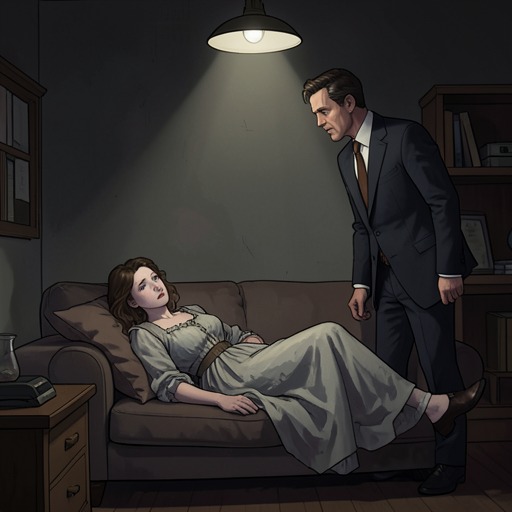
At Arthur Geiger’s house, Marlowe finds Carmen seated upright on a high-backed chair, apparently unconscious yet held in a rigid, composed pose. Her eyes are open but described as mad, and a faint chuckling sound comes from her without changing her expression. She is wearing earrings and a shawl, and Marlowe regards her not as a sexual presence but as someone incapacitated by drugs. The scene establishes the disjunction between her stillness and the signs that her awareness is impaired.
The episode is not confined to that crime scene. Later, Marlowe tells Vivian that Carmen reacted to the old oil wells with what he calls a mild fit. Vivian confirms that Carmen has such episodes once in a while. The recurrence matters: it makes the events at the wells intelligible to Vivian, but does not make their consequences harmless or predictable.
Memory and Uncertainty
When Marlowe asks Carmen how much she remembers of the preceding night, she denies that anything unusual happened and says she was sick at home. Marlowe rejects this account. The exchange presents a gap between her claim and what he knows, without settling whether she is deliberately concealing events, genuinely unable to recall them, or both.
That uncertainty returns in Vivian’s explanation of the family’s response. Vivian says she thought Carmen might forget what happened during an episode, having heard that people sometimes do. She also acknowledges that Carmen might already have forgotten. These are Vivian’s hopes and conjectures, not a confirmed account of Carmen’s memory. The narrative therefore makes uncertainty itself part of the condition’s effect: neither the family nor the reader can treat Carmen’s recollection as a dependable record of what occurred.
The Wells and the Hidden Death
Marlowe reconstructs the decisive episode at the old wells on the day Rusty Regan disappeared. Carmen had gone there with Regan to learn to shoot. Marlowe says that, instead of firing at the can he had set up, she turned the gun on Regan and shot him. He connects this act to her later attempt to shoot Marlowe, presenting both as acts directed at a person rather than at the target she was ostensibly meant to hit.
The account changes the meaning of Regan’s disappearance. Vivian eventually admits that Regan’s body is in a sump and says Carmen came home and told her what she had done. Vivian feared Carmen would expose the truth to the police, perhaps even boast of it, and that their father would learn what had happened. Her concern was not only the prospect of investigation: she says she could not bear for their father to die while thinking about Regan’s death. Vivian had turned to Eddie Mars for help and says she was trying to buy time, while hoping Carmen might forget.
Family Protection and Consequences
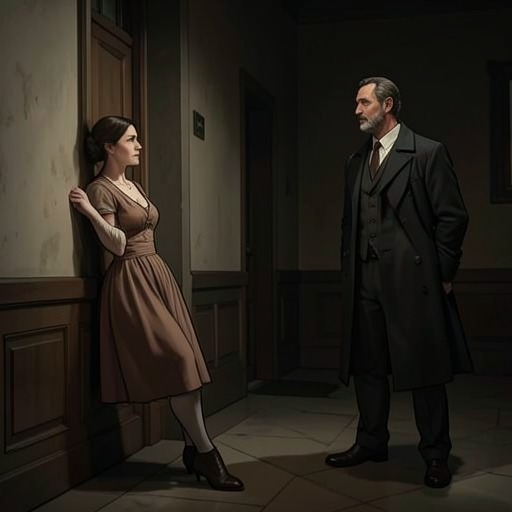
Vivian’s protection of Carmen is both a response to her recurring episodes and a source of further danger. Rather than take Carmen to the police after learning of Regan’s death, Vivian concealed what she knew and sought help from Mars. As Marlowe points out, this left Carmen at liberty to become involved in other dangerous situations. Vivian recognizes that she chose the wrong course, but explains that she felt she needed time and had nowhere else to turn.
Marlowe also discloses that Carmen later came to his apartment and tried to seduce him; he says he sent her away. In his reconstruction, this encounter supplies the immediate context for her attempt to shoot him: he suggests that Regan may once have rejected her in a similar way, and that she acted against Marlowe for the same reason. Carmen’s disturbed state and her capacity for deliberate action are thus held in tension. The episode helps explain her behavior, but it does not erase the danger her actions pose or resolve how much she understood at the time.
Narrative Significance
Carmen’s episodes are known through interrupted access: Marlowe observes her, Vivian describes what Carmen told her, and the truth about Regan emerges only when Marlowe confronts Vivian with his reconstruction. That layered account makes memory and testimony part of the mystery. Carmen’s own uncertain recollection cannot settle the history, while Vivian’s effort to shield her helps sustain the concealment.
The condition consequently becomes entangled with family loyalty, blackmail, and the failure of ordinary legal recourse. Vivian treats secrecy as protection for Carmen and for their father, but that choice enables the hidden death and leaves Carmen exposed to further crises. The narrative neither offers a diagnosis nor makes the episodes a complete explanation of her actions; instead, it shows how uncertainty about her awareness becomes a reason others use to protect, conceal, and control the truth around her.