Carmen’s .22 revolver
The Big SleepCarmen’s .22 revolver is a small weapon with an unusually legible personal history. Its engraved dedication, “Carmen from Owen,” connects it to Owen Taylor’s devotion to Carmen Sternwood, while its use at Joe Brody’s apartment turns that private attachment into public violence. Philip Marlowe takes possession of the gun after Carmen fires it, and later carries it into a street confrontation with the young man from Arthur Geiger’s store; the revolver thus moves from gift, to instrument of crisis, to part of Marlowe’s defensive equipment.
Identity and Physical Details
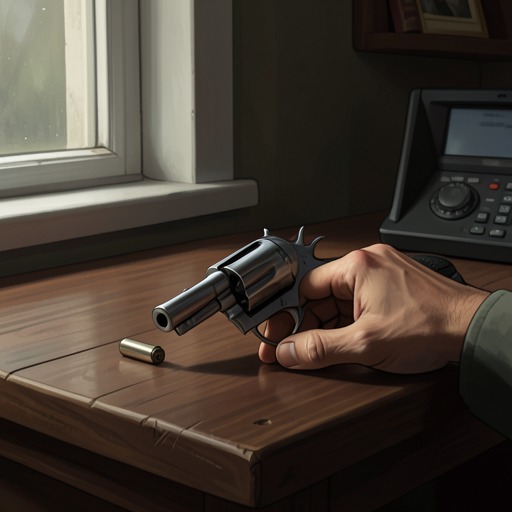
The revolver is identified as a Banker’s Special, a .22-caliber weapon loaded with hollow-point cartridges. It has a pearl grip and a small round silver plate set into its butt. The plate is engraved “Carmen from Owen,” a concise inscription that identifies Owen Taylor as the giver and makes the gun a material trace of his connection to Carmen. The object is not merely an anonymous firearm: its make, ammunition, grip, and dedication are all made visible when Marlowe examines it after the shooting.
The inscription gives the weapon a double character. It is a compact, usable gun, but it also bears the language of a gift. That intimate mark sits uneasily beside its immediate function as a threat in a room where several people are armed, where photographs are being contested, and where the firearm is actually discharged. Its personal meaning does not soften its capacity for harm; the two meanings remain present at once.
The Confrontation at Brody’s Apartment
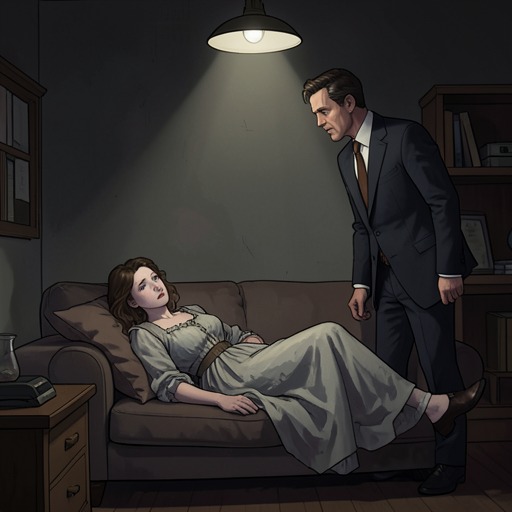
Carmen brings the revolver to Joe Brody’s apartment and uses it to force her way into the room. When Brody opens the door, she pushes him back by placing the little gun against his lips. She then demands her photographs. Brody attempts to placate her, while Agnes redirects her own gun toward Carmen; Marlowe grabs Agnes’s hand and keeps that weapon’s safety catch on. The revolver places Carmen at the center of the standoff, but the room’s danger is not controlled by any single person: several weapons and competing intentions crowd the same confined space.
The gun goes off as Brody reaches for it. The bullet breaks glass in a folded-back French window, and Brody falls, pulling Carmen’s feet from under her. The shot does not pierce the pane. When Marlowe later inspects the damage, he finds that the glass has been smashed but not holed, while the bullet has left a small hole in the plaster. He draws the drapes across the broken pane, a practical effort to obscure the damage while he deals with the people and weapons in the apartment.
After the shot, Carmen crawls toward the revolver where it has skidded into a corner. Marlowe steps past her, picks it up, and puts it in his pocket. She looks up at him and giggles; he pats her on the back and tells her to get up. He then takes the other visible guns from the room as well. The revolver’s movement from Carmen’s hand to the floor and then into Marlowe’s pocket records a change in immediate control: Carmen brought it to make a demand, but Marlowe secures it before she can use it again.
Marlowe’s Examination and Use
Once the confrontation has subsided, Marlowe studies the damaged French window and the gun. He identifies its model, caliber, hollow-point cartridges, pearl grip, and engraved silver plate. The small physical details clarify what the crisis had obscured: the weapon fired in the struggle was the same gun bearing the dedication from Owen to Carmen. The bullet’s effects—the broken pane and small plaster hole—also preserve a material account of the shot even as Marlowe draws the curtains across the damage.
Marlowe retains the revolver after examining it. Later, after hearing that shots have been fired, he drives away from the curb, loops back up the hill, and gets out between parked cars. As footsteps and cheerful whistling approach, he takes Carmen’s little revolver from his pocket. When the young man from Arthur Geiger’s store appears and his hand darts toward the inside of his jerkin, Marlowe steps close and puts the gun into the jerkin. The evidence establishes the revolver’s presence and use in this renewed confrontation, without establishing a further discharge there.
Personal Meaning and Narrative Function
The dedication “Carmen from Owen” makes the revolver a concrete link between two people before the later street encounter gives it another role in Marlowe’s hands. The text does not present the inscription as proof of every circumstance surrounding the gift; it does establish the giver and recipient in the object itself. That brief, durable wording contrasts with the unstable scene in which the gun is used: threats, sudden movement, a shot, broken glass, and Carmen’s attempt to crawl back to the weapon.
The revolver also makes violence materially difficult to dismiss. Its small size does not prevent it from changing the room: Brody reaches for it, the shot breaks the window and brings him down, and Marlowe takes control of the exposed guns. The bullet leaves a hole in the plaster even though it does not make a hole in the glass, an irregular trace that Marlowe notices and partially conceals with the drapes. In the later street scene, the same object that carried a personal dedication becomes an immediate means of confronting an approaching threat. Its significance lies in that movement between intimate token and practical weapon, and in the way its physical traces remain after the burst of action has passed.