Carmen’s attempted shooting of Marlowe
The Big SleepCarmen Sternwood’s attempted shooting of Philip Marlowe takes place at a derelict oil field, where the detective turns a staged target practice into a test of whether she will shoot him. She fires all five chambers at close range, but Marlowe has loaded the revolver with blanks. The confrontation makes his protective strategy visible: he does not merely disarm her, but arranges the encounter so that her attack can be revealed without killing him.
The abandoned oil field
The shooting occurs amid the remains of the industry that made the Sternwoods rich. The family’s estate looks down toward old derricks, most of the former oil field having become public parkland; a small number of wells had continued to produce only a few barrels a day. At the site Carmen directs Marlowe to, however, the wells have stopped. A dirt track runs between eucalyptus trees to a motionless wooden derrick, rusted equipment, empty oil drums, and a sump filmed with stagnant, oil-stained water.
This landscape is more than a remote backdrop. It brings the family’s origins in extraction into the immediate scene: the city falls away as the car follows the rutted road, while the deserted machinery and sump create a secluded place for violence. Marlowe checks the pumphouse and finds no sign of recent activity. The setting is quiet and open, but its abandoned structures also give him a practical way to stage his plan: a large wooden bull wheel can serve as a target behind which a small bullet would be stopped.
The staged target practice
At the oil field, Marlowe gives Carmen her small revolver and a rusty can to use as a target. He tells her that all five chambers are loaded and points out a square opening in the center of the wooden bull wheel, some thirty feet away. The arrangement appears to be ordinary instruction: he sets the can in the wheel and expects her to miss it, while the wheel would stop a small slug if she hit it. In fact, the target and the distance let him keep control of where the gun is pointed while testing what she will do when she has an opportunity to fire at him.
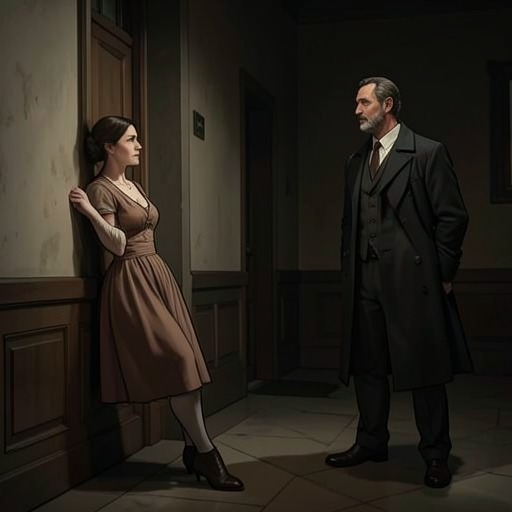
Marlowe warns Carmen not to begin shooting until he has returned to her side. She agrees with a giggle. As he walks back around the sump, however, she raises the revolver when he is about ten feet away and orders him to stand still. Her expression has changed; the gun is aimed at his chest, and her hand appears steady. The playful practice has turned into an immediate threat.
Marlowe does not retreat. He laughs and walks toward her, watching her finger tighten on the trigger. When he is about six feet away, Carmen fires. The shot cracks in the open sunlight, but he remains standing and grins at her. She fires twice more in rapid succession, and he rushes her before she can use the last chamber. He swerves aside as she fires again, avoiding the final shot at close range. Carmen has fired all five chambers at him, yet he is unharmed.
The blanks and the revelation
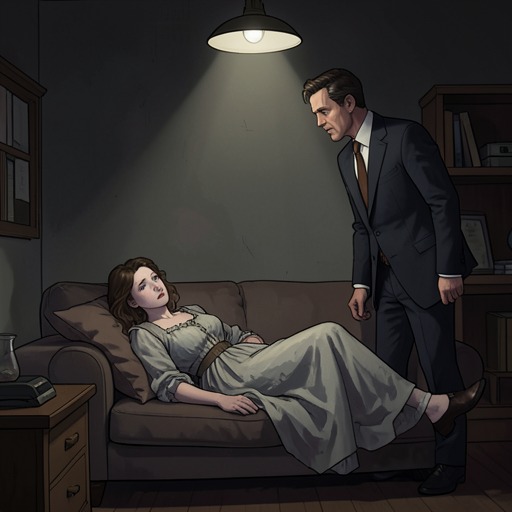
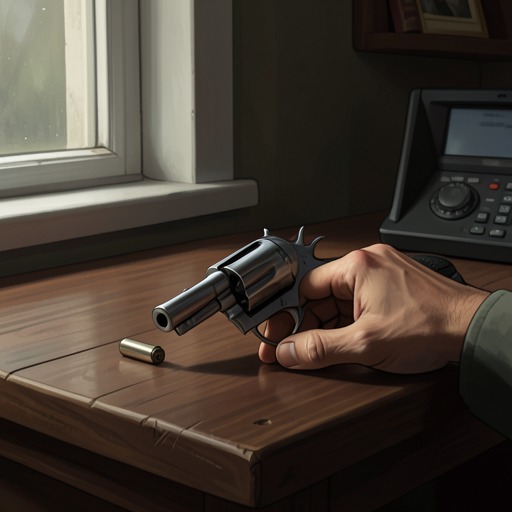
The apparent survival is explained later, when Marlowe produces Carmen’s gun in front of Vivian. He lays it on her white-satin knee and says that all five chambers are empty because Carmen fired them all at him. He then makes clear that he had loaded the revolver with blanks and had suspected what Carmen would do if she got the chance. His advance, his calm under fire, and his rush to seize her therefore belong to a deliberate test rather than an accidental escape from live ammunition.
The blanks alter the meaning of the scene without making Carmen’s action less direct. She aimed at Marlowe and pulled the trigger five times; the harmless cartridges prevented those shots from killing him. By showing Vivian the emptied gun and specifying that the shots came from five or six feet away, Marlowe turns what could have remained a private confrontation into evidence of Carmen’s danger. Vivian calls him horrible. He answers by identifying her as Carmen’s older sister and asking what she will do about it, shifting the immediate burden from his own survival to Vivian’s responsibility for her sister.
Earlier traces of the oil wealth
The abandoned wells at the end of the road belong to a landscape already visible from the Sternwood estate. From its terraces, Marlowe can see the old wooden derricks below the hill: most of the oil field has become a public park, donated to the city by General Sternwood, while a few wells had still yielded only five or six barrels a day. The family has moved uphill, away from the smell of oil and sump water, but the source of its fortune remains visible from the house. At the shooting site, that history is no longer a distant view. The wells have stopped pumping, and their machinery lies rusting beside stagnant, oil-scummed water.
From the estate’s view to the abandoned ground
The old oil field is visible long before the shooting. From the terraces of the Sternwood place, Marlowe looks past the high iron fence and its gilt spears toward wooden derricks below the hill. General Sternwood had donated most of the field as public parkland; the remaining wells produced only five or six barrels a day. The family had moved uphill, beyond the smell of oil and sump water, but its fortune remained legible in the landscape below.
At the place Carmen chooses, even that diminished industry has stopped. A rutted dirt track passes through tall eucalyptus trees to a motionless wooden derrick, rusted cable and pipe, a sagging loading platform, and empty oil drums. Nearby, old sump water sits stagnant beneath an iridescent oil scum. The city’s traffic quickly fades as Marlowe follows the track, and the abandoned site becomes a secluded setting for the confrontation. Its machinery is not merely atmospheric: a wooden bull wheel gives Marlowe a target behind which a small slug would stop.
That shift in distance—from the family’s protected terraces looking down at the source of its wealth to the disused oil ground itself—brings the history of the Sternwoods’ fortune into the scene without turning it into a new discovery. The old wells no longer work; their residue remains. Against that neglected industrial landscape, Marlowe’s carefully staged shooting test exposes a present danger within the family, while the visible traces of its past lie rusting around them.