Carmen’s nude-photo blackmail
The Big SleepCarmen’s nude-photo blackmail turns Arthur Geiger’s concealed camera and illicit book business into instruments of pressure against the Sternwood family. The incident begins with a photograph made without Carmen’s meaningful awareness, becomes a $5,000 demand delivered to Vivian Regan, and ends with Philip Marlowe taking custody of the image and its copies. Its resolution protects Carmen from public exposure, but the larger investigation is folded into an official account that conceals the family’s involvement.
Origins in Geiger’s operation
At Geiger’s house, Marlowe finds Carmen sitting in a high-backed teakwood chair on a raised platform, apparently unconscious and under the influence of drugs. A camera has been concealed inside a carved object and aimed at her; its flash explains the burst of light Marlowe had noticed, while Geiger lies dead nearby, shot three times. The arrangement makes the photograph more than a private image: it is the intended product of a system built to observe and exploit its subjects.
Marlowe dresses Carmen and tries to establish what has happened, but she remains incapacitated. When he checks the concealed camera, its plateholder is missing. The absence matters: the image has already been removed from the scene, and the photographer or someone else has retained the means to circulate it. Marlowe also finds Geiger’s coded notebook, while the house shows signs of entry through a jimmied kitchen window. The missing plate therefore sits among other evidence of an operation whose records and physical traces can be taken, hidden, or used against others.
The book business supplies the commercial background. Marlowe examines one of Geiger’s rented volumes and recognizes it as part of an elaborate lending library of illicit books, marked with dates showing that it has circulated. Later, confronting Joe Brody, he estimates that Geiger’s coded list contains about five hundred names and that the stock and loans could produce substantial rental income. Brody and Agnes Lozelle are positioned to take over the business and its valuable records; the photographs offer a separate route to profit, based not on rental fees but on the threat of exposure.
The demand against Vivian
The blackmail becomes explicit when Vivian gives Marlowe a thick white envelope addressed to her at 3765 Alta Brea Crescent. A messenger delivered it at 8:35 in the morning. Inside is a glossy photograph, measuring four and a quarter by three and a quarter inches, showing Carmen in Geiger’s chair. Vivian says the demand is $5,000 for the negative and the remaining prints, with payment required that night or the material will be sent to a scandal sheet.
The demand carries a second threat. The caller warns Vivian that a police scandal is connected to the matter and that she should disclose it quickly, or she might end up speaking to her sister through a wire screen. Vivian cannot explain what the alleged police trouble is. That uncertainty is part of the pressure: the blackmailer makes the danger sound larger than the photograph alone, linking the family’s fear of exposure to the possibility of legal consequences without specifying what the police know.
Marlowe’s handling of the photograph is restrained and practical. He examines it, asks what the demand is, and treats its physical existence as evidence to trace rather than as an invitation to judge Carmen. The image has passed from the concealed camera into an envelope delivered to Vivian, and its route gives the blackmailer control over both privacy and timing. The photograph’s small, portable form makes it easy to move; the threat attached to it gives that object power well beyond its size.
Brody, Carmen, and the recovery
Marlowe identifies Brody as the man who has taken over Geiger’s racket. In their confrontation, he reasons from the coded customer list, the known boxes of books, and the likely number of rentals to argue that the business could be worth a substantial sum. His calculation exposes the economic motive for seizing Geiger’s operation, though it does not make the photograph’s personal leverage any less dangerous. Brody’s interests lie in the business and the materials that can be used to extort the Sternwoods.
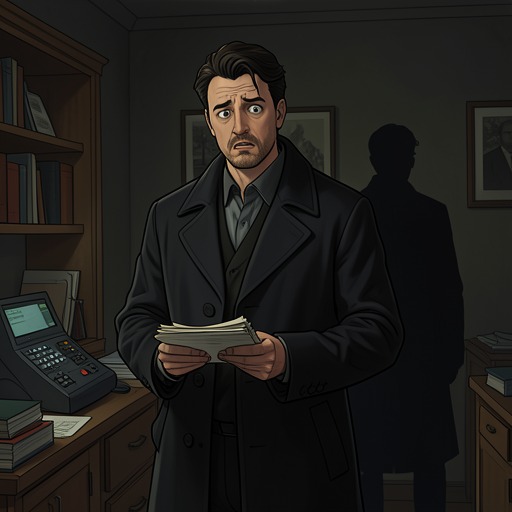
Carmen herself enters the confrontation carrying a small revolver and demands her pictures from Brody. She accuses him of shooting Geiger and says she saw him do it. Her intervention connects the blackmail directly to the earlier killing: the threatened photograph is not merely evidence of her presence at Geiger’s house but part of a chain of events she has only partially understood. Marlowe takes control of the weapons during the confusion, preventing the confrontation from becoming a further shooting.
Brody gives Marlowe a thick envelope containing a developed plate and five glossy prints. Marlowe asks whether these are all of them, receives Brody’s assent, and pockets the envelope. When Carmen asks for the pictures, he tells her he will take care of them and sends her home. He does not hand the images back to her or allow her to decide their immediate disposition; instead, he assumes responsibility for keeping them out of circulation. Carmen’s demand is answered through protection rather than disclosure of the evidence’s destination.
Secrecy, closure, and significance
Marlowe later tells Carmen that the photograph is gone and that Brody probably took it with him. He instructs her not to tell anyone she was at Geiger’s house, not even Vivian, and to leave the matter to him. The instruction shows that his protection depends on keeping Carmen’s presence hidden as well as recovering the image. Her safety is bound to a managed silence: the less the family and police discuss what happened, the less material remains for another blackmailer or investigator to use.
The photographs become part of the evidence Marlowe lays before Taggart Wilde, Bernie Ohls, and Captain Cronjager, alongside Geiger’s coded notebook, Geiger’s card to General Guy Sternwood, and three notes signed by Carmen. Wilde suggests that the notes were a lure: Geiger could present apparently legal documents, gauge whether a target feared something worse, and abandon the attempt if the target did not respond. Marlowe later characterizes Geiger’s effort against the General as blackmail, while Eddie Mars explains that Geiger used the same method on others. The nude photograph makes the threat concrete, but the broader racket depends on testing fear and exploiting whatever private vulnerability a target reveals.
The public account erases the Sternwoods and rearranges the killings. The newspapers credit Captain Cronjager with solving the deaths of Geiger and Brody, describe a dispute over a wire-service business, and report that Carol Lundgren confessed to killing Brody in revenge. They do not connect Owen Taylor’s death to Geiger’s killing or mention the Sternwoods, Marlowe, or Bernie Ohls. The blackmail is contained not through a public clarification but through the recovery of the images and an official story that leaves the family out. Its decisive result is thus double-edged: Carmen’s photograph is secured, while the truth surrounding its creation and use remains concealed.