Corruption, cover-ups, and official narratives
The Big SleepCorruption, cover-ups, and official narratives are not incidental obstacles in the investigation: they determine which crimes receive protection, which facts enter public records, and whose version of events becomes accepted. Across the novel, illicit business and police influence intersect with Philip Marlowe’s own professional secrecy, producing an uneasy distinction between solving a case and making its truth public.
Protection and the hidden economy
The private detective’s first visit to the Sternwood estate establishes the wealth behind the case in concrete terms. Marlowe describes himself as calling on four million dollars; outside, the cultivated grounds lead toward the old oilfield that made the family rich. Most of that land has become public park, donated by General Guy Sternwood, but a few wells still pump five or six barrels a day. The family has moved uphill beyond the smell of the oil, though the source of its wealth remains visible from the house. That separation between polished respectability and the less presentable foundations beneath it recurs throughout the investigation.
The corruption Marlowe encounters is more direct in his account of Eddie Mars’s influence. He identifies Mars’s Cypress Club at Las Olindas as a gambling operation protected by local law enforcement and connected to Los Angeles through a well-greased line. Marlowe suggests that this arrangement could extend to Arthur Gwynn Geiger’s illicit book business, especially because Geiger was Mars’s tenant. When Mars challenges him to specify the racket, Marlowe calls it the smut-book racket. The exchange exposes the protection system as a working relationship between criminal enterprise and official power, not merely a rumor about a corrupt city.
The physical settings reinforce the gap between public appearance and concealed activity. Geiger’s house is reached by a narrow, rain-swept road in Laurel Canyon, where Marlowe watches a woman enter and then sees a brief flash from the house. After shots are heard, the place becomes silent; when Marlowe returns, Geiger’s body has disappeared and another rug has been laid over the floor. The scene demonstrates how quickly a crime can be altered before it becomes an official record. Elsewhere, the Cypress Club occupies a shabby former mansion, while the Sternwoods’ old oil wells remain beneath their carefully landscaped estate: the novel repeatedly places concealed interests inside spaces that present a different face to outsiders.
Marlowe’s secrecy and its cost
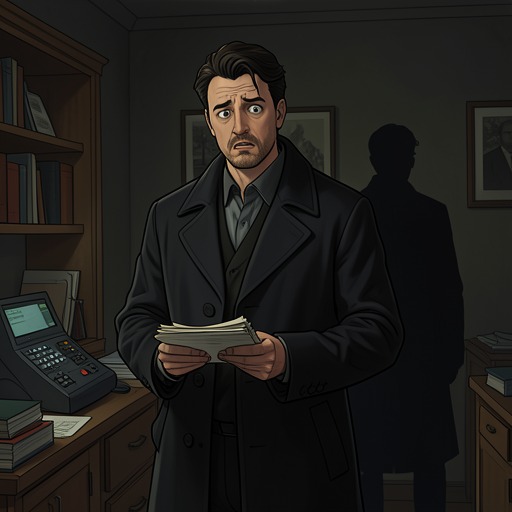
Marlowe’s conduct adds a private form of concealment to the institutional one. When he gives his account to Captain Cronjager, he says that he recounts events as they happened but leaves out two facts: Carmen Sternwood’s visit to Joe Brody’s apartment and Mars’s visit to Geiger’s house that afternoon. His omissions are deliberate in effect even when he says he did not fully understand, at the time, why he withheld one of them. He is protecting the client’s interests, but his selective account also limits what the police can know and act upon.
Cronjager frames the consequences in terms of responsibility. He accuses Marlowe of failing to report Geiger’s murder and then spending the day in a way that helped Geiger’s young associate reach Brody, who was killed that evening. The charge is not that Marlowe committed either murder; it is that withholding the first death from the authorities helped shape the conditions for the second. Marlowe admits that he may have done wrong, explaining that he wanted to protect his client and had no reason to expect the young man to go after Brody. The episode refuses to treat professional discretion as automatically innocent: a detective’s private judgment can preserve confidentiality while also narrowing the police’s opportunity to intervene.
Marlowe nevertheless insists that confidentiality has a legitimate boundary-setting function. He argues that his client is entitled to protection short of a grand jury, and that his license as a private detective gives the word private meaning. He points out that the Hollywood Division has two murders, both killers, the motives, and the instruments; what he wants suppressed is the blackmail connection and the parties’ names. In his view, the crimes have been solved sufficiently for law enforcement while the family scandal need not be exposed. That position protects his client, but it also accepts that the public account will not contain the whole story.
The official version
The dispute over how to close the cases turns on what can be proved and what the police are prepared to let become public. Marlowe says he can testify under oath that a book came from Geiger’s store and that Agnes Lozelle will acknowledge the nature of the store’s business. He argues that the store was a front and that the Hollywood police allowed it to operate for their own reasons; a grand jury, he suggests, might ask what those reasons were. His evidence gives him leverage in the room, because exposing the racket could bring scrutiny not just to the criminals but to the authorities who tolerated it.
Cronjager ultimately recognizes the institutional danger of public exposure. He is a homicide officer, he says, and does not consider the illicit literature his concern; still, he concedes that it would not help his division for the matter to be reported in the papers. The discussion reveals a negotiated settlement rather than a clean vindication of the law: the murders can be officially closed while the protection arrangement and blackmail remain outside the public explanation. Marlowe’s private evidence and the threat of grand-jury scrutiny help determine which version is acceptable to the officials in the room.
The next morning’s newspapers show the result. Their stories credit Cronjager with solving the killings and present Geiger’s death as part of a dispute over proceeds from a wire-service operation maintained behind a Hollywood Boulevard bookstore. They report that Joe Brody shot Geiger and that Carol Lundgren killed Brody in revenge, although Marlowe’s account has already established that the public version does not match the actual sequence. The papers also identify Owen Taylor as a chauffeur to a wealthy family, but do not connect him to the killing at Geiger’s house. The Sternwoods, Bernie Ohls, and Marlowe are absent from the reports; Agnes is described as a material witness. The article gives the impression that the murders happened close together and that Cronjager solved both almost immediately.
Taylor’s death receives its own misleading frame. The newspapers call him the driver of the “Lido Pier Suicide Car,” report that he was despondent and in poor health, and say his body will be sent to his family in Dubuque with no inquest. The account supplies a public explanation while omitting the connection between his death and the events surrounding Geiger. The newspaper narrative does not simply leave out details: by arranging the known facts into a coherent but false sequence, it makes official closure appear straightforward.
Law, truth, and the ending
Captain Gregory articulates the wider disillusionment behind the case’s compromises. He describes himself as a reasonably honest policeman who would like to see powerful figures such as Eddie Mars punished alongside less influential criminals. But he doubts that this kind of justice will prevail, in Los Angeles or elsewhere. His account does not excuse Mars or establish that Mars committed every crime attributed to the surrounding network. Gregory specifically distinguishes suspicion from proof: Mars admitted hiding his wife at Realito and employing Lash Canino as a protection man, but denied knowing Canino’s criminal activities or Harry Jones and Joe Brody, and claimed not to know about Geiger’s racket. Gregory suspects Mars may know something about Rusty Regan’s disappearance, yet acknowledges that this has not been demonstrated.
That distinction between suspicion, evidence, and public narrative matters to the novel’s unresolved center. The investigation can identify the mechanisms of protection and expose how the official account has been arranged, but those achievements do not make every concealed fact legally or publicly available. Marlowe’s final reflection places that compromise against the novel’s recurring image of death as “the big sleep.” He contrasts the indifference of the dead to whether they lie in an oil sump or a marble tower with his own involvement in the surrounding nastiness. The metaphor closes the case without suggesting that official closure has cleansed it: the public story is tidier than the underlying events, and Marlowe remains implicated in the difference.