Geiger’s blackmail attempt against the Sternwoods
The Big SleepGeiger’s blackmail attempt against the Sternwoods is the case that brings Philip Marlowe into the family’s private affairs. Its instrument is not a straightforward legal claim but a carefully qualified demand: a letter from Arthur Gwynn Geiger encloses three promissory notes signed by Carmen Sternwood while conceding that they represent gambling debts and may not be legally collectible. The attempt exposes how money, family secrecy, and the threat of public embarrassment can exert pressure even when the paper offered as evidence has an obvious legal weakness.
The demand and its evidence
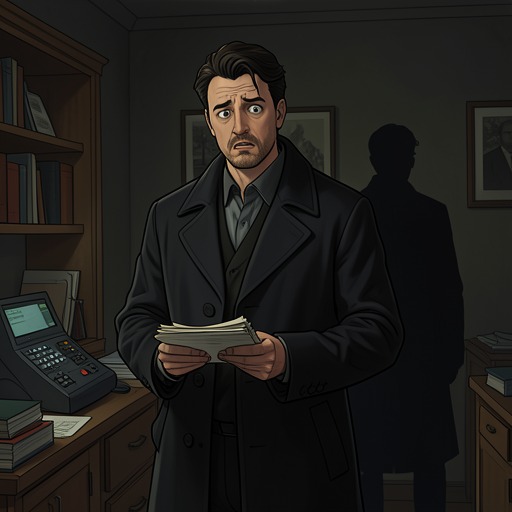
General Guy Sternwood tells Marlowe that Rusty Regan, whose companionship had helped protect him from would-be blackmailers, has abruptly left a month earlier. The General says he has heard nothing from Regan and has been blackmailed again. He produces a brown envelope addressed to him and containing Geiger’s card and a letter. The card identifies Geiger as a dealer in rare books and deluxe editions; the letter describes the enclosed obligations as gambling debts, acknowledges their legal uncollectibility, and nevertheless says Geiger assumes the General may wish to honor them.
The three notes are dated in September and promise Geiger one thousand dollars each, for a total of three thousand dollars. Each is signed by Carmen, and Marlowe judges the handwriting sprawling and childish. The notes give the demand a concrete form, but Geiger’s own qualification undercuts the prospect of straightforward collection: he does not present them as ordinary enforceable debts. The letter instead leaves the decision to the General, whose wealth and concern for his daughters make the possibility of exposure matter independently of what a court might award.
The episode also connects the new demand to an earlier one. The General tells Marlowe that, nine or ten months before Regan arrived, he paid Joe Brody five thousand dollars to leave Carmen alone. He can barely recall Brody and suggests that his butler, Norris, might know more. The two incidents establish that Geiger’s approach is not the first time the family has paid to make a threat against Carmen go away; it also gives Marlowe a prior name and payment to consider as he begins investigating.
Marlowe weighs money against exposure
Asked for his conclusion, Marlowe initially advises the General to pay. His reasoning is practical rather than a judgment that Geiger’s claim is legitimate: the money might cost less than prolonged trouble, while the General is wealthy enough that several blackmailers would have difficulty taking an amount he would notice. The General rejects the advice on grounds of pride. Marlowe counters that pride is precisely what a blackmailer may be counting on, and explains that Geiger has structured the matter to preserve deniability: the notes could be used to press for payment, but Geiger’s letter also admits they are gambling debts and thus supplies a defense if he tried to collect them.
Marlowe distinguishes paying Geiger from ending the problem. He offers to take Geiger off the General’s back, but warns that this may cost additional money and will not necessarily secure anything in return. The family, he says, is already known to people who prey on the wealthy. The General nevertheless places the matter in Marlowe’s hands and authorizes him to make a deal if he judges Geiger sufficiently honest. Marlowe accepts the assignment, promising to deal with Geiger forcefully. The exchange turns a consultation about the value of the notes into an investigation, while leaving the precise terms and outcome of any negotiation unresolved at this stage.
From private leverage to a chain of crimes
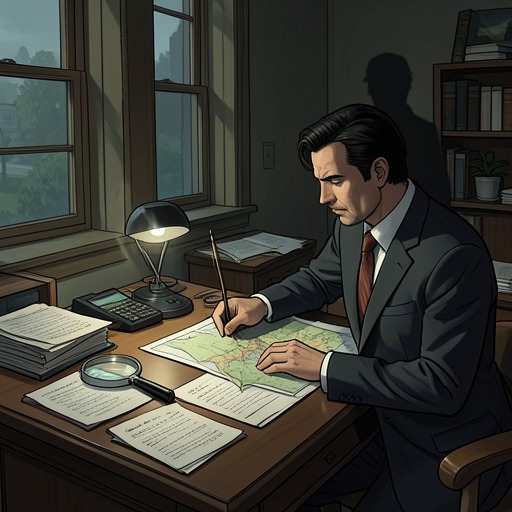
The blackmail is tied to the illicit business concealed behind Geiger’s bookstore. Later, Marlowe argues that the shop is a front and that the police have allowed it to operate; he offers to testify that a book found in the case came from Geiger’s store and points to its stamped dates. The operation is not merely a bookseller’s dispute: Marlowe understands that Geiger’s leverage over Carmen arises within a racket and that other people may seek control of that business or its evidence.
Marlowe’s reconstruction connects the attempt to Carmen’s photographs. He concludes that Owen Taylor, the Sternwoods’ chauffeur, went to Geiger’s house because he cared for Carmen and objected to Geiger’s treatment of her. Taylor found Geiger taking a photograph of Carmen, fired the shot that killed him, and escaped with the negative. Joe Brody later admitted taking the photographic plateholder from Taylor after intercepting him, then moving toward taking over Geiger’s books and seeking money from the Sternwoods. Brody’s account places the photographs and the illicit stock at the center of the consequences of Geiger’s operation, although the blackmail letter itself concerned Carmen’s notes.
The police response shows how the initial case becomes entangled with further violence and competing accounts. When Captain Cronjager accuses Marlowe of withholding a murder and indirectly allowing the sequence that led to Brody’s death, Marlowe acknowledges that he did not report Geiger’s death and says he was trying to protect his client. He also argues that Brody was a crook pursuing the racket rather than Geiger’s killer, and that Taylor had the motive and opportunity to shoot Geiger. Marlowe’s account distinguishes inference from proof: he calls an alternative scenario physically possible but morally implausible, relying on motive, opportunity, and the circumstances he has learned.
Official accounts and the cost of concealment
Marlowe does not tell the authorities everything he knows. In his account to Captain Cronjager and the others, he leaves out Carmen’s visit to Brody’s apartment and Eddie Mars’s visit to Geiger’s that afternoon. He says he does not know why he omits one of those facts, while identifying protection of his client as his reason for handling the case closely. That selective disclosure makes the blackmail investigation part of a wider conflict between a private detective’s obligations and the police demand for a complete account.
The official story reported the next morning bears little resemblance to the full chain Marlowe has reconstructed. The newspapers do not connect Owen Taylor, whose car was recovered at Lido Pier, with Geiger’s death, and do not mention the Sternwoods, Marlowe, or Bernie Ohls. Instead, they credit Cronjager with solving two murders arising from a supposed dispute over a wire-service operation; they report that Brody killed Geiger and Carol Lundgren killed Brody in revenge. The coverage also presents Taylor as a despondent chauffeur whose death is treated as a suicide, with no inquest planned. The public version turns connected events into a tidy, separate account and leaves the family’s exposure out of the record.
That concealment is not simply a newspaper distortion: it is prepared through choices about what Marlowe reports and what the police are willing to make public. Marlowe argues that the bookstore’s operation had been tolerated by Hollywood police and invokes the possibility that a grand jury might ask why. Wilde acknowledges that such questions can embarrass those who run cities; Cronjager, in turn, says publicity about indecent literature would not help his division. The case therefore shows how the threat of scandal operates on more than one level: Geiger uses the family’s vulnerability, while officials and investigators manage which parts of the criminal story become public.
Significance
Geiger’s blackmail attempt begins with three notes and a deliberately equivocal letter, but its stakes expand because the documents point toward Carmen, a hidden business, photographs, and a family history of buying relief from threats. The notes are both evidence and a bargaining device: their acknowledged weakness limits Geiger’s legal claim without removing their power to unsettle the General. The episode sets the terms of Marlowe’s work, requiring him to judge not only what can be proved but what his client can bear and what disclosure may cause.
The later handling of the case supplies a grim counterpoint to the General’s first question of whether to pay. Marlowe’s protection of the Sternwoods does not produce a transparent resolution; it helps shape a partial account in which the deaths and the blackmail operation are separated or obscured. In the novel’s broader concern with corruption and official narratives, Geiger’s attempt is an opening demonstration that a claim’s practical force may come less from its legal strength than from the private shame and institutional compromises surrounding it.