Geiger’s house
The Big SleepGeiger’s house, also called the Geiger hideaway and identified as 7244 Laverne Terrace, is a secluded hillside residence whose privacy makes it both a venue for Arthur Gwynn Geiger’s illicit photographic operation and the first major crime scene investigated by Philip Marlowe. Its concealed approach and carefully arranged rooms initially obscure what happened there; the later disappearance and staged return of Geiger’s body show how readily the house can be altered to control what investigators see.
Setting and Approach
The house stands on a narrow, curving stretch of Laverne Terrace, reached from Laurel Canyon Drive. Houses there sit down the slope behind hedges and shrubs; their front windows are screened from the road, and the wet, tree-covered hillside gives the street a secluded character. Geiger’s small house is particularly difficult to observe: a square box hedge masks its front door, while the back entrance is reached by wooden steps from the lower, alley-like street.
Marlowe follows Geiger’s car to the address during heavy rain and watches him enter through the hedge. Later, he sees a woman arrive in a maroon or dark-brown Packard convertible. Its registration identifies Carmen Sternwood and gives her West Hollywood address. At 7:20, a sudden flash from inside the house is followed by a scream and then three gunshots. The isolated position delays any direct view of what has happened: Marlowe must approach on foot, and the house falls silent before he reaches the entrance.
Interior and Crime Scene
Marlowe cannot get in through the front door, so he climbs over the railing and forces entry through a French window. The main room extends across the width of the house. Its low ceiling and brown walls are decorated with Chinese embroidery and Chinese and Japanese prints; low bookshelves, floor cushions, silk, and a broad tapestry-covered divan make the room markedly different from a conventional living room. A carved lamp and a black desk with gargoyle details add to the elaborately furnished interior.
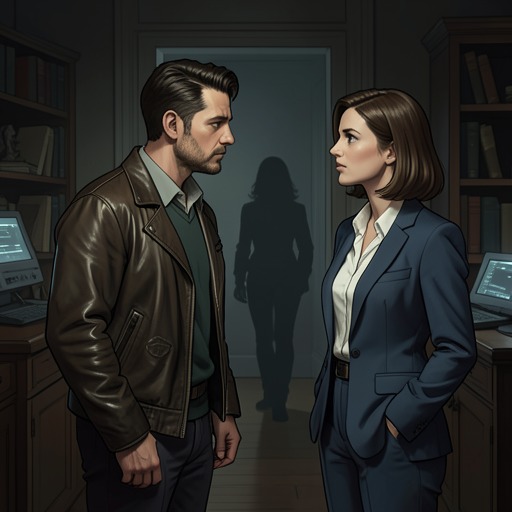
In the room, Carmen sits rigidly in a high-backed teakwood chair on a low dais. She is drugged and unresponsive, while a small chuckling sound continues. Marlowe’s attention turns to Geiger, lying dead on the floor beyond the edge of the Chinese rug. A carved object resembling a totem pole is in fact a camera, its lens directed at Carmen; a blackened flashbulb attached to it accounts for the flash Marlowe saw outside. The camera makes the room’s decorative furnishings part of Geiger’s operation: the scene that seemed private has been arranged for covert photography.
The shots Marlowe heard had not missed. Geiger is wearing Chinese slippers, black satin pajamas, and an embroidered coat. Nearby, glasses and a flagon stand on a lacquer tray; the liquid in the flagon smells of ether and possibly laudanum. These details establish the room as more than a place of residence: it contains the apparatus and drugs associated with the compromising photographs and with Carmen’s incapacitated state.
A Mutable Crime Scene
After leaving Carmen safely elsewhere, Marlowe returns to the house and finds that the scene has changed. Two strips of embroidered silk have been removed from the wall, and another rug has been laid on the floor. Most importantly, Geiger’s body is gone. Marlowe searches the house, including a separate, locked bedroom, but does not find him. On the bare floor he notices what appear to be two parallel grooves leading toward the front door, consistent with a body having been dragged away.
The body’s absence does not last. When Marlowe later enters the previously locked bedroom, he finds Geiger laid out on the bed, with the missing strips of tapestry crossed over his torso. Two black candles and incense have been arranged in the room. The placement has transformed the body from evidence left at the scene of the shooting into a deliberately composed display. Marlowe does not touch it, and the room’s staged stillness underscores how thoroughly the residence has been altered since his first entry.
The changes make the house an unstable source of evidence. A camera, missing wall hangings, a new rug, apparent drag marks, and the body’s transfer into the other bedroom record different moments in a sequence of concealment. Marlowe’s later invitation to Bernie Ohls to come to 7244 Laverne Terrace and see where the bullets went links the address to the physical evidence of the shooting, even as the missing and repositioned body complicates the scene.
Evidence, Secrecy, and Narrative Function
Geiger’s house is connected to the wider case through the images made there. Vivian Regan shows Marlowe a photograph delivered to her by messenger: Carmen in the chair on the dais, wearing only her earrings. Marlowe recognizes the setting from his visit. Later, when he tells Carmen that the photograph is gone and suggests that Joe Brody probably took it, he instructs her not to disclose that she had been at the house. The residence’s private interior thus becomes the source of an image that can travel beyond it and threaten the Sternwood family.
When Marlowe presents the evidence to Taggart Wilde, the items include Carmen’s photographs, Geiger’s card to General Guy Sternwood, three notes signed by Carmen, and Geiger’s blue notebook of coded names and addresses. The house is not merely an isolated murder location: its camera and rooms sit at the center of a system that links private access, illicit photographs, coded clients, and blackmail. The materials removed from the residence can be displayed and interpreted elsewhere, while the events inside remain subject to concealment.
The official account further separates the house from the truth of what happened there. Newspaper reports describe a killing at a Laurel Canyon bungalow and credit Captain Cronjager with solving the murders, but omit the connection between Owen Taylor and the crime at Geiger’s residence and leave the Sternwoods and Marlowe out of the story. The secluded house makes private wrongdoing difficult to see; the public narrative then reproduces that concealment by assigning the case a cleaner, incomplete explanation. Its narrative significance lies in this double function: it is both the hidden stage of Geiger’s operation and the place where the investigation first encounters how evidence can be made to disappear, rearranged, and misreported.