Geiger’s illicit book stock
The Big SleepGeiger’s illicit book stock is the inventory that makes Arthur Gwynn Geiger’s apparently respectable bookstore a profitable illicit lending operation. Its polished bindings conceal obscene books marked with rental dates; when the stock is carried away after Geiger disappears, it becomes both evidence of a takeover and a measure of the business’s reach. The books link the investigation’s physical clues to its economic motives and to the protection that has allowed the storefront to operate openly.
Appearance and Concealment
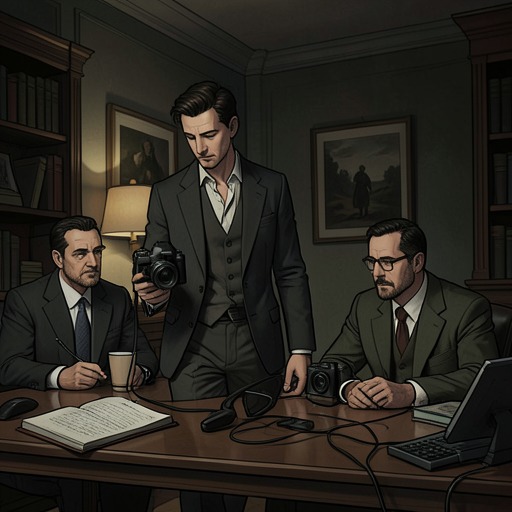
Geiger’s store presents itself as a refined bookseller’s shop. Its dim frontage is screened from the street; inside, a thick blue rug, leather chairs, polished tables, and glass cases display tooled bindings. Philip Marlowe recognizes that this merchandise is designed to look appropriate to wealthy customers, but the respectable appearance conceals the actual nature of the stock. The books’ physical presentation is therefore part of the business: the display offers a plausible public face, while the rental operation remains obscured behind it.
Marlowe obtains a sample volume by watching a nervous man retrieve a wrapped book from a cypress tree in the park. The book is heavy, well bound, and printed on fine paper, with elaborate photographs. Its endpaper bears dates recording when it was checked out and returned. Those marks identify it not simply as illicit material but as a circulating rental book. The stock’s organization leaves a documentary trace of lending inside an object otherwise dressed to suggest an expensive collectible.
The Racket and Its Scale
After examining the volume in his car during the rain, Marlowe identifies it as part of a lending library rather than a one-off sale. The contrast between the handsome binding and the book’s obscene contents makes the store’s presentation a deliberate cover for a recurring business. Marlowe reasons that a racket operating so visibly on the boulevard must enjoy protection; the location and public-facing shop matter as much as the books themselves.
The stock’s commercial value becomes clearer when Joe Brody tries to take over the operation. Marlowe estimates that the coded customer list contains about five hundred names and that the dozen boxes moved from the store represent roughly five hundred books, with additional volumes still out on loan. Even using cautious assumptions—half the names active, each generating a dollar rental—he calculates a potential gross of $125,000 while leaving the inventory’s capital intact. This is an estimate, not an audited accounting, but it explains why the books are worth stealing and why control of the lending list matters alongside possession of the physical stock.
Removal and Competing Claims
Following Geiger’s disappearance, Marlowe sees books being packed into newspaper-lined wooden boxes in the store’s back room. He follows the removal in a small truck to the Randall Place apartment house and connects the destination with Joseph Brody, who may be the same Joe Brody previously paid by General Guy Sternwood to stop pursuing Carmen Sternwood. The relocation turns the books into a clue: someone is not merely clearing a dead man’s premises but transferring the machinery of an ongoing enterprise.
Brody later acknowledges the connection between the books and the smut-book racket. Marlowe points out that the stock was moved from the store, arguing that whoever took it wanted time to organize a takeover while Geiger’s body was hidden. The inventory thus helps explain the concealment surrounding Geiger’s death: removing it protects the business and gives its prospective operators room to establish control before the disappearance is understood.
Evidence, Protection, and Significance
Marlowe keeps the recovered book and later brings it to the authorities. He directs Taggart Wilde and Captain Cronjager to the stamped dates on its endpaper and offers to testify that it came from Geiger’s store. Agnes Lozelle can confirm the kind of business the shop conducted. Together, the book’s rental marks, its origin, and the witness’s knowledge make the stock concrete evidence rather than merely a lurid rumor.
The evidence also puts the police division’s tolerance of the store under scrutiny. Marlowe argues that the storefront was plainly a cover and that the Hollywood police had allowed it to operate for their own reasons; Wilde acknowledges that a grand jury might ask why cities are run as they are. Cronjager is concerned that public exposure would damage his division. The book therefore carries two kinds of information: the dates record the rental business, while its presentation to the officials exposes the institutional protection surrounding it.
Geiger’s illicit book stock is more than a collection of contraband. It is the material foundation of a profitable racket, the object of a struggle for control after Geiger’s disappearance, and a piece of evidence through which Marlowe connects crime to official complicity. Its carefully respectable bindings condense the operation’s central contradiction: an illicit business able to circulate in public by making its surface look legitimate.