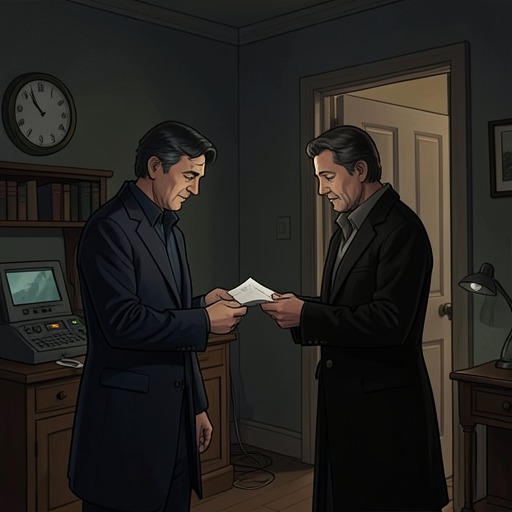
Joe Brody—Agnes
The Big SleepJoe Brody and Agnes Lozelle are partners in an attempted takeover of Arthur Geiger’s illicit book business, but their alliance rests on shared opportunity rather than secure loyalty. Brody calculates the racket’s potential value, while Agnes is implicated in his effort to exploit the business and the Sternwood family scandal. Their partnership becomes most visible when Philip Marlowe confronts Brody: Agnes is concealed nearby, then brought into the room, armed, and asked to support Brody’s claims. Yet her weary judgment of him and Brody’s admission that he had paid and dismissed her make the relationship look as unstable as the enterprise they hope to carry away.
Partnership and the Geiger Racket
Brody’s connection with Agnes emerges in the wake of Geiger’s murder and the removal of the body from Geiger’s house. Brody has taken possession of the book operation’s records and stock, and Marlowe presses him on the scale of the business. The coded customer list contains about five hundred names; Brody has twelve boxes of books, with an estimated total of at least five hundred titles once books out on loan are included. Marlowe calculates that even a partial return to the list could produce roughly 125,000 rentals, worth at least $125,000 at a dollar per rental. The calculation identifies what binds Brody and Agnes: the chance to convert Geiger’s established business into money.
Agnes is already involved closely enough that Brody knows she can hear Marlowe’s account of the racket. When Marlowe points to her knowledge, she protests that he is wrong, and Brody orders her to stop interrupting. Her response reveals both her participation and the strain of being treated as a subordinate in Brody’s plan. The scene does not establish that she shares his control of the operation; instead, it shows Brody speaking for the partnership while Marlowe treats her as someone who understands its value.
A Partnership Under Pressure
Brody’s account of their circumstances is both an admission and a bid for assistance. He says Agnes hates him, that he had thrown her out, and that although he paid her, he would have had to dismiss her anyway because she was too unstable for him. He then asks Marlowe for money, explaining that he and Agnes are nearly broke and need to move on. Marlowe refuses to take money from his client, leaving the pair without the help Brody seeks. Their supposed partnership is thus marked not by settled mutual commitment but by a recent rupture and an urgent shared need to escape their present position.
When Agnes reacts angrily during the confrontation, Brody takes a small automatic from a desk drawer and gives it to her. He instructs her to sit beside Marlowe, keep the weapon trained low, and use her judgment if Marlowe makes trouble. Agnes obeys, visibly shaken, and takes up position beside him. The arrangement makes their cooperation concrete, but also exposes its coercive edge: Brody assigns her the dangerous role while retaining control of the encounter and its terms. Her compliance demonstrates that she remains involved with him; it does not erase the uncertainty and resentment already evident between them.
Shared Story, Unequal Trust
Brody also tries to make Agnes an alibi. Asked about the previous night, he claims he had been at home and that Agnes was with him, then seeks her confirmation. The claim is self-interested, and the exchange does not independently establish whether it is true. Its importance lies in Brody’s assumption that their association can serve as evidence for his innocence. Agnes is made part of his defense as well as his business, but the partnership’s dependence on her corroboration leaves it vulnerable to the same lack of trust that marks their other dealings.
After Marlowe has recovered Carmen’s photographs, Brody insists that he is clean and says he knows nothing about them, again turning to Agnes for agreement. Agnes answers with a sardonic judgment of Brody as only half-smart, suggesting that she sees through his confidence even while remaining beside him. Her remark gives the relationship a sharp asymmetry: Brody repeatedly invokes her as witness and accomplice, while Agnes evaluates him with fatigue and skepticism. Their closeness is functional, not proof of a durable bond.
Narrative Role and Outcome
The partnership links Geiger’s commercial racket to the attempted exploitation of the Sternwood family. Brody’s interest in the coded list and book stock supplies a financial motive for taking over Geiger’s operation; the photographs and the family’s vulnerability provide another means of leverage. Agnes’s presence makes the scheme a joint undertaking, though the evidence gives Brody the clearer role as planner and spokesman. Through Marlowe’s questioning, the pair’s business ambitions, need for money, and effort to support a common account are exposed in the same room.
The relationship has no reconciliation or lasting resolution in the evidence presented here. Brody’s request for money and claim that he and Agnes must leave together coexist with his admission that he had already dismissed her; her armed cooperation coexists with open dissatisfaction and skeptical commentary. Their alliance therefore functions as a temporary compact under pressure, built around profit, concealment, and survival rather than demonstrated trust. The eventual effort to take over Geiger’s operation does not make them equals: Brody directs the scheme, while Agnes is repeatedly asked to assist, corroborate, or stand guard.