Las Olindas
The Big SleepLas Olindas is both a town on the coast and a threshold in Philip Marlowe’s investigation: its Cypress Club brings him face to face with Eddie Mars, while its roads lead away from the club’s cultivated performance toward concealed people and the exhausted oil country beneath the Sternwood wealth. The town’s spaces repeatedly place respectability, criminal power, and public truth in uneasy proximity.
Setting and Approach
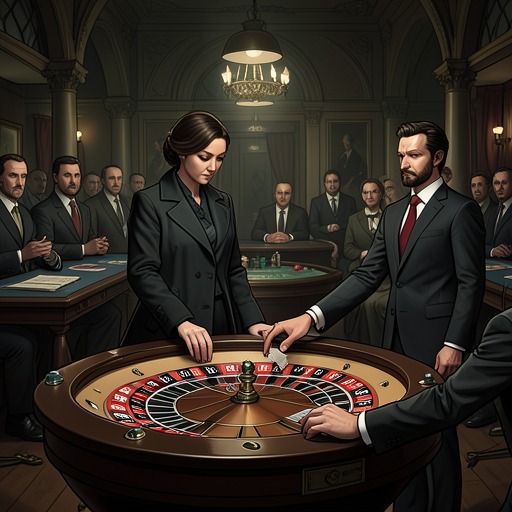
Marlowe reaches Las Olindas at about nine on an October night, beneath a high moon partly lost in beach fog. At the far end of town stands the Cypress Club, a rambling former summer mansion and later hotel, set in a dense grove of wind-twisted Monterey cypresses. Its enormous porches, turrets, stained-glass window trim, empty stables, and outward shabbiness preserve the atmosphere of an old estate rather than a modern entertainment venue. Eddie Mars has left the house largely as he found it instead of refashioning it as a Hollywood set.
The approach makes the club feel set apart without removing it from the town. Marlowe leaves his car beneath sputtering arc lights and walks along a damp gravel path; a doorman admits him to a huge, dim lobby, where a white-oak staircase curves into darkness. Music and confused voices come from behind heavy double doors, seeming distant from the building itself. A blond associate of Mars, previously encountered at Arthur Gwynn Geiger’s house, leads Marlowe through the hall to Mars’s office.
The Cypress Club
The club’s interior preserves a deliberate contrast between its entertainment and its faded setting. At about half past ten, a small orchestra of five Mexican musicians plays a softened rhumba to an empty dance floor. The gourd player rubs his fingertips as if they hurt, then reaches for a cigarette; the other four bend together to retrieve drinks from beneath their chairs. Their manner suggests tequila, though the drinks are probably mineral water. The performance’s show of liveliness goes largely unnoticed.
The former ballroom retains heavy crystal chandeliers, rose-damask wall panels darkened by dust, and a parquet floor made from many kinds of hardwood, from Burma teak and several oaks to ruddy wood and pale California lilac. Only a small area before the orchestra is exposed; old-rose carpeting covers the rest. The room’s layered materials and subdued music resist the bright, manufactured spectacle associated with Hollywood night spots. The club remains a business operating inside a mansion whose older identity has not disappeared.
Routes, Concealment, and the Oil Landscape
Las Olindas is also a point of passage between guarded interiors and less settled places. After leaving the club with a woman who is shaking, Marlowe drives down a curving lane on the blind side of the house. It opens onto De Cazens Boulevard, the town’s main drag; they pass old arc lights, dark-looking shops, and a service station before reaching a drugstore that is still open. The route offers a quick transition from the club’s private, controlled space to ordinary streets and a place where the woman can pause.
Elsewhere in the investigation, the landscape around the Sternwood estate reveals the economic history behind its sheltered grounds. From the estate’s terraces, Marlowe sees the old oil derricks below the high iron fence: most of the field has become a public park donated to the city by General Guy Sternwood, but scattered wells still produce five or six barrels a day. The family has moved uphill, beyond the smell of sump water and oil, yet the source of its money remains visible from the house.
A later drive reaches a more desolate remnant of that industry. After rain, Marlowe follows a rutted dirt track fringed by tall eucalyptus trees, where city traffic quickly grows faint. An oil-stained walking beam rises above a branch, connected by rusty cable to other derricks that have not moved in perhaps a year. Rusted pipe, a sagging loading platform, empty oil drums, and an old sump covered with stagnant, oil-scummed water mark a site whose wells no longer pump. The abandoned field contrasts with the estate’s maintained terraces and the public park made from most of the family’s former oil property.
Place in the Investigation
Las Olindas matters not simply as the setting of a club encounter but as part of a wider geography of money, access, and concealment. The Sternwoods’ oil wealth remains rooted in land below their elevated home; Mars’s club occupies an old mansion adapted to his business; and the town’s roads carry Marlowe between the club, its surrounding streets, and more remote places. The movement between these spaces continually changes what can be seen and who can be reached.
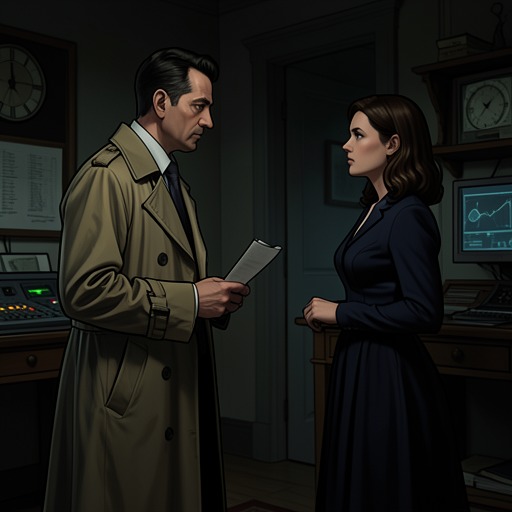
The same tension between private arrangements and public accounts shapes the investigation. In reporting his account to Captain Cronjager and district attorney Taggart Wilde, Marlowe omits Carmen Sternwood’s visit to Joe Brody’s apartment and Mars’s afternoon visit to Geiger’s house. He later argues that Geiger’s bookstore was an obvious front for an illicit operation tolerated by the Hollywood police, warning that a grand jury might ask why. Newspaper accounts then present a simplified version of the murders, omit the Sternwoods and Marlowe, and credit Cronjager with solving the cases. Against that official story, the Cypress Club and the oilfield remain material reminders of the money, influence, and hidden routes the public narrative leaves out.