Lido Fish Pier
The Big SleepLido Fish Pier is the coastal site where Owen Taylor’s Buick is recovered from the water with Taylor dead inside. The pier’s broken railing, the car’s condition, and the timing inferred from the tide and weather give the investigation concrete evidence of a plunge into the sea; later, the discovery becomes part of Philip Marlowe’s reconstruction of the events surrounding Arthur Geiger and the Sternwood family.
Setting and approach
The pier projects seaward from a faded stucco arch on the coast highway at Lido, about thirty miles from Los Angeles. When Philip Marlowe arrives with Bernie Ohls, people are gathered at the far end, while a motorcycle officer keeps another crowd from going out onto the pier. The scene has already drawn the familiar public attention that follows a death: parked cars line the highway, and spectators cluster beyond the barrier.
A low black power barge is moored against the pilings at the pier’s end. On its deck, the hoist has set down a large black-and-chromium car, its chains still around it. The recovery operation has brought the submerged vehicle into view, converting what happened out of sight into a scene that can be inspected by investigators and onlookers alike.
Recovery of the car and body
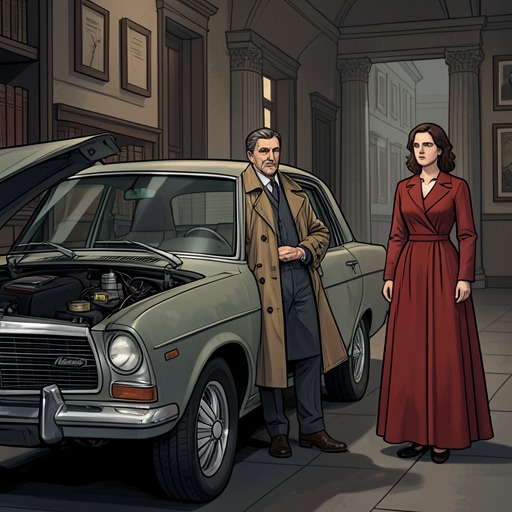
The car is damaged but recognizable. Its front bumper is bent, one headlight is smashed and the other pushed upward, the radiator shell is dented, and the paint and nickel are scratched. Water has soaked the upholstery; the tires appear undamaged. These details establish the violence of the car’s passage through the pier barrier without suggesting that the vehicle was battered along its sides by another car.
Owen Taylor is found in the driver’s seat. His body is still draped around the steering post, and a bruise is visible on his forehead. The evidence does not by itself explain whether the car went into the water by accident or was deliberately driven there, but it confirms that Taylor, the Sternwoods’ chauffeur, is the dead man in the recovered Buick.
The damaged pier supplies a rough chronology. A section of white two-by-fours has been broken through, and the exposed splintered wood is dry inside, indicating that the impact came after the rain stopped. Considering the amount of water available to cushion the fall and the limits imposed by the tide—an earlier or later plunge would have carried the car farther or crowded it against the pilings—the investigators place the event at about ten the previous night, perhaps as early as nine-thirty. Boys fishing in the morning spotted the car underwater; the barge crew then raised it.
Investigation and changing significance
At the pier, the circumstances initially remain uncertain. The damaged railing and the car’s position show that the Buick went through the barrier, but the visible evidence does not settle how Taylor came to be driving it into the water. The examination and recovery nonetheless give Marlowe and Ohls a fixed place and time against which to test competing accounts.
The pier’s importance sharpens when Marlowe confronts Joe Brody. He tells Brody that the Buick was lifted from twelve feet of water off Lido Fish Pier and that Taylor had been struck before the car went over, with the hand throttle pulled down. Marlowe connects Taylor’s visit to Geiger’s house with his attachment to Carmen Sternwood and his objection to Geiger’s conduct toward her. In Marlowe’s reconstruction, Taylor entered the house armed, discovered Geiger photographing Carmen, and shot Geiger; Brody then pursued Taylor and took the photographic negative from him. This account makes the plunge part of a chain of violence and evidence-taking, rather than an isolated traffic accident.
The pier therefore functions as both a recovery site and a point of convergence in the investigation. It yields the body and car that establish Taylor’s death, while its physical traces help constrain the time of the plunge. The distance between the hidden events at Geiger’s house and the public spectacle at the waterfront is also significant: private wrongdoing leaves measurable evidence in a damaged barrier, a submerged car, and a body that the authorities must bring into view.