Los Angeles law enforcement’s compromised protection system
The Big SleepLos Angeles law enforcement’s compromised protection system is the web of informal accommodation that lets illegal businesses operate under police observation while leaving officials room to control the consequences when violence brings them to attention. Its reach is visible in the protection associated with Eddie Mars, the tolerance of Arthur Geiger’s bookstore racket, and the official handling of the Geiger and Joe Brody killings. The result is a distinction between solving crimes and making their full circumstances public: the police can claim a case while suppressing the connections that would expose the arrangements beneath it.
Protection and the Open Racket
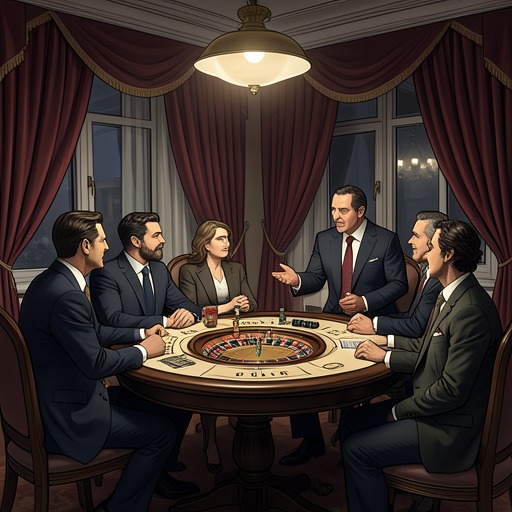
Philip Marlowe describes the arrangement directly to Eddie Mars: Mars’s Cypress Club at Las Olindas caters to wealthy gamblers, while local law and a connection into Los Angeles provide protection. Marlowe suggests that Geiger, as Mars’s tenant, may also have received some of that protection. Mars reacts by denying knowledge of Geiger’s racket, but Marlowe identifies the business as the illicit lending of pornography. The scene establishes a possible relationship between an influential club owner and a criminal enterprise without proving exactly what Mars knew or did for Geiger.
The bookstore’s conspicuous location makes the arrangement more telling. Geiger’s illicit stock is not hidden in an inaccessible backwater: the store operates on Hollywood Boulevard, and a rent book records the circulation of its volumes. Marlowe argues that police may prefer such illegal activity to remain in a visible, predictable place, where they can monitor it and intervene when they choose. His account is an interpretation of police practice, not a formal policy statement, but it explains how tolerance can function as a kind of control: the racket is permitted to continue so long as its operators and risks remain manageable.
The scale of the business gives that tolerance an economic dimension. Marlowe estimates that Geiger had at least five hundred books, with more out on loan, and calculates that lending a five-hundred-book stock repeatedly could produce roughly 125,000 rentals at a fifty-percent turnover. Even at a dollar per rental, the operation could yield $125,000 while retaining its capital. These are Marlowe’s calculations, offered while confronting Joe Brody and his accomplice over their attempt to take over the business; they are not an audited accounting. But they make clear why a racket with a substantial revenue stream might attract protection and why control of Geiger’s stock and records could become a source of conflict.
The Police, the Private Detective, and the Evidence
After the two murders are in police hands, the dispute shifts from who committed them to what can be admitted into the official account. Captain Cronjager has both killers and, as Marlowe puts it, the motives and instruments in the cases. Marlowe argues that his client is entitled to privacy and that he has a private detective’s license; he wants the blackmail connection suppressed so that the Sternwood family’s names do not enter the public record. His position protects a client, but it also aligns with the police division’s interest in avoiding publicity about Geiger’s business and the protection that may have allowed it to operate.
Marlowe presses the evidentiary risk rather than relying on an abstract accusation. He points to the dates stamped inside the rented book and offers to testify that it came from Geiger’s store. He says Agnes Lozelle will acknowledge the nature of the business and argues that the store plainly served as a front. If a grand jury investigated why Hollywood police had allowed it to operate, the inquiry could embarrass the division. Cronjager admits that publicity about indecent literature would not help his division, while Taggart Wilde recognizes that grand juries can ask inconvenient questions about how cities are run. The threat of scrutiny helps bring the officials toward a contained resolution.
That resolution does not mean every fact is openly shared. When Marlowe recounts events to the officials, he leaves out Carmen Sternwood’s visit to Brody’s apartment and Mars’s afternoon visit to Geiger’s, though he says he tells the rest as it happened. Wilde tells him that he will still need to make statements for the files, while suggesting it may be possible to keep the killings separate and the General’s name out of both. The distinction between a record kept internally and an account released publicly becomes central: officials can preserve enough information to close cases while withholding the links that would expose the family scandal and the protection network.
Public Account and Private Omissions
The next morning’s newspapers demonstrate how far the public story can diverge from the events Marlowe knows. Their reports do not connect Owen Taylor, whose car was recovered from the Pacific with his body inside, to the killing at Geiger’s Laurel Canyon bungalow. They omit the Sternwoods, Bernie Ohls, and Marlowe. Taylor is described simply as the chauffeur of a wealthy family, and Cronjager receives credit for solving the two Hollywood Division murders. The papers present Geiger as killed by Brody over proceeds from a wire-service operation and Brody as killed by Carol Lundgren in revenge; Lundgren is reported in custody and identified as having confessed.
The narrative compresses the sequence as well as concealing its connections. The coverage gives the impression that Geiger was killed the previous night, Brody about an hour later, and Cronjager solved both cases almost immediately. Taylor’s death is presented separately as a suicide: he was said to have been despondent and in poor health, and his body was to be sent to his family in Dubuque, with no inquest planned. This account offers the appearance of a clean police success while separating the chauffeur’s death from the crimes and removing the family’s blackmail problem from view. Its omissions are not incidental details; they determine what the public can understand about the cases.
Limits and Significance
The compromised system is not portrayed as an all-powerful organization with a single command. Its operation emerges through practical accommodations: a racket that can function openly, a club owner who says he has friends in town, a police division concerned about scandal, a district attorney willing to contain publicity, and a detective who withholds facts to protect his client. The evidence supports a pattern of compromised protection and selective disclosure, while leaving the precise terms of each official relationship uncertain.
That uncertainty persists in the later discussion of Mars. A police official describes himself as reasonably honest and says he wants the law to prevail, yet doubts that justice of that kind is likely in Los Angeles or comparable cities. He does not conclude that Mars killed Terence Regan; instead, he says Mars may know something and could have hidden his wife at Realito in an effort to mislead investigators. He also reports that Mars admitted employing Lash Canino as a protection man, while denying knowledge of Canino’s other activities and of Geiger’s racket. The distinction matters: the system produces suspicion and concealment, but suspicion is not proof of every alleged crime.
The novel therefore treats official closure as a negotiated outcome rather than a synonym for complete truth. The Geiger and Brody murders can be assigned killers, and the department can claim credit, while the surrounding blackmail, tolerated business, and Taylor connection are kept out of the newspaper version. Marlowe’s private investigation exposes some of this structure, but his own omissions help sustain it. Protection is both an instrument of criminal business and a method for limiting what becomes publicly knowable.