Owen Taylor dies in the Lido Pier car plunge
The Big SleepOwen Taylor dies when his car goes through the rail at Lido Pier and plunges into the water, but the apparent accident quickly becomes an unresolved murder. The discovery links a dead chauffeur to the earlier violence at Arthur Geiger’s house, yet the official account ultimately labels Taylor’s death a suicide and disconnects it from that crime. His death exposes how a physical scene can support competing explanations—and how authority and publicity can make one version prevail without resolving the truth.
Discovery at Lido Pier
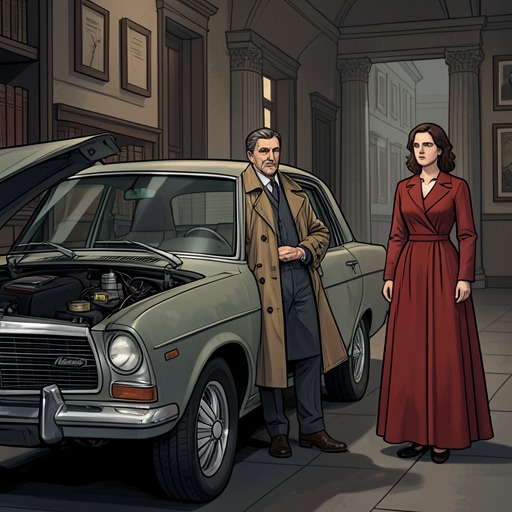
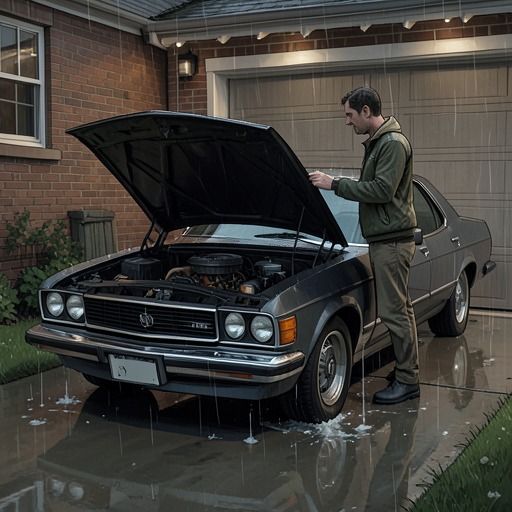
After a night of heavy rain, Bernie Ohls tells Philip Marlowe that a Buick belonging to the Sternwood family has been found in the surf off Lido Pier, with a man inside. At the pier, the car has been hauled onto a low black barge, its front end damaged and its interior soaked. Taylor remains in the driver’s seat. The novel identifies him as a young chauffeur, connecting the discovery to the Sternwood household and to the maroon convertible seen earlier at Arthur Geiger’s house.
The car’s path gives the death a public, physical setting: it has broken through the white railing at the end of the pier and entered the water. But the damage alone does not settle what happened. The details of the vehicle and the body instead become evidence over which the men at the scene disagree, each reading the same wreck as a different kind of event.
Competing Explanations
A uniformed officer suggests that Taylor may have been drunk and showing off in the rain. The plainclothesman rejects that account: the hand throttle is set halfway down, and Taylor has been struck on the side of the head. He calls it murder. A member of the barge crew argues for suicide, reasoning from the car’s straight track along the pier and the force needed to breach the railing. The scene thus produces not one self-evident conclusion but rival interpretations, including an explicit suspicion that Taylor was assaulted before the plunge.
The distinction matters because the car’s plunge can be made to tell a story of reckless driving, deliberate suicide, or murder. The witnesses do not establish which explanation is correct. Their disagreement leaves Taylor’s death factually unsettled even as the investigation moves toward a public resolution.
Connection to the Geiger Case
The death follows the shooting at Geiger’s house. While Philip Marlowe watches the house in the rain, a flash of light and a scream draw him toward it; three shots sound just as he reaches the entrance, and someone escapes. When Marlowe returns later, Geiger’s body has disappeared. Taylor’s presence at the house is not explained at the moment of the shooting, but the later investigation places his death beside the Geiger affair rather than treating the cases as wholly separate.
This connection also rests on the particulars of the Sternwood property and its surroundings. The household’s money came from an oilfield below the family estate, while Taylor’s final confrontation with Carmen Sternwood takes place at old, disused wells. The contrast between the estate above and the exhausted industrial ground below gives the story’s violence a geography: family wealth, concealed crimes, and abandoned places are interwoven without making the setting itself proof of what happened to Taylor.
Official Closure and Public Account
The morning papers describe Taylor as the driver of the “Lido Pier Suicide Car” and report that he was a chauffeur to a wealthy family. They do not connect him to the killings at Geiger’s bungalow. Instead, their account says that Joe Brody shot Geiger and that Carol Lundgren killed Brody in revenge; Captain Cronjager receives credit for solving both murders. Taylor’s death appears separately as a suicide, and the papers say his family in Dubuque will receive his body and that there will be no inquest.
The account is not merely incomplete: it rearranges the events into a clean, finished case. It omits the Sternwoods, Bernie Ohls, and Marlowe, and presents the separate deaths as if they had been solved by an uncomplicated police investigation. In a later confrontation, Cronjager rebukes Marlowe for failing to report Geiger’s murder and says that the failure allowed the books to be moved and contributed to the chain of events ending in a second killing. That criticism underscores the consequences of Marlowe’s decision to protect his client, even though it does not settle the circumstances of Taylor’s death.
The Death’s Place in the Ending
Taylor’s death remains within the larger pattern of concealment that the public report exemplifies. Much later, Marlowe identifies the old wells as the place where Carmen Sternwood shot Rusty Regan, revealing that the polished family story and the newspaper version of the earlier crimes alike conceal decisive facts. The novel does not offer an equivalent final explanation of Taylor’s death; it leaves the disagreement at Lido Pier standing beside the official designation of suicide.
That unresolved contrast gives Taylor’s death its lasting significance. The pier wreck is visible, the competing interpretations are stated, and the newspaper account is widely legible, yet visibility does not produce truth. The novel’s closing meditation returns to death as “the big sleep,” placing the dead beyond the explanations and judgments that continue among the living. Taylor’s case remains one more death absorbed into a story that is tidier than the evidence permits.