Owen Taylor’s Buick
The Big SleepOwen Taylor’s Buick is a Sternwood family car whose unauthorized use and recovery from the sea turn it into one of the investigation’s most concrete links between Carmen Sternwood, Owen Taylor, and the violence at Geiger’s house. First seen as part of the family’s opulent world, it returns as a damaged vehicle with a dead driver inside: a private possession made public evidence, and a physical trace that complicates the competing stories told about Owen’s final hours.
Identity and Place in the Sternwood World
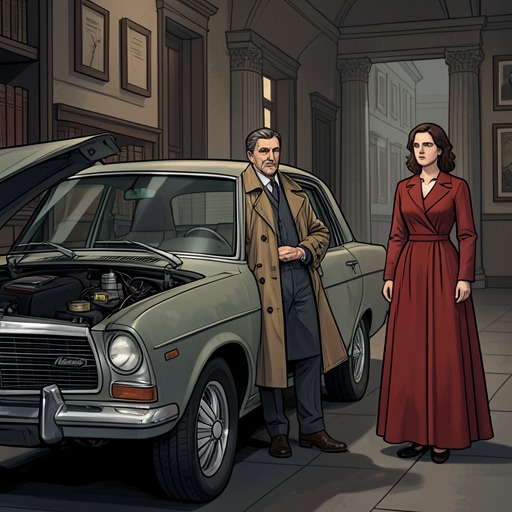
The Buick belongs to the family’s larger automotive environment, introduced at the Sternwood estate alongside a maroon Packard convertible being dusted by a chauffeur. The estate’s carefully tended grounds and expensive cars establish the setting of inherited wealth; in that world, vehicles can be taken for granted as conveniences and their use informally shared. The Buick’s importance emerges when the ordinary privilege of access becomes a question of permission and responsibility.
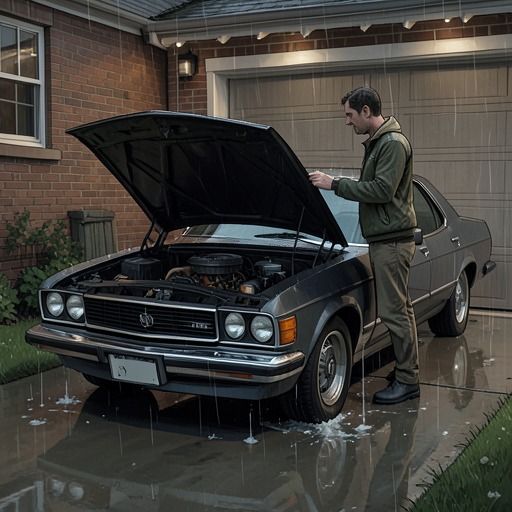
Its identity is established through the car itself: a Buick sedan, later described by Bernie Ohls as new, and registered to Carmen Sternwood at her West Hollywood address. When Philip Marlowe examines it in the rain outside Geiger’s house, it is a maroon or dark-brown convertible, its left window down. That registration makes the vehicle more than an anonymous car at a crime scene: it connects the scene to Carmen and the Sternwood household, while its use by Owen points toward the chauffeur’s place within that household.
Unauthorized Use and the Geiger Connection
Carmen explains that Owen had taken the car without permission on the night it disappeared. The family customarily allowed him to use a car on his night off, but that night was not his night off. The distinction matters: access to the family’s property was familiar, yet Owen’s particular trip was outside the agreed routine. The Buick therefore records both his proximity to the household and his independent decision to go out.
Marlowe’s surveillance places the car near Geiger’s house during a rainstorm. After following Geiger to Laverne Terrace, Marlowe sees a woman arrive and enter the house. He then checks a parked maroon or dark-brown Packard convertible, finds the registration in Carmen’s name, and sits waiting. At 7:20, a flash of light and a scream come from inside Geiger’s house; Marlowe reaches the entrance just before hearing three shots. The car’s presence binds Carmen to the immediate setting of the crime, although its presence alone does not establish who drove it or what happened inside.
Later, Marlowe offers Joe Brody a reconstruction of the events at Geiger’s: Owen, who was devoted to Carmen and objected to Geiger’s treatment of her, entered by the back way and interrupted Geiger while he was photographing Carmen nude. In this account, Owen’s gun went off and Geiger died; Owen fled with the negative. Marlowe then argues that Brody must have taken the photograph from Owen. This explanation situates the Buick within the chain of events by placing Owen at Geiger’s house, but it is part of Marlowe’s interrogation of Brody, not a direct account of Owen’s actions witnessed by the reader.
Recovery at Lido Fish Pier
The Buick reappears as a major police discovery after a call from Ohls: a family car is adrift in the surf off Lido Fish Pier, and there is a man inside. Ohls first describes it as a new Buick sedan messed up with sand and seawater. At the pier, the recovery is made visible in the machinery of the investigation: the car, black and chrome glistening in the morning sun, rests on a power barge with the hoist chains still around it. The setting shifts the vehicle from private property to an exposed object surrounded by police, workers, and onlookers.
The wreck bears specific signs of impact. Its front bumper is bent; one headlight is smashed and the other bent upward, though its glass remains unbroken. The radiator shell is dented, paint and nickel are scratched, and the upholstery is sodden and black. The tires appear undamaged. These details make the car’s physical state a record of its plunge into the water, while also emphasizing what remains uncertain: the damage describes the crash but does not, by itself, explain how it happened.
Owen’s body is still draped around the steering post, his head at an unnatural angle. He is identified as the slim, dark-haired young man who had been good-looking; now his face is bluish white, his eyes show a dull gleam beneath lowered lids, and sand lies in his open mouth. A bruise marks the left side of his forehead. The car has carried its driver into death, but the visible injury and the state of the vehicle do not settle whether the plunge was an accident or the result of prior violence.
Competing Accounts and Material Evidence
When Marlowe confronts Brody, he states that the Buick was recovered from twelve feet of water off Lido Fish Pier, with a dead man inside. He adds that the driver had been sapped, the car pointed out toward the pier, and the hand throttle pulled down. Brody immediately protests that Marlowe cannot pin the death on him. The car thus serves as a pressure point in the interrogation: its location and condition allow Marlowe to confront Brody with a sequence that connects the recovered vehicle to the events around Geiger’s house.
The evidence assembled around the Buick has different degrees of certainty. Carmen’s registration establishes ownership; Carmen’s account establishes that Owen took it without authorization and outside his night off; the recovered body establishes that Owen ended up in it at sea. Marlowe’s reconstruction links Owen’s trip to his feelings for Carmen and Geiger’s photographing her, while his later description of the car’s position and hand throttle presents the death as more than a simple loss of control. Keeping these layers distinct matters: the Buick supplies observable facts, but people interpret those facts under pressure, and their explanations are not equally direct evidence.
From Useful Object to Exposed Wreck
The Buick’s movement across the story carries it from the sheltered wealth of the Sternwood estate to Geiger’s rain-darkened neighborhood and finally to the public spectacle of a body recovered from the sea. At first, a family car is an unremarkable sign of resources and access. Once Owen takes it on a night when he has no permission, it becomes a trace of an unapproved journey; once it is hauled onto the barge, its battered surfaces and soaked interior make that journey impossible to keep private.
Its narrative force lies in this change of status. The car cannot explain Owen’s motives or independently identify the person responsible for his death, but its registration, route, damage, and recovery constrain the stories that can be told. As material evidence it is both revealing and incomplete: it connects the household to the crime and gives the investigation a body, a place, and a set of physical details, while leaving the circumstances of the final plunge open to investigation.