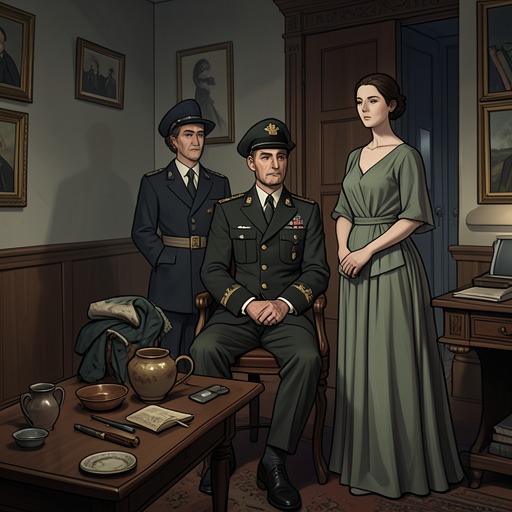
Philip Marlowe—General Guy Sternwood
The Big SleepPhilip Marlowe—General Guy Sternwood is a professional relationship founded on a detective’s commission and tested by the question of what loyalty to a client permits. General Guy Sternwood hires Marlowe to deal with Arthur Geiger, whose threat to the family is not yet fully understood; Marlowe’s investigation then draws him into deaths, concealed evidence, and a scandal the General cannot afford to have exposed. The relationship’s defining tension is that Marlowe serves the General without becoming simply his instrument: he protects the family’s privacy, but the protection carries consequences, and it never supplies the General with the complete truth about the family’s past.
Commission and Terms
Marlowe arrives at the Sternwood estate as a hired private detective, sharply conscious of the contrast between his professional appearance and the wealth he is approaching. He describes himself as “everything the well-dressed private detective ought to be” and notes that he is “calling on four million dollars.” The General’s wealth is therefore not incidental scenery: it establishes the unequal circumstances of the meeting, even as the business between them depends on Marlowe’s judgment and discretion.
The butler, Norris, introduces Marlowe to the General. The old man is gravely ill and receives him from a wheelchair, but he remains alert enough to question the proposed course of action. When Marlowe explains that confronting Geiger may amount to paying off blackmail, he cautions that such a payment may not end the threat. He offers instead to remove Geiger from the General’s immediate concern, while warning that the operation could cost money and would not necessarily solve the underlying problem. The General recognizes the delicacy of the work and asks that it be handled with as little shock to the people involved as possible.
The exchange establishes a compact rather than a detailed plan. Marlowe asks whether he may make a deal if Geiger seems even approximately honest; the General answers that the matter is now in Marlowe’s hands and that he does not do things by halves. Marlowe accepts the authority to act, but not a guarantee of a clean or predictable result. From the outset, the job binds him to the family’s interests while leaving him to decide what those interests require in practice.
Discretion Tested by the Investigation
The assignment rapidly becomes more than a negotiation. Marlowe witnesses the events surrounding Geiger’s house: a flash of light, a scream, gunshots, and a departing car. When he returns, Geiger’s body has disappeared. These circumstances put the investigation beyond the bounds of a routine effort to stop a blackmailer. They also leave Marlowe managing information about a death before the authorities have an accurate account of it.
Marlowe later reconstructs how the Geiger case connects to the Sternwood household. Joe Brody admits that Owen Taylor, the family’s chauffeur, was devoted to Carmen Sternwood and went to confront Geiger. Brody says Taylor found Geiger photographing Carmen, shot him, and took the negative; Brody then pursued Taylor and stole the photographic plateholder. Brody’s account also explains why he tried to take over Geiger’s book racket and extort money from the Sternwoods. The private assignment has thus exposed the family to a chain of exploitation and violence, not just a single demand for payment.
When the police challenge Marlowe for failing to report Geiger’s death promptly, he acknowledges that protecting his client influenced his conduct. Captain Cronjager argues that an earlier report might have prevented the books from reaching Brody and might have kept Carol Lundgren from killing him. Marlowe accepts that he may have acted wrongly, while defending his decision in the uncertainty he faced: he had no reason to think Lundgren would pursue Brody with lethal intent. His loyalty is consequently not an abstract promise. It becomes a choice with foreseeable risks, judged differently by the detective and by the officials responsible for the resulting deaths.
Client Loyalty and the Official Account
Marlowe’s defense of the case rests on distinctions between proof and inference. He argues that Taylor had both motive and opportunity to kill Geiger, whereas Brody’s conduct and aims do not fit the theory that Brody committed both the first killing and Taylor’s death. Taggart Wilde points out that even a gun found with Taylor would not, by itself, prove who fired it; Marlowe replies that the alternative would require too many coincidences and contradict Brody’s apparent purpose. The dispute shows Marlowe making a reasoned case, not presenting every part of the affair as legally established fact.
That limit becomes explicit when Wilde asks whether Marlowe has told his story with all relevant details. Marlowe admits that he has left out personal matters and intends to keep doing so. His refusal preserves the boundary between a client’s confidence and an official investigation, but it also means that the version given to the authorities is deliberately incomplete. Professional discretion here has a cost: it shields the Sternwoods while restricting what the police can know and prove.
The morning papers turn that incomplete account into a public narrative. They credit Cronjager with solving two slayings, report that Brody killed Geiger and Lundgren killed Brody, and present Taylor as a despondent chauffeur whose death was treated as suicide. They do not connect Taylor with the Geiger killing or mention Marlowe, Bernie Ohls, or the Sternwoods. The newspapers’ confident sequence differs from the uncertainties Marlowe has discussed with the officials. The family’s absence from the reports is a measure of the protection he sought, while the distortion of the events reveals how readily an official public story can substitute for a more complicated truth.
Payment, Unfinished Knowledge, and Significance
After the newspaper accounts appear, Norris tells Marlowe that the General has been unwell and assumes the investigation is complete. Marlowe confirms that his work regarding Geiger is finished, and Norris conveys the General’s offer of a five-hundred-dollar check. Marlowe calls it generous. The exchange closes the immediate business relationship in the language of payment and completion, but it does not mean that the wider mysteries involving the Sternwood family have been resolved.
The contrast between formal closure and continuing uncertainty shapes Marlowe’s relationship with the General. Later, the investigation into Rusty Regan leads Marlowe to the discovery that Carmen killed Regan, a truth Vivian has concealed. Marlowe confronts Vivian with what happened at the old wells: Regan had taken Carmen there to teach her to shoot, and she turned the gun on him. He does not treat the earlier Geiger commission as permission to expose every family secret; instead, the relationship’s pattern of protection extends into a more serious moral choice. At the novel’s end, he reflects that the General can remain apart from the “nastiness” in which Marlowe has become implicated, while the dying man waits in his bed. The thought joins private loyalty to the novel’s image of death as “the big sleep”: Marlowe has served and protected the General, but his service cannot undo the family’s losses or make its concealed history clean.