Philip Marlowe—Vivian Regan
The Big SleepThe relationship between Philip Marlowe and Vivian Regan moves from mutual testing toward a constrained alliance, but never becomes uncomplicated trust. Marlowe’s professional obligation to the Sternwood family limits what he will tell Vivian; her need to protect her family and manage the danger surrounding Rusty’s disappearance makes that silence consequential. Their exchanges repeatedly bring attraction, suspicion, and the question of what protection costs into the same room.
First Impressions and Professional Boundaries
Vivian first appears to Marlowe in an oversized, carefully appointed room at Sternwood place, reclining on a chaise-longue and watching him over her drink. He reads her as striking and dangerous; she, in turn, treats the private detective as an unfamiliar figure and challenges his profession. Their first encounter establishes a balance of observation and wariness: each assesses the other before either offers much trust.
When Vivian asks how Marlowe intends to investigate Rusty’s disappearance, he asks when her husband left. Her question assumes that Marlowe can explain his method, but the exchange quickly reveals that she does not control what he knows or what he may disclose. She says her father would not allow the police to be brought into the matter, setting family privacy against the formal machinery of investigation. The missing-person inquiry is thus personal and professional at once: Vivian wants answers, while Marlowe has been retained by her father and must keep the client’s confidence.
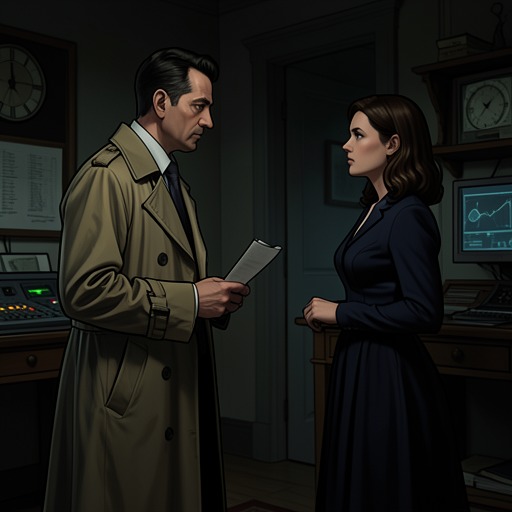
The boundary becomes explicit when Vivian calls Marlowe repeatedly and raises the matter of Owen Taylor. She wants to know what her father hired him to do and asks whether it concerned Carmen. Marlowe refuses to answer without the General’s permission, and will not even confirm whether Carmen is involved. His silence is not simply evasion; it is the working rule that governs their relationship, and it leaves Vivian to test him through other means.
Evidence, Secrecy, and a Limited Alliance
Vivian brings Marlowe a thick white envelope delivered by messenger that morning. Inside is a photograph, and its arrival gives the conversation a concrete urgency: Vivian is not merely curious about the investigation but is facing material that could expose her family. Marlowe agrees that he may be able to do something, while declining to explain how or why. The exchange offers her practical reassurance without the information she has been trying to obtain.
In the office, Vivian suddenly tells Marlowe that she likes him and invokes his belief in miracles. They share a drink, and she says she will obtain five thousand dollars. She also tells him that Eddie Mars’s blonde wife is the woman with whom Rusty supposedly ran away. Her confidence that this connection may make Mars more amenable is part of her attempt to use personal leverage where she lacks access to Marlowe’s confidential information. The money, the photograph, and the new disclosure turn their interview into a tentative working arrangement, but do not dissolve the underlying mistrust.
Even as they part, Vivian returns to the question of what her father told him. Marlowe again says he must speak to the General first. Vivian looks at the photograph and comments on the woman pictured, leaving the exchange suspended between what she has learned, what she fears, and what Marlowe will not confirm. Her repeated questions show that the professional barrier remains active even after the two have begun to cooperate.
Protection and Personal Intimacy
Later, in fog, Marlowe sees a man threaten a woman and demand her bag. After the man leaves, he recognizes Vivian and returns the bag. She responds by asking whether he is now her bodyguard. The encounter places Marlowe in the role of immediate protector, but Vivian’s tone does not turn the rescue into uncomplicated gratitude. She quickly asks whether he has found anything out about Rusty, then says that even if the missing man was her husband, the investigation is apparently none of her business. Her remark exposes the frustration produced by Marlowe’s reserve: she is close enough to depend on him, yet still excluded from the information he holds.
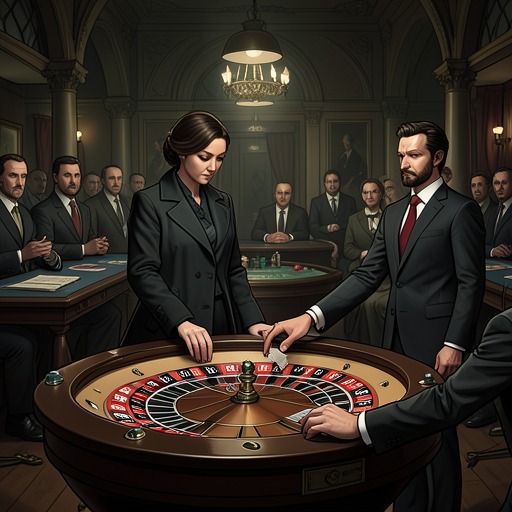
Their relationship briefly crosses into physical intimacy when Vivian invites Marlowe closer and asks him to hold her. Marlowe responds, but interrupts the encounter with a direct question about what Eddie Mars has on her. Vivian stiffens and challenges the premise. Marlowe points to a pattern he has observed: Mars lets her win money, then sends someone to recover it, while she appears insufficiently surprised by the arrangement. He suspects that the gambling and its staged reversals are an act, at least partly meant for his benefit. The scene turns intimacy into another test of what Vivian is concealing and what Marlowe can infer.
That suspicion is consistent with Marlowe’s wider investigation, though he does not immediately possess the whole truth. He later explains that Vivian’s reference to the police finding Rusty’s car in a garage led him to infer that the police knew something and that the Missing Persons Bureau might already have the case. He also recalls reading the meaning of Taggart Wilde’s manner when Wilde asked whether the General had said he was looking for Rusty: Marlowe understood that the question concerned whether the law’s resources were being used. His account shows how he has tried to separate what Vivian knows from what she has told him, while avoiding disclosure to the police of anything they do not already know.
The Family Secret and Its Cost
Marlowe’s restraint toward Vivian is part of a larger professional choice. In recounting the Geiger and Brody cases to the authorities, he admits that he withheld Vivian’s visit to Brody’s apartment and Eddie Mars’s visit to Geiger’s house. Captain Cronjager accuses him of failing to report a murder and thereby allowing events to proceed toward another one. Marlowe accepts that he may have done wrong, but explains that he was trying to protect his client. He also argues that the official account overlooks the difference between physical possibility and what he believes about the people involved: he considers Owen Taylor, rather than Joe Brody, the more credible killer of Arthur Geiger.
Marlowe does not present this loyalty as clean or cost-free. He tells Taggart Wilde that he is selling his limited courage and intelligence for a living, that revealing as much as he has without consulting the General conflicts with his principles, and that he remains on the case. He argues that police officers also cover things up to oblige people with influence. The defense places his relationship with Vivian inside a compromised system: secrecy is an ethical burden for him, but it is also the means by which he protects his client’s family from public exposure.
At the end, Vivian offers Marlowe fifteen thousand dollars, and he forces the concealed family crisis into the open. He asks her to take Carmen somewhere far away, to a place equipped to care for her and keep weapons and alcohol from her. Vivian then confesses that she went to Eddie Mars for help after Carmen returned and told her what she had done. Carmen had killed Rusty; Vivian feared that police questioning would draw the truth from her, and that the General would tell the authorities everything, dying with the knowledge. Vivian says she had been buying time, even as Mars’s help came at a price and she turned to drink to endure the deception.
Marlowe’s response to Vivian’s confession is not to expose the secret immediately, but to insist on a concrete form of protection for Carmen. His request recognizes both the danger of leaving her without care and the damage done by keeping the truth from the General. Vivian’s confession changes the basis of their relationship: what had been guarded questioning about Rusty and the investigation becomes a shared knowledge of the family’s central crime, with Vivian responsible for arranging care and Marlowe choosing what to reveal.
An Alliance Without Resolution
The relationship ends not in a declaration of trust but in a difficult arrangement. Marlowe leaves Sternwood place knowing that he has become part of the concealment surrounding Rusty’s death, even as he has tried to protect the General from a devastating truth. He reflects that the dead sleep the same whether their bodies lie in a sump or in a marble tower, while the living remain implicated in the circumstances around them. That judgment makes his loyalty to Vivian and her family morally uneasy: his protection may spare the dying General, but it also sustains a silence that has already distorted the official story.
Vivian and Marlowe therefore remain bound by unequal knowledge and a limited shared responsibility. She has disclosed the truth about Carmen and sought his help; he has demanded that she act to secure Carmen’s safety, while withholding the full account from the General and the authorities. Their cooperation is real, but it cannot restore Rusty, undo the earlier cover-up, or make professional duty and family loyalty coincide. The relationship’s decisive movement is from suspicion to complicity in a protective decision, with the cost of that decision left unresolved.