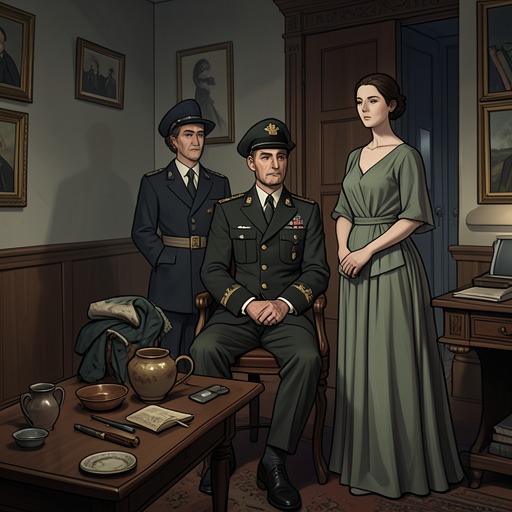
Rusty Regan disappears
The Big SleepRusty Regan disappears from the Sternwood estate in September, and the silence around his departure becomes the case’s governing uncertainty: the police find his abandoned car, suspect he may have left with Eddie Mars’s wife, and wait for ordinary habits to expose the pair’s whereabouts. The disappearance is first presented as an intimate family loss and then recast as a police theory, while the book’s geography—from the oilfield below the Sternwood estate to the wet hillside roads and decaying club—gives the unanswered question a physical landscape.
Background and Departure
Before disappearing, Regan had become a source of companionship to General Guy Sternwood. The General describes him as the breath of life: Regan spent hours with him, sweating and drinking brandy while recounting stories of the Irish revolution. He had served as an officer in the Irish Republican Army and, the General says, was not legally in the United States. Their relationship is described as a marriage, though the General calls it a ridiculous one that probably lasted less than a month as a marriage. The disclosure makes Regan’s departure more than a missing-person report: it breaks a close attachment for an old and failing man.
The General says Regan went away a month before their conversation, abruptly and without speaking to anyone or saying goodbye. The lack of explanation is the wound as well as the puzzle. The General nevertheless expects to hear from him one day, and the story sets that hope beside the new blackmail threat that prompts his disclosure. Regan’s absence thus enters the plot through a household already under pressure, where private vulnerability and criminal leverage coexist.
The Missing Car and Police Theory
Captain Gregory dates Regan’s disappearance to September 16. It was the chauffeur’s day off, and no one saw Regan take his car. Four days later, the car was found in a garage at Casa de Oro, a fashionable bungalow court near the Sunset Towers. A garage employee reported it because it did not belong there. Police found no prints on the car that matched anyone in their files and could not determine who had put it in the garage. The vehicle therefore supplies a trace of Regan’s movements without identifying either his destination or what happened to him.
The car’s presence at Casa de Oro leads the investigators toward Eddie Mars’s wife. She had left around the same time as Regan, within roughly two days, and a man who sounded like Regan had reportedly been seen with her. The identification was uncertain: police could not establish that the man was Regan. Gregory explains that the missing woman had been blonde when she vanished, but would not still be blonde, and that police had not found her car; he therefore thinks the two probably left in it. For him, the missing woman and Regan are the only plausible focus of the inquiry. The fourteen-day head start and the lack of direct identification leave this as a working theory, not a solution.
Waiting, Secrecy, and the Wider Investigation
Gregory expects the pair, if they are together, eventually to leave financial traces. Regan was known to have fifteen thousand dollars; the woman may have had money and valuable jewelry. In a strange town and under new names, Gregory reasons, they would still have familiar appetites and would eventually cash a check, incur a debt, or write a letter. Police readers are already looking for results, but Gregory considers it too soon. His account turns the passage of time into an investigative instrument: the case may remain hidden until the fugitives re-enter the ordinary financial system.
The inquiry is constrained by secrecy. Gregory says the work has had to remain under the hat, while Marlowe’s investigation repeatedly crosses paths with private power and compromised appearances. The disappearance is not resolved by the car alone; it is entangled with the Sternwood family’s wish to keep scandal private and with Eddie Mars’s influence over the circumstances surrounding the case. Regan’s absence functions as a mystery whose apparent explanation—flight with Mars’s wife—can absorb police attention without establishing what actually happened.
A Landscape of Wealth and Concealment
The setting makes the contrast between the Sternwoods’ wealth and the case’s uncertain evidence visible. From the estate, terraces and trimmed trees descend toward the high iron fence and its gilt spears. Below, the old oilfield that made the family rich is mostly public park, though a few wells still produce five or six barrels a day. The family has moved uphill beyond the smell of the oil and sump water, but the source of its fortune remains in view. That separation between polished residence and material foundation echoes the disappearance itself: the household presents a protected surface, while the facts that could explain its troubles lie beyond easy access.
Other locations extend the mystery through a network of watchable and hidden spaces. On a rainy evening, Marlowe follows Arthur Gwynn Geiger’s car up Laurel Canyon Drive to Laverne Terrace, where cabin-like houses sit below road level behind hedges and shrubs. Later, the Cypress Club at Las Olindas appears as a dark, decaying mansion among wind-twisted Monterey cypresses, its faded grandeur preserved rather than remade. At the investigation’s far edge, a rutted track leads past eucalyptus trees to motionless, oil-stained derricks, rusted pipe, empty drums, and an old sump. These places do not disclose Regan’s fate, but they give the disappearance its recurring spatial character: movement into concealment, uncertain observation, and a rich city’s neglected margins.