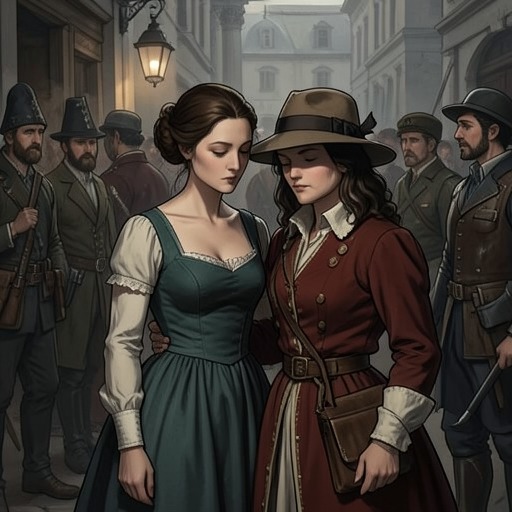
Rusty Regan—Mona Mars
The Big SleepThe relationship between Rusty Regan and Mona Mars is a story of affection obscured by rumor and criminal misdirection. Harry Jones’s account presents Regan as having been devoted to Mona before she became Eddie Mars’s wife, while the supposed flight of the two lovers becomes part of Eddie’s plan to hide Mona and mislead anyone investigating Regan’s disappearance. The novel ultimately distinguishes the genuine attachment from the false explanation built around it: Regan and Mona did not simply vanish together, and the apparent elopement conceals a more complicated arrangement.
Identity and Background
Harry Jones offers the most direct account of Regan’s feelings. He says Regan was sweet on a singer named Mona Grant, who later took the name Mona Mars. Jones recalls Regan as someone he knew casually, not as a close friend, but insists that he liked him and regarded him as a good man. His characterization pushes against the convenient assumption that Regan married Vivian for her family’s money: Jones describes him as a restless person who seemed to look beyond his immediate surroundings and, in Jones’s judgment, did not care much about wealth.
The account places Regan and Mona’s attachment before Mona’s marriage to Eddie Mars. Jones says Regan became sore when Mona changed her name to Mars and married into a wealthy family. He also reports that Mona disliked Eddie’s rackets, particularly the criminal activities surrounding blackmail, stolen cars, and fugitives. That opposition matters to the relationship’s later significance: Mona was not merely a romantic figure in an elopement rumor but someone whose connection to Regan intersected with her resistance to Eddie’s criminal world.
Attachment and Conflict
Jones describes a possible attempt by Regan and Mona to leave together, but carefully qualifies the story: Regan may have started to run away with her. According to Jones, Regan had once warned Eddie openly that he would intervene if Eddie involved Mona in criminal trouble. The reported warning makes Regan’s attachment more than a private longing; it places him in opposition to Eddie over Mona’s safety and over the reach of Eddie’s rackets.
Regan’s disappearance is not presented through a confirmed account of a shared departure. Jones says he stopped seeing Regan around the middle of September, though he did not notice the absence immediately. What eventually drew his attention was hearing someone claim that Eddie’s wife had left with Regan and that Eddie seemed to accept the situation rather than resent it. Jones passed the story to Joe Brody, who saw the possibility of exploiting it for money from both Eddie and Regan’s wife. Thus, the rumor about the lovers acquired a second life as a potential instrument of blackmail.
The False Elopement and Its Purpose
The apparent flight with Regan is finally exposed as part of Eddie’s deception. Marlowe explains to Vivian Regan that Eddie hid Mona at Realito and put Lash Canino there to guard her, making it appear that she had run away with Regan. Eddie also had Regan’s abandoned car placed in the garage of the location where Mona had been living. These arrangements gave the rumor a physical prop and a plausible destination, helping sustain the explanation that Regan had disappeared with Eddie’s wife.
Marlowe’s reconstruction gives the arrangement a larger purpose: Eddie wanted the police to accept a satisfying explanation for Regan’s absence without discovering where Regan had gone or why. The elopement story therefore served as cover, not confirmation of a reunion. Mona’s presence at Realito and Regan’s car there do not establish that the two were living together; in Marlowe’s account, those details were deliberately positioned to make a misleading story credible. Jones’s report that Regan may have begun to leave with Mona remains a fragment of the past, distinct from Eddie’s later fabrication about what happened after Regan vanished.
Narrative Significance
The relationship is disclosed indirectly, through Jones’s recollections and Marlowe’s explanation to Vivian, rather than through a scene between Regan and Mona. That structure makes the lovers’ story inseparable from the problem of evidence: an affectionate attachment, a possible attempted departure, a public rumor, and a staged cover can all be made to look like the same event. Jones’s account humanizes Regan by describing him as more interested in Mona than in money, while Marlowe’s reconstruction shows how Eddie exploited that attachment to redirect suspicion and preserve a false account of the disappearance.
The story also clarifies why the rumor could be persuasive. Mona had been close to Regan, opposed Eddie’s criminal activities, and was said to have disappeared around the time Regan was no longer seen. Eddie’s conduct then appeared to fit the rumor, while his concealment of Mona and the placement of Regan’s car helped manufacture corroboration. The relationship remains emotionally meaningful but factually bounded: the evidence supports Regan’s affection and the possibility that he began to leave with Mona, while the supposed completed elopement is exposed as a misleading explanation for Regan’s disappearance.