Terence “Rusty” Regan’s disappearance
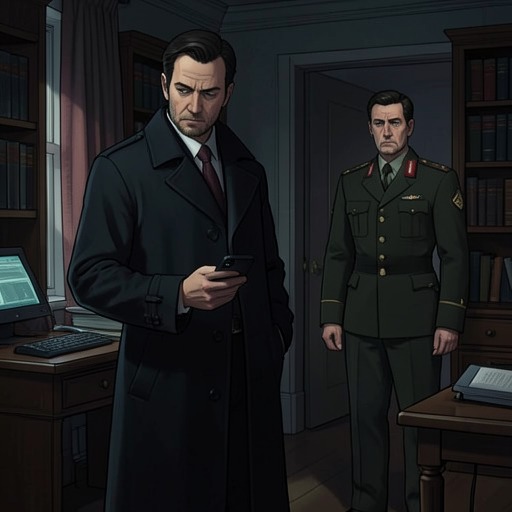
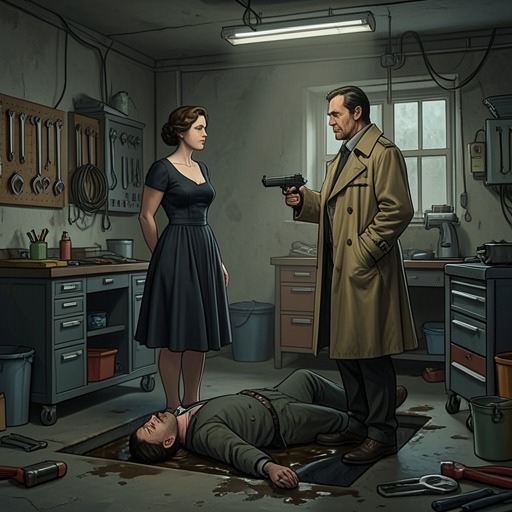
The Big SleepTerence “Rusty” Regan’s disappearance is the unresolved absence at the center of Philip Marlowe’s investigation for General Guy Sternwood. Regan leaves without explanation, and the recovery of his car near the Sunset Towers encourages investigators to connect him with Mona Mars. That apparent trail is manufactured by Eddie Mars: the final account reveals that Eddie used the false elopement story to conceal where Regan had gone and protect a larger financial scheme.
Background and Departure
Before the disappearance, Regan had become a source of comfort to the ailing General. The General describes him as the breath of life while he was there: Regan spent long hours with him, drank brandy, and told him stories of the Irish revolution. He had served as an officer in the Irish Republican Army and was not legally in the United States. The General regarded their marriage as an unlikely one that may not have lasted a month in practice, but Regan’s presence mattered to him. His abrupt departure therefore leaves both a practical mystery and a personal absence.
The General says Regan left about a month before their conversation, without a word to anyone and without saying goodbye. He admits that the silence hurt, while still expecting to hear from Regan again. Vivian Regan gives Philip Marlowe a more specific account: one afternoon a month earlier, Regan drove away in his car without telling anyone. She adds that the car was later found in a private garage. Her phrasing leaves unclear who discovered it and what she knows about the circumstances; the account soon becomes part of the puzzle rather than a reliable explanation.
The Car and the Police Theory
Captain Gregory’s file places Regan’s departure on September 16, late in the afternoon. It was the chauffeur’s day off, and nobody saw Regan take his car. Four days later, a garage attendant reported the vehicle, which had been left at the Casa de Oro, a bungalow-court establishment near the Sunset Towers. Police could not determine who had put it there, and the fingerprints they found did not match prints on file. The abandoned car gave investigators a tangible lead, but it did not establish how, why, or with whom Regan had left.
The garage location seemed to connect Regan’s disappearance to Mona Mars. Police found that Mona was living at the Casa de Oro and had left around the time Regan disappeared, within roughly two days. Someone resembling Regan had reportedly been seen with her, but hotel staff could not identify him positively from a photograph. Gregory notes the weakness of such identification and treats the case as one that must be pieced together from uncertain sightings and circumstantial details.
Regan’s known money sharpened the competing possibilities. He carried about fifteen thousand dollars in cash, according to the police information, while Mona may have had money and valuable jewelry of her own. Her husband, Eddie, said he and Mona did not live together, though they remained friendly. Gregory considers the prospect that Regan and Mona left together, but rejects jealousy as a sufficient reason to treat Eddie as the likely culprit. His working theory focuses on the woman and Regan himself: they may have departed in her car, had a fourteen-day head start, and could remain out of reach until their money ran low and they re-entered ordinary financial channels.
A Disappearance Inside Other Scandals
The uncertainty surrounding Regan develops alongside a separate chain of blackmail and violence. General Guy Sternwood tells Marlowe that, months before Regan arrived, he paid Joe Brody five thousand dollars to leave Carmen Sternwood alone. Later, the evidence Marlowe presents to Taggart Wilde includes Carmen’s signed notes, Arthur Geiger’s card to the General, Carmen’s photographs, and Geiger’s coded notebook. Those objects document the blackmail operation, but they do not by themselves explain Regan’s absence. Their importance is that they show how the family’s vulnerabilities and the criminal businesses around it overlap, while the real explanation for the disappearance remains concealed.
Marlowe’s discoveries at Geiger’s house expose another danger to the Sternwoods. He finds Carmen in a drugged, disoriented state and Geiger dead beside a concealed camera aimed at her. Later, a photograph of Carmen reaches Vivian in a messenger-delivered envelope addressed to her at 3765 Alta Brea Crescent. When Marlowe discusses the missing photograph with Carmen, he tells her it is probably with Brody and instructs her not to tell anyone she had been at the house. These episodes do not reveal where Regan went, but they show why a plausible public account could shield powerful people and why the evidence surrounding the Sternwood family was repeatedly managed rather than openly disclosed.
Carmen’s own statements add another layer of uncertainty. When Marlowe asks how much she remembers of the night at Geiger’s, she claims she was sick and at home; Marlowe rejects the denial. He later tells her that the photograph is gone and asks her to leave the matter alone. The gap between her account and the events Marlowe knows illustrates how memory, concealment, and protection complicate testimony in the novel. Regan’s disappearance is likewise first presented through partial reports and misleading appearances, though its eventual explanation comes from Marlowe’s reconstruction rather than Carmen’s recollection.
The Concealed Explanation
In his final explanation to Vivian, Marlowe connects the disappearance to Eddie Mars’s larger plan. He says Eddie stood behind Geiger, using him as a front in the attempt to extract money from the Sternwoods. The General’s decision to hire Marlowe rather than pay Geiger showed that he was not frightened by the blackmail; Eddie needed to learn whether Vivian’s father had a vulnerability of his own. If the General could be made to pay, Eddie could collect quickly; otherwise, he could seek money from Vivian through gambling while waiting for her inheritance.
Marlowe then explains how Regan’s absence served Eddie. Because people knew of the bad blood between Eddie and Regan, Eddie could become a suspect if Regan vanished without a plausible alternative. Eddie therefore hid Mona at Realito and placed Lash Canino there to guard her, while arranging for Regan’s car to be left at the garage where Mona had been staying. Together, the hidden wife and abandoned car created the appearance that Mona had run away with Regan. Marlowe says Eddie knew where Regan had gone and why, and wanted the police to accept an explanation that would keep them from finding out. The disappearance was not simply a possible elopement: it was a false trail designed to protect Eddie’s interests and preserve a much larger prospect of profit.
Consequences and Narrative Significance
The apparent solution built from the Casa de Oro, Mona’s absence, and uncertain witness identification is therefore also a mechanism of concealment. The clues are real, but their arrangement gives them a misleading meaning: Regan’s car is found where Mona lived, and a possible sighting supports the story that they left together. Marlowe’s disclosure changes the significance of those facts without making the earlier police inquiry irrational; Gregory’s theory reflects what the available evidence appears to show, while Eddie has manipulated the setting in which that evidence will be read.
The disappearance also exposes the limits of official investigation in the novel. Police records can establish dates, a car’s location, and the absence of usable identification, yet those facts cannot reveal the purpose behind the false trail. Marlowe’s account gives Vivian the concealed connection between Regan, Mona, Eddie, and Canino, but the available evidence does not disclose Regan’s ultimate fate in this explanation. His absence remains the mystery that gives Eddie’s scheme its cover and makes the distinction between a found car and a known destination crucial.