The Realito confrontation with Lash Canino
The Big SleepThe Realito confrontation with Lash Canino turns Philip Marlowe’s captivity into a lethal reversal. With Mona Mars’s help, Marlowe gets free of the rope, retrieves a second gun, and returns to the house where Canino has left him bound. He tricks Canino into approaching a car he believes contains a wounded or dying Marlowe, then shoots him. Mona, who has been hiding to protect Eddie Mars, releases Marlowe from his handcuffs afterward. The encounter resolves the immediate threat but leaves its moral cost in view: Mona asks whether Canino had to die, then concedes that he did.
Capture and reversal
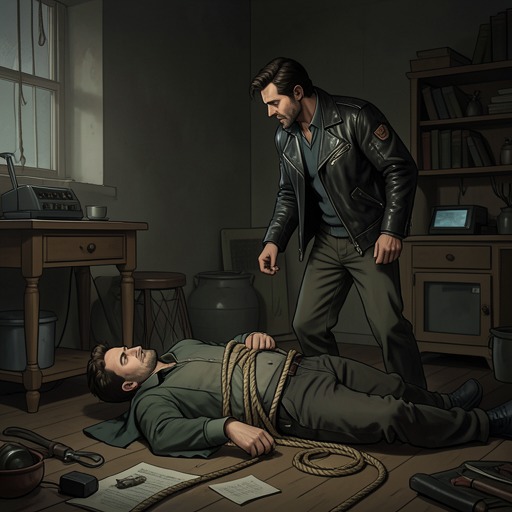
At the Realito hideout, Marlowe is caught through coordinated action by Canino and Art. Art uses an air-stiffened inner tube to pin Marlowe’s arms, leaving him unable to reach the gun in his pocket; Canino then strikes him until the scene gives way to darkness. The attack makes Marlowe’s position plain: he is restrained, outnumbered, and at the mercy of men who have prepared their trap without needing to announce their teamwork.
Mona changes the immediate balance. She returns with a kitchen knife and cuts the rope at every knot, though she cannot free Marlowe from the handcuffs because Canino has their key. Her actions complicate the apparent opposition between captive and captor: she is helping Marlowe, yet she has explained that she hid because she loves Eddie Mars and wanted to show she would do what Eddie wanted. Her loyalty has not made her safe; it has left her in a house with Canino and Marlowe, both of whom she knows to be dangerous to one another.
The return to the house
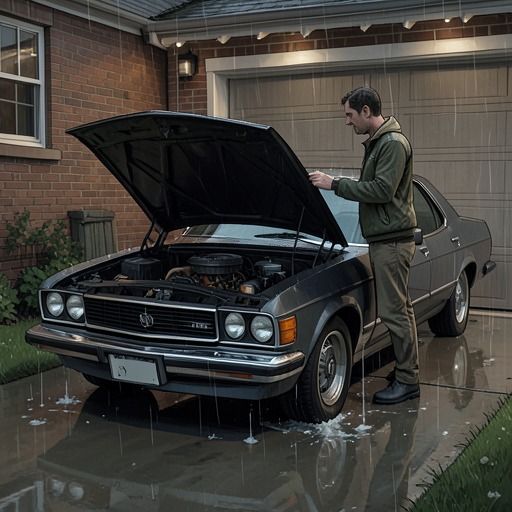
Once free of the rope, Marlowe goes out into the rain still handcuffed. He finds his convertible with both tires repaired and mounted, retrieves another gun from the car, and returns to the house rather than simply leaving. The working car and the concealed weapon give him a chance to act, but the handcuffs continue to limit what he can do. His return is therefore not a clean escape: he re-enters the danger on terms shaped by his restraints and by Mona’s presence inside.
Marlowe waits outside and listens. He imagines Canino will take Mona away and leave Marlowe tied up, but cannot count on what Canino will do. Instead of entering the house, he tosses gravel at a screened window to draw attention. When the house goes dark, he starts the car and crouches by its rear wheels. The motor becomes part of his deception: it is running, but Marlowe is no longer in the place where Canino expects him to be.
The staged attack and Canino’s death
Canino fires at the car after a darkened window moves. Marlowe pretends to be hit, producing a cry and then silence; Canino laughs, apparently convinced that the shots have taken effect. Mona comes out toward the car, with Canino close behind her. When she calls out that she can see Marlowe through the window, Canino knocks her aside and fires again at the supposed target. His response confirms that he has accepted the trick and exposes him to Marlowe’s return fire.
Marlowe calls out, “Finished?” and shoots Canino four times when the man turns toward him with his gun still raised. Canino falls in the wet gravel, and the confrontation ends with his death. The timing matters as much as the gunfire: Marlowe has used the running car, darkness, and Mona’s warning to make Canino reveal himself, but he shoots because Canino remains armed and Marlowe cannot safely wait. The encounter is an escape only because Marlowe converts his apparent helplessness into a ruse.
Mona and the aftermath
After Canino falls, Mona remains still in the rain. Marlowe retrieves Canino’s gun, and Mona says she had feared Marlowe would come back. He answers that they had a date and begins laughing, but the laughter stops when Mona bends over Canino. She takes a small key on a thin chain and uses it to unlock Marlowe’s handcuffs.
Mona asks, “Did you have to kill him?” Marlowe does not answer her with an explanation. Her own reply—“Yes,” she says softly. “I suppose you did.”—registers both the necessity she recognizes and the unease that remains. The key frees Marlowe from the physical restraint that survived his escape from the rope, while the exchange refuses to make Canino’s death feel like a consequence without weight. Mona’s help has enabled Marlowe to survive, but it does not erase the danger that brought them together or the ties to Eddie Mars that shaped her choice to hide.