Cholly and Pecola Breedlove
The Bluest EyeCholly and Pecola Breedlove are father and daughter, but their relationship is marked by the collapse of the care and security that parenthood should provide. Cholly’s violence against his family drives them from their home, and his sexual assault of Pecola results in her pregnancy. In the novel’s retrospective account, that private catastrophe is set beside the family’s poverty, dispersal, and the community’s failure to understand the conditions that produced the harm.
Family Rupture and Displacement
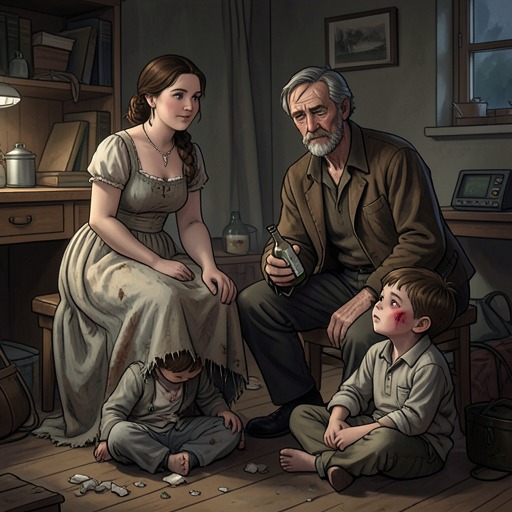
Pecola comes to stay with the MacTeer family after Cholly has burned the Breedlove home and struck his wife. The household has been scattered: Pauline stays with the woman for whom she works, Sammy is with another family, and Cholly is in jail. Pecola arrives with nothing—not even a spare dress or a nightgown. Her sudden presence in another family’s home gives the rupture a concrete measure: the child has been displaced, stripped of possessions, and separated from the rest of her family.
The MacTeer household is told to be kind to Pecola and not to fight with her while the adults wait for the family to reunite or decide what to do. Their mother can only wonder what has got into people, and describes the public consequences of Cholly’s actions: the Breedloves are outdoors. For Pecola, her father’s violence is not an abstract family failing; it has changed where she can live and who is around her. The protection she receives comes from the MacTeers, not from the household in which she was born.
Pregnancy and the Marigolds
The narration later names the central violation directly: Pecola is having her father’s baby. The sisters remember believing that this was why no marigolds grew in the fall of 1941. Their childhood explanation binds the plants’ failure to Pecola’s pregnancy, though the retrospective voice recognizes that the earth itself may have been unyielding. The relationship between father and daughter thus reaches beyond the domestic scene: its consequences become part of the children’s attempt to make sense of a world in which their hopes cannot take root.
The seed image makes the connection painfully exact. The girls had placed seeds in their own plot of black dirt, just as Cholly had placed his seeds in his own plot. But the narration refuses to equate the children’s innocence and faith with his lust or despair: none of these forces could make the earth yield. The seeds shrivel and die, and so does Pecola’s baby. The image does not soften the difference between a child’s hope and a father’s sexual violence; instead, it places both within a barren condition that defeats the possibility of growth.
Retrospective Judgment and Consequences
The account is told from the sisters’ later perspective. They acknowledge that, at the time, they blamed Pecola’s pregnancy for the absent flowers; only afterward do they admit that they had not considered the earth’s own barrenness. That change in understanding turns the garden into more than a childhood memory: it exposes the limits of the children’s faith while widening the explanation beyond a single cause. The failure lies not only in what happened between Cholly and Pecola, but in the conditions surrounding them and in the adults and community that could not protect her.
The relationship’s outcome is rendered through absence and death. Cholly is dead; the girls’ innocence is dead; the seeds and Pecola’s baby have died. The concluding question of why remains open rather than offering a consoling explanation. Cholly’s actions have devastated his daughter, but the narration also insists on a world whose soil is unyielding. Their father-daughter bond therefore stands as one intimate expression of a larger failure of nurture: the conditions that should sustain life instead leave Pecola exposed, pregnant, and bereaved.