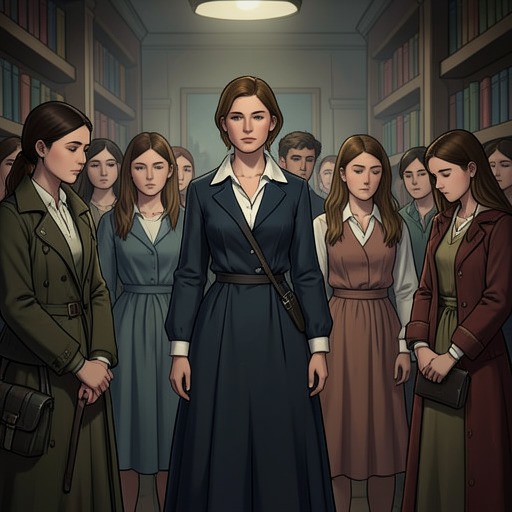
Claudia MacTeer and Maureen Peal
The Bluest EyeClaudia MacTeer and Maureen Peal’s relationship is a brief but consequential childhood rivalry: Maureen’s wealth and popularity unsettle Claudia, while their confrontation over Pecola exposes the racialized standards of beauty and status that shape how the children see one another. Claudia’s jealousy turns into hostility, then into a painful recognition that Maureen’s social approval has become a measure by which Claudia and Frieda are made to feel inferior.
A Disruptive Arrival
Maureen enters school as a new girl whose arrival disrupts the familiar rhythm of Claudia’s world. The narrator describes her as a “high-yellow dream child,” with long brown hair braided into two ropes down her back, and notes that she is rich by the sisters’ standards. Her appearance, money, and immediate appeal to the other girls give her a social position that Claudia and Frieda cannot ignore.
The sisters initially try to reduce Maureen’s advantage by finding flaws in her. They alter her name to “Meringue Pie,” then take satisfaction in discovering that she has a dog tooth. These small discoveries offer a brief counterweight to their envy, but do not change the larger fact: Maureen is admired, and the other girls will not join Claudia and Frieda in their hostility. Her locker beside Claudia’s lets Claudia encounter this difference repeatedly during the school day, turning Maureen’s popularity into a regular reminder of what the sisters lack.
Jealousy and Social Rank
Claudia’s jealousy is not simply a private dislike of Maureen. It grows from a visible contrast in status: Maureen is wealthy and adored, while the sisters’ attempts to criticize her leave them isolated in their resentment. The narrator recalls that they suspected themselves of secretly wishing to resemble her, even as they tried to bring her down to size. Their response reveals how the children have learned to treat appearance and popularity as measures of worth.
The rupture becomes sharper when the girls’ attention turns to Pecola. After the children have encountered a disturbing moment involving Pecola’s father, Maureen says she does not care if Pecola sees him exposed. Frieda answers that Maureen does care, because that is what she keeps talking about. Claudia then tells Maureen to stop speaking about Pecola’s father. The exchange shifts their rivalry from unspoken envy to a conflict over how Pecola may be discussed and treated.
The Confrontation Over Pecola
Maureen responds by insulting Pecola’s father and challenging Claudia’s standing to object. Claudia swings at Maureen and misses, striking Pecola instead; she then throws her notebook, which also hits Pecola. The scene makes Claudia’s defense of Pecola imperfect and consequential: in trying to strike back at Maureen, Claudia’s actions injure the person she means to defend. The hostility between the two girls thus unfolds in the presence of a more vulnerable third child, whose exposure becomes material for their quarrel.
Maureen’s taunt identifies Claudia and the other girls as Black, and Claudia reacts with anger, swinging at her again. Maureen’s words do more than provoke a fight. They force the girls to confront a social ranking in which Maureen’s admired appearance and popularity seem to place her above them. Claudia and Frieda later feel the force of Maureen’s final words: if Maureen is cute, they reason, then they must be lesser. The sisters’ assessment shows how quickly an argument between children can reproduce the standards of beauty and value that make one girl’s approval seem like another’s diminishment.
Meaning and Later Echo
The rivalry clarifies the difference between Claudia’s resistance to imposed standards and the social power those standards retain. Claudia and Frieda can mock Maureen’s name and appearance, but their private insults cannot undo the other girls’ admiration of her. When Maureen’s judgment lands, the sisters experience it as a verdict on their own worth. Her popularity gives the insult force that their counterattacks lack.
The novel later recalls the children’s contrasting looks at Maureen and Pecola, while admitting uncertainty about whether the community remembered those differences or merely knew them. That uncertainty makes the episode more than an isolated quarrel: the children have defended themselves against others, treated speech as a code to decipher, and scrutinized gestures, yet their vigilance does not keep them from participating in the judgments that isolate Pecola. Maureen and Claudia stand on opposite sides of a contest over status, but their conflict also reveals the shared social world that turns a child’s appearance and vulnerability into grounds for ranking and exclusion.