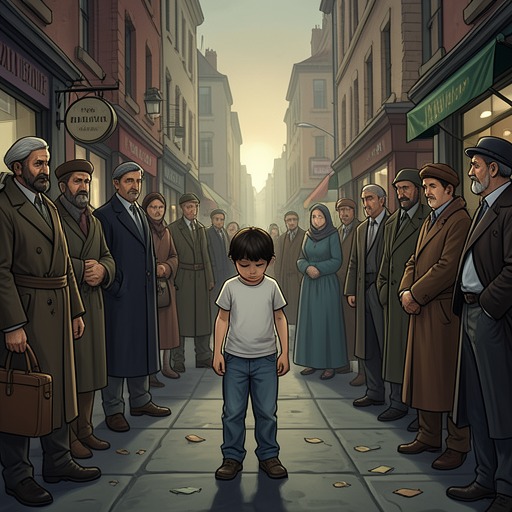
Claudia and Frieda look for whiskey for Frieda
The Bluest EyeClaudia and Frieda look for whiskey for Frieda after Frieda discloses that Mr. Henry touched her and explains why she fears she has been ruined. The search is a child’s attempt to answer sexual violation with the fragmentary explanations available to her: whiskey, the girls believe, might prevent the future her mother has made frighteningly vivid. The episode exposes both the girls’ loyalty and the failure of the adults around them to give Frieda a clear, protective account of what happened.
Disclosure and the fear of being ruined
Frieda tells Claudia that Mr. Henry touched her. The account follows the sisters’ effort to understand what he did: Frieda distinguishes the touching from showing his body, and points to where he touched her. Claudia asks whether Frieda’s mother whipped her; Frieda insists that she did not. Instead, Frieda says that Miss Dunion came in after the household had quieted and urged her mother to take her to a doctor because she might be ruined. Her mother began shouting again, this time at Miss Dunion rather than at Frieda.
What frightens Frieda is not merely the touching but the meaning the adults have attached to it. She says she does not want to be ruined, then explains the word by connecting it to the Maginot Line and to her mother’s claim that the line, China, and Poland were ruined. The comparison turns a child’s confused understanding of sexual harm into a bodily fear: Claudia imagines Frieda grown large, with swollen legs and a face surrounded by rouged skin. Claudia, too, begins to feel tears. The sisters do not have a dependable explanation that separates what Mr. Henry did from what Frieda fears will happen to her.
The search for whiskey
Claudia first tries to reassure Frieda with exercise and not eating, responding to the image of future fatness that the word ruined has brought to mind. Frieda counters that China and Poland are ruined too, though they are not fat. She explains that, according to her mother, whiskey ate them up. The girls then consider whiskey as a way of keeping Frieda from being ruined, even though they have no money, no whiskey at home, and no idea who might sell them any.
Claudia supplies a possible source: Pecola, whose father is always drunk. The proposal makes the girls’ plan depend on knowledge of another household’s suffering. They decide to ask Pecola for whiskey without telling her why they want it. The secrecy is not evidence of a considered plan to deceive her; it shows that the children have a proposed remedy but no adult explanation they can confidently give. Their errand grows from care for Frieda, while the circumstances that make them undertake it remain beyond their understanding.
Persistence and the limits of the remedy
The search becomes a matter of resolve as well as need. After resting against a tree, Claudia suggests going home, but Frieda refuses: she believes she is fighting for her life and insists they have to get the whiskey. Claudia reminds her that their mother will punish them; Frieda answers that their mother will not, and presses on. The exchange gives the errand its urgency: for Frieda, turning back would mean surrendering to the feared transformation she associates with being ruined.
The episode does not make whiskey a reliable cure or provide the girls with a sound account of sexual harm. Instead, it shows how they make a practical response out of overheard adult language, frightening comparisons, and the knowledge that a nearby household may contain alcohol. Their effort is an act of sisterly solidarity, but its desperate logic also measures the absence of trustworthy adult protection. The girls act because Frieda is afraid and Claudia takes that fear seriously, even when the remedy they imagine cannot address what has happened.
Narrative significance
The search places children’s bodily vulnerability alongside their limited power to interpret it. Frieda has been touched by a lodger, and the adults’ argument over who let him in and whether she may be ruined leaves the child struggling to understand both the violation and its consequences. Claudia’s questions register that struggle without resolving it; the girls instead turn toward an improvised errand, carrying adult words into a child-sized theory of danger and cure.
The scene also gives care a concrete form. Claudia proposes Pecola as a source; Frieda keeps moving when Claudia wants to stop. Their companionship does not erase their ignorance, but it prevents Frieda from facing her fear alone. By making the search for whiskey the girls’ response to a disclosure of touching, the narrative shows how a child’s attempt to help can be tender and determined while still constrained by the neglectful explanations and protections available to her.