Geraldine and Junior
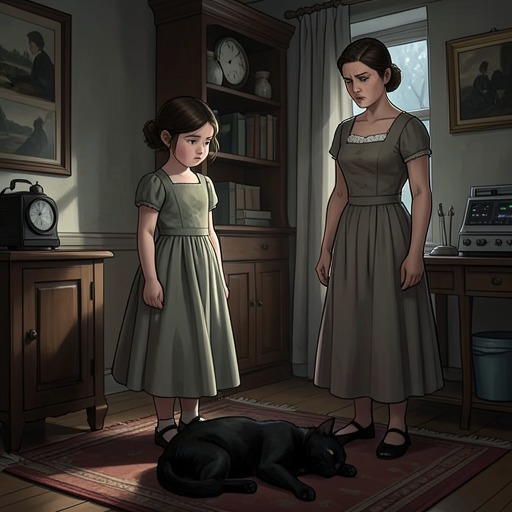
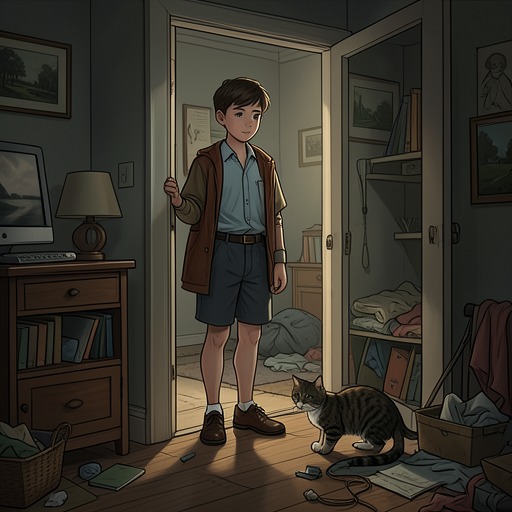
The Bluest EyeGeraldine and Junior’s relationship joins exacting physical care to emotional distance. Geraldine keeps her son clean, fed, and clothed, but does not speak to him tenderly or indulge him with affection; Junior comes to recognize the contrast between her manner toward him and her tenderness toward the family cat. The distinction becomes a source of resentment that he redirects into cruelty toward the animal and, as he grows older, into bullying girls. Their household thus presents care as something that can meet bodily needs while leaving a child emotionally isolated—and shows how that isolation can travel outward as harm.
Identity and Household
Geraldine lives in Lorain, Ohio, where she has built a carefully ordered domestic life: she irons shirts, tends potted bleeding hearts, and plays with her cat. She gives birth to a son, Louis Junior, whom the narrative calls Junior. Her home is next to the playground of Washington Irving School, a setting that places him close to other children even as his most consequential early relationships remain within the household.
Geraldine’s attentiveness is organized around maintenance and order. Junior is brushed, bathed, oiled, and shod, and she makes sure his physical needs are met. He is not left to cry for lack of comfort or food. Yet the description draws a clear boundary around this care: it answers bodily needs, but does not develop into conversation, cooing, or kissing. Her mothering is not a simple absence of attention; it is attention sharply limited to what can be managed materially.
Care Without Tenderness
The central tension in Geraldine and Junior’s bond is the difference between being looked after and being openly loved. Geraldine fulfills Junior’s physical desires, but does not talk to him, coo to him, or engage in kissing bouts. These absences matter because the narrative sets them beside the attention she gives another dependent creature in the same home.
Junior notices that Geraldine behaves differently toward him and the cat. The animal can be soothed when he mistreats it, and Geraldine’s response makes the contrast visible to him. The text does not present Junior as unaware of the household’s emotional distinctions: he recognizes them and forms a grievance around them. The cat therefore becomes more than a household companion. It occupies a position in the family’s emotional life that Junior sees as denied to him.
This contrast keeps the relationship from being reduced to either total neglect or uncomplicated devotion. Geraldine provides extensive practical care, and her presence is sufficiently constant that she can intervene when Junior abuses the cat. At the same time, the narrative marks the limits of her maternal intimacy in concrete terms: she does not offer the ordinary gestures of verbal and physical affection that might have made her care feel reciprocal or emotionally sustaining.
Resentment and Harm
As Junior grows older, he learns to direct his hatred of his mother toward the cat. He spends happy moments watching it suffer, while Geraldine is seldom away from home and can effectively soothe the animal after he abuses it. The pattern makes the household’s emotional triangle plain: Junior’s hostility originates in his perception of his mother’s different treatment of him and the cat, but the animal bears the immediate cost.
Geraldine’s interventions provide some protection to the cat without resolving the underlying conflict between mother and son. The text shows her soothing the animal after Junior hurts it, but supplies no corresponding scene of open discussion or renewed tenderness between her and Junior. Her availability can interrupt the abuse; it does not erase the resentment that has found its target in the cat. The family’s careful domestic order therefore contains a recurring cycle of injury and repair rather than a resolution of Junior’s grievance.
The consequences extend beyond the home. Junior increasingly enjoys bullying girls because it is easy to make them scream and run; he laughs when they fall and their bloomers show. This conduct is not identical to his abuse of the cat, but its placement after the account of his household behavior makes it part of the portrayal of a boy who turns pleasure toward the distress and humiliation of more vulnerable targets. The narrative links his domestic resentment to a wider pattern of inflicted harm without claiming that Geraldine’s limited affection alone explains every later action.
Narrative Significance
Geraldine and Junior’s relationship complicates the idea that attentive provision necessarily amounts to emotional care. Geraldine meets Junior’s bodily needs with regularity and maintains a composed household, yet the boy experiences and acts upon the difference between her treatment of him and the cat. The gap between practical nurture and felt affection is consequently registered not through an abstract judgment but through the domestic details of bathing, grooming, soothing, and withheld intimacy.
The cat’s position also gives the relationship a visible measure of unequal tenderness. Geraldine can soothe it after Junior’s abuse, while Junior watches how she treats it and turns his anger toward it. Care and cruelty coexist in the same home: Geraldine’s actions protect the animal, but Junior’s resentment repeatedly makes it suffer. The relation’s significance lies in this unsettled contrast, where bodily provision, emotional deprivation, and harm are neither interchangeable nor cleanly separable.