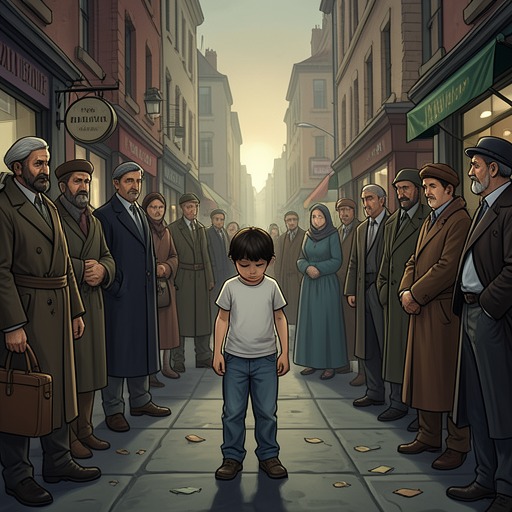
Lake Shore Park racial-exclusion rule
The Bluest EyeThe Lake Shore Park racial-exclusion rule barred Black people from entering a public park whose welcoming landscape was presented as belonging to white families. The prohibition makes segregation concrete: a place designed for recreation becomes inaccessible to Black residents, and its exclusion shapes both what they may do and what they can imagine.
The Park and Its Restriction
Lake Shore Park is described as a city park furnished with rosebuds, fountains, bowling greens, and picnic tables. It lies in a part of town where the sky is blue, away from the orange-patched sky above the steel-mill section. Though empty at the moment the sisters pass it, the park seems reserved for clean, well-behaved white children and their parents, who would play there in summer and run down the slope to the lake.
That anticipated scene is bounded by an explicit rule: Black people are not allowed in the park. The exclusion is not presented as a misunderstanding or a temporary inconvenience, but as a restriction on who may use a public space. The carefully tended setting and its imagined family leisure expose the racial boundary beneath the park’s apparent welcome.
Access, Visibility, and Everyday Segregation
The rule belongs to a broader pattern in which racial hierarchy operates through ordinary encounters as well as formal limits on access. At a store, Pecola brings three pennies to the counter, but the white immigrant shopkeeper’s gaze withdraws from her; he does not see her as someone worth the effort of a glance. The park’s ban and the shopkeeper’s failure of recognition differ in form, yet both make Black presence subject to exclusion: one bars entry, while the other denies meaningful acknowledgment.
School offers a contrasting example of how racialized treatment distributes ease and approval. When Maureen Peal is called on, teachers smile encouragingly, and other children do not subject her to the hostility directed at some Black pupils. The contrast underscores that access and regard are not shared evenly within the same town or school. The park’s restriction is part of a social order in which race shapes who is welcomed, protected, and treated as visible.
Consequences for Childhood and Belonging
Because Black residents cannot enter Lake Shore Park, the sisters encounter it as a forbidden place whose pleasures remain out of reach. The park nevertheless fills their dreams. Its exclusion therefore has a consequence beyond physical access: the idealized summer scene becomes something they can picture but cannot freely inhabit.
This denied space echoes other pressures on Black childhood in the novel. Junior’s mother forbids him to play with Black children and teaches him a racial distinction between “colored people” and “niggers.” Elsewhere, Pecola’s experience of school includes a reference to having blue eyes, linking the desire for acceptance to a racialized ideal of beauty. Together, these details show how segregation reaches beyond park gates into children’s relationships, social standing, and sense of what might make them welcome.
Significance
Lake Shore Park condenses structural inequality into a visible boundary around a place of recreation. The park’s flowers, water, and family leisure do not make it universally public: the rule reserves its pleasures for white people while excluding Black residents. By placing that restriction beside less formal acts of racial disregard and distinctions among children, the narrative presents segregation as both institutional and everyday, shaping not only where people may go but also the futures and forms of belonging they are encouraged to imagine.