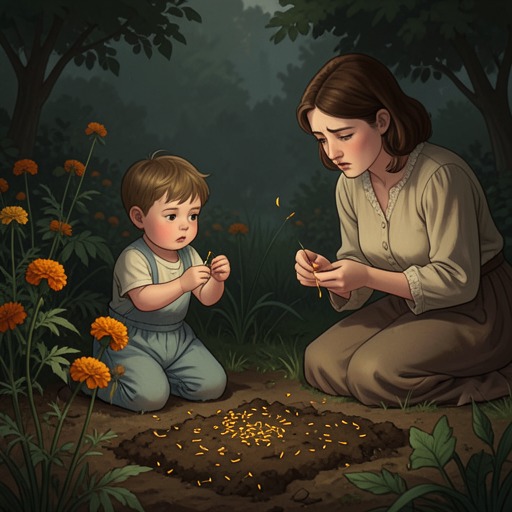
Marigolds and barren soil
The Bluest EyeMarigolds and barren soil is the novel’s recurring image of hoped-for growth thwarted by the conditions in which it is planted. The seeds Claudia and Frieda receive and plant become a measure of the community’s failure around Pecola: when nothing grows, the girls first look for an explanation in the earth, but Claudia’s final reflection recognizes that their own hopes and actions were implicated too.
The planting and its promise
The girls’ planting begins with anticipation. By summer, Claudia and Frieda have received the seeds they had waited for since April, in packets they are to sell for five cents each. The seeds arrive as part of an ordinary childhood undertaking, but the narration gives their planting a wider charge: the girls hope for a living result, while the seasonal passage of time makes the garden a measure of what their small efforts can and cannot change.
The summer image of a slim young girl in a pink crepe dress, one hand on her hip and the other hanging loosely at her thigh, carries the same suspended quality of promise. The figure appears amid the narrator’s reflections on storms and summer, before the account returns to the seeds. In that movement, seasonal abundance and expectation stand beside the uncertainty of what the earth will sustain; nature is not simply a backdrop for the girls’ feelings, but the medium through which the novel tests their hope.
The failed growth
The marigold project ends without the growth the girls had anticipated. At the conclusion, Claudia remembers explaining the failure as a matter of planting the seeds too deeply, then shifting blame to the earth, the land, and the town. The sequence matters: an initially practical explanation widens into an accusation against the conditions of their home, but it also lets the children evade their own part in what happened.
Claudia’s account does not establish that the girls’ gardening caused Pecola’s fate. Instead, it places the failed planting alongside the community’s failure to defend her, making the absent flowers an image through which the narrator examines the limits of childhood action and the consequences of collective neglect. The earth’s barrenness is not offered as a simple, independent cause; it becomes part of a network of explanations that includes human choices and the social world in which the girls live.
Pecola and the community’s responsibility
The image sharpens when the adult narrator remembers seeing Pecola searching through garbage. The question of what Pecola might be looking for leads Claudia to name the thing the community had destroyed. The seeds’ failure and Pecola’s suffering are linked through this belated recognition: the narrator can no longer treat the garden’s outcome as an isolated disappointment, or the girl’s condition as a misfortune for which no one is answerable.
The same closing reflection describes a community that, when the land destroys something, accepts the result and says the victim had no right to live. Claudia explicitly calls that judgment wrong, even as she acknowledges that recognizing the wrong does not undo it. Her final insistence that it is much too late locates the loss in a particular town and at its edge, among garbage and sunflowers. The setting binds neglect to place: what the community would rather explain away has taken root in the conditions of its own life.
Meaning and narrative function
The marigolds give the novel a material image for a failure that cannot be reduced either to bad soil or to the girls’ gardening technique. The barren result invites easy displacement of blame, first onto the earth and then onto the town, while Claudia’s retrospective voice brings the explanation back to the people who lived there. Nature carries narrative weight, but it does not absolve the human community: the land’s failure and the social failure are held in the same closing account.
The image also exposes the limits of the girls’ early perspective. Claudia remembers that they had learned to defend themselves and to treat speech as a code, gestures as things to scrutinize. Yet retrospective understanding changes the meaning of that vigilance: seeing Pecola and knowing the community did not protect her is different from having been able to intervene. The seeds thus frame the distance between childhood hope and adult recognition, and the painful difference between explaining a loss and accepting responsibility for it.