Maureen Peal and Pecola Breedlove
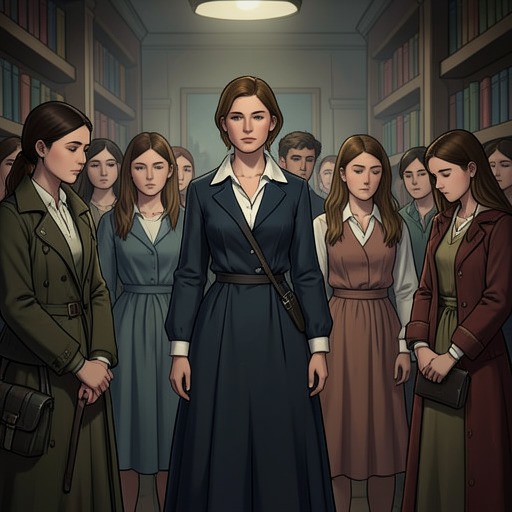
The Bluest EyeMaureen Peal and Pecola Breedlove’s short-lived connection at school turns a friendly introduction into a defining encounter with racialized beauty and social comparison. Maureen first draws Pecola close, but her later taunts make the friendship a vehicle for shame: Pecola is left looking after Maureen as she runs away, while the girls who remain absorb the ranking her words impose.
Introduction and Social Contrast
Maureen enters the school year as a conspicuous disruption to the children’s accustomed routine. She is described as a high-yellow girl with long brown hair in two braids, and as rich by the neighborhood children’s standards. Her appearance and money make her stand apart before she has said much. Against her, Pecola is already isolated at school: she wonders at length about the ugliness she believes makes teachers and classmates ignore or despise her, and she sits alone at a double desk. Their first encounter therefore brings together a girl whose appearance and status attract attention and one who has learned to understand herself through others’ rejection.
At first Maureen seems to close that distance. After the children have been talking about a near-fight, she puts her arm through Pecola’s and behaves as though they are close friends. She introduces herself and asks Pecola’s name. When the name reminds her of a character in the film Imitation of Life, Maureen explains that the character is a mixed-race girl who hates her black mother and later cries at her funeral. She remembers the character as pretty and says she intends to see the film again. Pecola answers quietly, while Maureen’s comparison brings the idea of beauty into their conversation at the very moment their acquaintance seems to offer Pecola inclusion.
From Familiarity to Humiliation
The change in their interaction comes through a question Maureen asks Pecola: whether she has ever seen a naked man. Pecola blinks, looks away, and asks where she would have seen one. The question shifts their exchange from friendly curiosity to a subject that makes Pecola uncomfortable. When Claudia challenges Maureen, the argument turns toward whether Pecola has seen her father naked. Pecola cries out that she has not; Maureen insists otherwise and invokes what Bay Boy said. The accusation places a private family matter before the other children and makes Pecola’s denial part of a public quarrel.
Maureen ends the encounter by running across the street against traffic. Once safely on the other side, she shouts that she is cute and that the others are ugly and black. The declaration makes the comparison explicit: her claim to attractiveness depends on degrading the girls she has left behind. Pecola stands apart, her eyes fixed in the direction Maureen has gone, and seems to fold into herself. Her posture registers the injury without answering it; the attention that had briefly made her Maureen’s companion has become a spectacle of rejection.
Consequences for Pecola and the Group
Maureen’s words do not wound Pecola alone. As the girls walk on, the group slows, and Claudia’s narration acknowledges that they are sinking under the perceived wisdom and relevance of Maureen’s insult. If Maureen is cute, they reason, then they are not; the conclusion turns one girl’s boast into a judgment on all of them. Her wealth and appearance had already marked her as different, but the quarrel gives that difference a sharper social meaning, setting her claimed beauty against the Black girls’ sense of being lesser.
For Pecola, the episode compounds an isolation that predates Maureen’s arrival. She already tries to discover in the mirror the source of the ugliness she associates with being ignored or despised at school. After Maureen’s departure, Pecola’s silence and withdrawal show how readily the group’s judgments settle on her. The scene does not make Maureen the source of every rejection Pecola experiences; instead, it shows a moment when an existing hierarchy is spoken aloud and becomes harder for the children to dismiss.
Narrative and Thematic Significance
The encounter’s force lies in its reversal. Maureen first offers the appearance of friendship by linking arms with Pecola; soon afterward, she uses a claim of beauty to cast Pecola and the others as ugly and Black. Her initial attention appears to welcome Pecola into companionship, but the later confrontation reveals how unstable that welcome is when social standing and appearance become grounds for comparison.
Claudia’s recollection extends the episode beyond a quarrel between schoolchildren. The girls do not simply reject Maureen’s judgment; they recognize its power and begin to apply it to themselves. The scene thus connects Pecola’s personal shame to a collective encounter with racialized standards of attractiveness. Maureen’s abrupt exit leaves no reconciliation, while Pecola’s averted future-facing gaze and the group’s newly unsettled walk preserve the encounter as a lasting measure of how beauty can be made into a hierarchy among children.