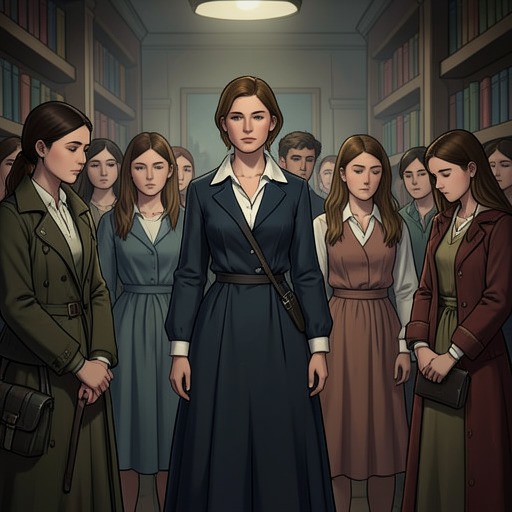
Maureen Peal insults Pecola and breaks with the MacTeer sisters
The Bluest EyeMaureen Peal insults Pecola and breaks with the MacTeer sisters in a schoolyard confrontation that converts a personal question into a racialized contest over beauty and belonging. Maureen’s attack exposes the instability beneath her favored status: she has been welcomed by classmates and teachers, but now uses that status to humiliate Pecola and distinguish herself from the Black girls around her.
Background and Setting
Maureen’s arrival at school had already unsettled the MacTeer sisters’ familiar routines. Described as rich by their standards, with long brown hair, green eyes, and a complexion that seemed to evoke summer, she enchanted the school. Teachers smiled when they called on her, and the ordinary hostility directed at other children seemed to pass her by. Her reception establishes the privilege she carries into the later confrontation: she is not simply a new classmate but a girl whose looks, money, and social welcome set her apart.
The encounter unfolds against a wider pattern in which racialized appearance governs who is treated as visible or worthy. Pecola’s experience at a store, where the white shopkeeper’s gaze retreats and fails to recognize her, provides a stark counterpoint to the attention Maureen receives at school. The contrast clarifies why Maureen’s claim to be cute is more than a personal boast: the girls are navigating a hierarchy that makes appearance and race consequential in ordinary encounters.
The Confrontation
Maureen turns to Pecola with a question about whether she has ever seen a naked man. Pecola answers that she has not and asks where she would have seen one. Maureen then directs the subject toward Pecola’s father. When Claudia challenges her, Maureen insists that she was speaking to Pecola, not Claudia. The exchange makes Pecola’s family life a weapon in an argument she did not initiate.
Pecola emphatically denies having seen her father naked. Maureen counters that Bay Boy said otherwise, and the two girls repeat their opposing claims. Pecola’s shoulders hunch and her neck draws inward as if she wants to cover her ears. Claudia tells Maureen to stop talking about Pecola’s father. The bodily withdrawal marks the cost of the exchange before the confrontation turns openly hostile: Pecola is made the subject of the girls’ dispute while trying to retreat from it.
Maureen asks Claudia what she cares about Pecola’s father and calls him an old Black man. Claudia answers by challenging Maureen’s own identification as Black. Claudia swings at her but misses and hits Pecola in the face instead. Angered by the mistake, she throws her notebook; it catches Pecola in the back as Pecola turns and runs across the street against traffic. Claudia’s defense therefore compounds Pecola’s hurt, even though Pecola was the person she meant to protect.
Insult, Separation, and Aftermath
Once across the street, Maureen shouts that she is cute and the others are ugly. Her declaration converts the dispute into a direct ranking of the girls’ appearances. She runs off, leaving Claudia and Frieda facing her rejection, while Pecola stands apart with her eyes fixed in the direction Maureen fled. She seems to fold inward, and her pain provokes Claudia’s anger. The scene ends not with reconciliation but with distance: Maureen has broken with the sisters, and Pecola is left carrying the humiliation and the unintended blows.
Narrative Significance
The episode shows how racial and appearance-based status can be reproduced within a conflict among Black girls. Maureen has benefited from being treated as exceptional at school; when challenged, she turns that distinction into an insult directed at the others. Her claim to cuteness invokes the same beauty hierarchy that makes Pecola vulnerable, but the passage does not make Maureen’s privilege equivalent to the deeper rejection Pecola experiences elsewhere.
Claudia’s failed attempt to defend Pecola complicates the scene’s moral shape. Her intervention recognizes that Maureen is using Pecola’s father to shame her, yet the missed swing lands on the person Claudia means to protect. The mistake, followed by Pecola’s withdrawal, makes solidarity present but imperfect: resistance does not prevent harm, and anger at the aggressor can be displaced onto the more vulnerable girl. The confrontation thus leaves the sisters’ friendship with Maureen ruptured while making Pecola’s isolation more visible.