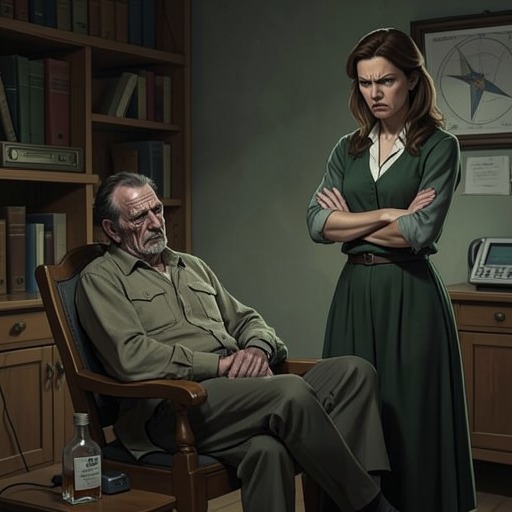
Pauline and Cholly's abusive marriage
The Bluest EyePauline and Cholly's abusive marriage is a bond in which violence and occasional tenderness coexist, while alcohol, poverty, and coercion narrow Pauline’s choices. Pauline remembers nearly leaving after Cholly tried to set their house on fire, yet staying without being able to recall what held her. Later, she describes a marriage in which his drunken assaults have made intimacy something she endures rather than welcomes; after his absence, children mistake the visible residue of attachment for evidence that the violence was not real.
Identity and Background
The marriage is presented through fragments of Pauline’s recollection and through the children’s later attempts to interpret it. Rather than offering a sustained account of how the couple came together or a complete chronology, the narrative makes the relationship legible through its domestic consequences: a threatened house fire, money taken from Pauline’s pocketbook, drunkenness, beatings, and sexual coercion. Its instability belongs to the same impoverished household in which food and domestic provisions have to be carefully preserved and stored. Such conditions form part of the marriage’s environment, but they do not explain away the violence within it.
Pauline’s recollections resist a simple account of the marriage as uniformly bad. She says that Cholly “sure ain't give me much of a life,” then immediately acknowledges that some things were not always bad. This qualification matters: her memory does not erase harm, but neither does it reduce the relationship to a single, uncomplicated judgment. The contrast between her recognitions—what Cholly did to her and what could still draw her toward him—gives the marriage its painful complexity.
Violence and the Possibility of Leaving
Pauline remembers one moment when she was resolved to leave: Cholly had tried to set the house on fire, and she was “all set in my mind to go.” The plan did not become departure. She cannot remember what stopped her, and she does not suggest that Cholly gave her a good life or that the danger was imaginary. The gap between the resolve to leave and remaining is itself part of the account: the decision to escape is clear, while the force that prevented it is not.
Her description of their domestic life also includes a smaller, telling breach of trust. Cholly sometimes came into bed not too drunk, while Pauline pretended to be asleep because he had taken three dollars from her pocketbook that morning. Intimacy is already entangled with vigilance and material injury: even when he approaches her bed, she measures the encounter against what he has taken. The detail gives the marriage’s hardship a specific scale, down to money missing from her pocket, without making poverty a justification for his conduct.
Coercion and Unequal Intimacy
Pauline’s later account marks a sharp change in what the marriage means to her. It is “not like that anymore”: most of the time, Cholly is thrashing against her before she wakes and continues after she is awake. At other times, she cannot bear to be next to him when he is drunk. Her words distinguish forced sexual access from the rare earlier moments when she describes lying beside him, and they make clear that his actions are not mutual intimacy.
Pauline says she no longer cares about the situation and places her hope in her Maker’s protection. That appeal does not turn the abuse into a chosen or acceptable condition; it shows the spiritual language through which she endures a life she describes as having offered her little. Her repeated assurance that her Maker will take care of her sits beside her insistence that earthly circumstances no longer make a difference, suggesting resignation rather than safety or reconciliation.
How the Children Interpret the Marriage
After Cholly is gone, the children observe that Pauline seems not to feel well and speculate that she probably misses him. They immediately question why she would miss a man who got drunk and beat her. Their conversation exposes how visible attachment can be mistaken for consent: one child argues that if Pauline did not love him, she would not have let him do it so often. Another insists that she did not like it and explains that Cholly made her endure it.
The exchange does not show the children possessing a full understanding of the marriage. They move between assumptions about love, blame, and force, asking how anyone could make another person do something like that before accepting that he could. The episode reveals the social afterlife of domestic abuse: the children have witnessed the violence, yet still have to reason their way toward recognizing coercion. Their account makes the marriage’s central contradiction visible without treating Pauline’s endurance as proof that she welcomed the harm.
Aftermath and Narrative Significance
The marriage leaves its effects in a household and community where hardship is not confined to one private relationship. Pauline’s recollections disclose the gap between wanting to leave and staying, while the children’s later discussion shows how that gap can be misread from outside as evidence of love or permission. Cholly’s absence does not settle the meaning of the marriage; instead, it prompts the children to confront what they saw and what they had not understood.
Through this divided perspective, the relationship is rendered neither as a simple story of affection nor as an abstraction called abuse. Specific acts—the attempted house fire, the missing three dollars, the drunken beatings, and the forced sexual encounters—give substance to Pauline’s account. The children’s questions then expose the consequences of confusing survival with consent. The marriage’s defining condition is not that tenderness and violence are interchangeable, but that intermittent attachment and material constraint coexist with harm, making the harm harder for both Pauline and those around her to name.