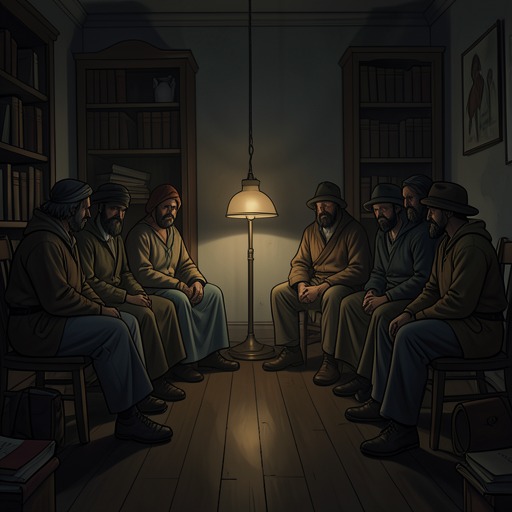
Quiet as it's kept
The Bluest Eye“Quiet as it's kept” is both the opening phrase of the novel and a statement of its narrative predicament. It sounds like the beginning of confidential neighborhood talk, but its secrecy is double-edged: the story is being told, even as some of what it means remains withheld. The phrase frames the book as an act of disclosure that implicates the teller, the community, and the reader in what is made known and what is kept quiet.
Opening and Narrative Function
The phrase opens a story in which the absence of marigolds in fall 1941 is linked, in the children’s understanding, to Pecola’s pregnancy by her father. The opening does not begin with an impersonal explanation of events. Instead, it adopts the sound of someone confiding a story to others, placing the reader within the charged intimacy of shared talk before revealing the devastation at its center.
That choice makes the phrase more than a stylistic flourish. It establishes a voice that can sound familiar and communal while introducing material that is private, painful, and difficult to tell. The story’s beginning thus makes disclosure part of the subject: the reader is being entrusted with knowledge, but not offered the illusion that every silence has been resolved.
Gossip, Confidence, and Withheld Knowledge
The phrase recalls women talking among themselves about someone or something within their circle—the family or neighborhood. Its implied message is conspiratorial: this is a confidence, something not meant for everyone to know. Yet the confidence is not simply kept. The words also announce that a secret is being shared with the listener, who is drawn into a conversation that has boundaries even as it crosses them.
This double movement—holding a secret and revealing it—is essential to the phrase’s effect. The confidence is exposed and sustained at once. The reader receives the story as an intimate disclosure but is also made aware that the knowledge has been shaped by limits: some things are shared, while others remain hidden from the people within the community or from those outside it.
Writing as Disclosure
The novel’s account of the phrase describes writing the book as a public exposure of private confidence. That formulation turns the opening into a compact description of the act of narration itself. What begins in the register of neighborhood talk becomes a written disclosure, carrying private knowledge beyond the circle in which such talk would ordinarily circulate.
The disclosure is not presented as simple transparency. The phrase identifies secrets shared by a collective voice and secrets withheld from that voice, whether by the community itself or by the world beyond it. Its implication is therefore not that telling makes every hidden fact available, but that narration has to confront the uneven distribution of knowledge: who can speak, what can be confessed, and what remains concealed even as the story is made public.
A Written Voice and the Reader’s Position
The expression is described as deliberately speakerly: although it is written, it is chosen for how it sounds like speech. This oral quality gives the narrative the texture of a voice addressing a listener, not merely a sequence of events recounted from a distance. The reader occupies the position of someone included in the confidence, and that inclusion carries responsibility as well as intimacy.
The phrase consequently establishes a form of narrative complicity. To hear the story is to enter a relation with what the community has told, withheld, or failed to protect. Its opening promise of confidential talk cannot make the underlying pain harmless; instead, the gap between secrecy and exposure shapes how that pain is encountered. “Quiet as it's kept” names the tension the book asks its reader to sustain: the story must be told, yet the telling cannot erase the silences and exclusions bound up with it.