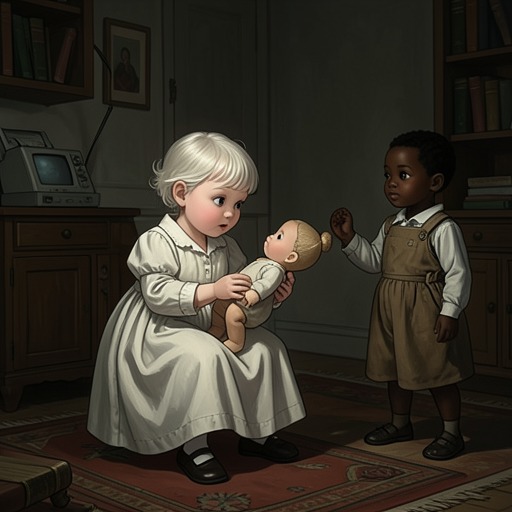
See Jane
The Bluest Eye“See Jane” is the recurring primer language through which The Bluest Eye sets an idealized family scene against the violence and fracture of the story it frames. Its images of a strong, smiling father, a playful dog, and a friend who will play with Jane begin as a promise of ordinary domestic happiness; repeated in increasingly compressed form, they become a formal counterpoint to the damage the narrative reveals.
The Primer’s Ideal Family
The refrain presents domestic life as easy to recognize and repeat: Jane can play, the dog can run, and the father is “big and strong” and smiling. In one passage the primer’s words run together without spaces, turning a legible lesson into a continuous verbal block. The image remains reassuring, but the form makes its composure harder to sustain: the reader encounters the ideal not as a naturally whole scene but as language pressed together until its divisions disappear.
The father-and-daughter sequence associates paternal strength with smiling and play. The primer offers no conflict or uncertainty; family affection appears as a settled fact, expressed in simple statements and familiar roles. That clarity matters because the book places the refrain alongside a story in which childhood and family life cannot be secured by such formulas. The primer’s confidence becomes a measure of the distance between a socially circulated ideal and the realities represented around it.
Repetition and Formal Change
The refrain returns in several variants. One repeats the father’s strength and smile; another gives way to a dog who barks and runs, followed by the invitation to play with Jane. Later, a friend arrives and will play with her. Each version keeps the same elementary pattern—look, identify, play—while shifting the people and actions placed inside it. Repetition makes the primer’s language recognizable, but its recurrence also draws attention to what changes around it.
The typography registers that tension. The primer passages appear as unspaced capital letters, unlike the surrounding prose. Their visual compression makes reading momentarily difficult: words that teach a child to distinguish people, actions, and relationships lose the spaces that make those distinctions clear. The device does not simply reproduce a children’s reading exercise; it makes the exercise’s neatness feel strained, as though the formula cannot comfortably contain the story beside it.
Contrast with the Story’s Violence
The father’s smile and the invitation to play carry a sharp countermeaning when set against the narrative’s account of Cholly’s childhood. When he was four days old, his mother wrapped him in two blankets and one newspaper and placed him on a junk heap. The primer’s secure father-child picture therefore stands in marked contrast to a history beginning with abandonment. Its promise of protection is not universal or self-fulfilling; the phrase “big and strong” belongs to an idealized lesson, while the story supplies a particular childhood without that shelter.
The dog-and-play version also appears beside a passage in which Pecola is under a heavy quilt, trying to connect the pain between her legs with the face of her mother looming over her. The cheerful invitation to play does not explain or soften that scene. Its placement instead makes the gap between childhood as the primer imagines it and childhood as the narrative depicts it especially stark: the simple command to look and play shares the page with pain that cannot be resolved by a simple lesson.
Framing and Significance
Across its appearances, “See Jane” functions as more than a quoted model of beginner reading. Its repeated clauses and substitutions give the book a frame against which family, childhood, and safety can be measured. The recurring pattern promises that people and relationships will be plainly visible and orderly; the surrounding narrative repeatedly unsettles that promise through abandonment, violence, and suffering.
The sequence also makes the reader experience the strain formally. The words remain familiar, yet their unspaced presentation resists the effortless clarity they are supposed to teach. Repetition preserves the ideal while exposing its insufficiency: Jane’s world of smiling fathers, running dogs, and companions at play continues to be recited, but it cannot account for the histories and injuries set beside it.