Bingfa Zhi Dao
The Book of Five RingsThe Way of Strategy is the governing discipline of Miyamoto Musashi’s teaching: a practical method for overcoming opponents that links individual combat, the command of troops, and the wider work of rule. It is not merely a collection of sword techniques. Its central demand is to train until judgment becomes embodied and adaptable—to read an opponent, choose the moment, and act without being trapped by a fixed form.
Meaning and Scope
Strategy is presented as the warrior’s craft, one that commanders must enact and troopers must understand. Musashi distinguishes it from the many other Ways, including religious teaching, learning, medicine, poetry, tea, archery, and other arts. The warrior’s Way is twofold: pen and sword. Even someone without natural ability may become a warrior by assiduously pursuing both, though the defining purpose of strategy is martial victory and the power or distinction that victory can bring to oneself or one’s lord.
Musashi calls the Way a discipline of resolute acceptance of death, but distinguishes the warrior’s relation to death from the readiness with which people in other stations may die from duty or shame. Strategy is specifically grounded in overcoming men: victory in a contest between individuals and success in battle against large numbers are related expressions of its purpose. The distinction matters because the book does not treat combat as a metaphor detached from its consequences; it sets the study of strategy within the struggle for survival, victory, and service.
The Way is also broader than the sword-fencing that Musashi associates with many contemporary practitioners who call themselves strategists. His account joins close combat to large-scale command, and later describes strategy as a means by which a superior person can manage subordinates, govern a country, foster its people, and preserve a ruler’s discipline. Individual technique is therefore an entry point into a general capacity for judgment and action, not the final measure of the art.
The Five-Book Structure and Training
The book presents the Way through five books: Ground, Water, Fire, Wind, and Void. The Ground book lays out the structure of the method, from its smallest details to its largest principles, like a road mapped on firm ground. Water represents adaptability: it changes shape according to its receptacle, ranging from a trickle to a wild sea. The Fire book concerns fighting; the Wind book examines the traditions of other schools; and the Void addresses the illusory nature of worldly things. Together, the books place practical instruction within a larger account of how strategy is understood and practiced.
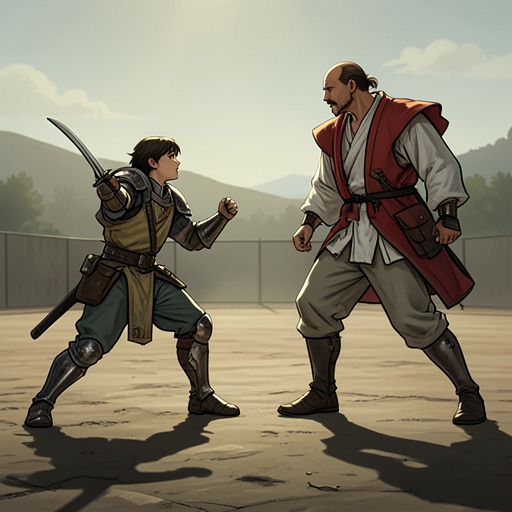
The structure carries a principle of scale. Musashi argues that learning to defeat one person can teach the strategist how to defeat many, just as a great Buddha can be made from a one-foot model. This does not mean that large-scale command is simply a duel enlarged without change: the strategist must learn to understand an opponent’s strategy, strength, and resources, then apply the principles gained through individual practice to much larger forces. The movement from the small to the great is a trained transfer of understanding.
Training is the condition that makes that transfer possible. Musashi says that practice day and night broadens the spirit and propagates both large-scale strategy and hand-to-hand combat. The nine principles begin with honesty of thought and the Way’s dependence on training, and conclude by directing the student to attend even to trifles and to do nothing useless. The principles are not offered as a substitute for practice: they are broad commitments that must be set in the heart and tested through persistent work.
Musashi describes the results in escalating terms. A student who earnestly adheres to strategy may learn to win fights, to prevail through the eye, to control the body, and to overcome opponents through spirit. He claims that sufficient training can enable victory even against twenty or thirty enemies, and that a strategist may come to beat ten men with spirit. In large-scale strategy, the corresponding achievement is the dexterous management of many subordinates. The claims connect personal mastery to command, while making sustained training—not natural talent alone—the means by which either is approached.
The Body as a Method of Judgment
The practical method begins with the body. Musashi instructs the student to keep the head erect, the face composed, and the neck straight; to lower the shoulders, brace the abdomen, and put strength through the legs to the toes. The companion sword is wedged in the belt against the abdomen so the belt does not slacken. This is not an isolated fighting pose: everyday stance should become combat stance, so that ordinary bearing and readiness in battle do not become separate habits.
The gaze likewise trains judgment as well as vision. Musashi calls its two aspects Perception and Sight, with perception strong and sight weak, and asks the strategist to see distant things as if close and close things from a distance. Attention should not be captured by insignificant movements of an opponent’s sword; the student must be able to look to both sides without moving the eyeballs. The same gaze applies in single combat and large-scale strategy, joining immediate observation to a wider view of the situation.
Weapon handling and footwork follow the same refusal of dead form. The long sword is held with a comparatively floating feeling in the thumb and forefinger, the middle finger neither tight nor slack, and the last two fingers tight. The hands must not have play, but neither should the grip become fixed: a fixed hand is dead, while pliability is living. The grip remains intent on cutting, with a slight change in the thumb and forefinger when the sword is used to dash aside, ward off, or force down an opponent’s blade.
The feet should move as in normal walking, whether the steps are quick or slow, large or small. The toes are somewhat floating while the heels tread firmly. Musashi rejects jumping-foot, floating-foot, and fixed-steps, and emphasizes Yin-Yang foot: the practitioner must not move only one foot, but alternate left and right when cutting, withdrawing, or warding off a cut. These instructions make movement continuous and responsive rather than dependent on a single favored step.
Close combat extends this principle into bodily contact. In Glue and Lacquer Emulsion Body, the fighter sticks to the opponent with head, body, and legs, leaving no gap; Musashi warns that people often advance the head and legs while allowing the body to lag behind. In the Body Strike, the fighter enters through a gap in the guard, turns the face slightly aside, and drives the left shoulder into the opponent’s breast, timing the force with the breath. The stated consequence is a blow capable of knocking an opponent ten or twenty feet away, and, if pursued, of striking until the enemy is dead. The examples show strategy as coordinated perception, posture, timing, and force—not dexterity isolated in the hands.
Perception, Timing, and Scale
Musashi contrasts his method with narrow training in small techniques. He criticizes a focus on fingertip dexterity, a contest decided by the limited reach of the forearms, or the practice of minor hand and leg movements with a bamboo sword. Such skills do not suffice when a person fights for life in full armour. His alternative is repeated contests and serious study of survival, the meaning of life and death, the strength of attacks, and the edge and ridge of the sword.
The scale of that training is both practical and conceptual. Musashi calls his method a sure way to win when fighting one against five or ten, and asks the student to consider the principle that one man’s ability to defeat ten corresponds to a thousand men’s ability to defeat ten thousand. He acknowledges that no one can assemble a thousand or ten thousand opponents for everyday practice. Instead, training alone with a sword can cultivate an understanding of an enemy’s strategy, strength, and resources, enabling the practitioner to grasp how strategy applies against many. The individual exercise is valuable because it develops transferable judgment, not because it reproduces the numbers of a battlefield.
Timing is the hinge between knowledge and action. Musashi says that all five books are chiefly concerned with timing. The strategist must learn the opponent’s disposition in battle: whether the enemy’s spirit is flourishing or waning, where the best position lies, and how the enemy’s condition should determine the movement of one’s own men. In a duel, the fighter first recognizes the other school, judges its quality and strengths and weaknesses, and then attacks at an unsuspected moment, guided by the opponent’s rhythm and modulation. Knowing the times means more than noticing a passing opening; it means understanding intentions well enough to find opportunities to win.
This attention to circumstance explains why the method is not reducible to a fixed catalogue of maneuvers. The student must see broadly, remain physically ready, and adapt the action to the opponent’s condition. Perception identifies what matters; training makes the body capable of responding; timing chooses when to act. At every scale, victory depends on bringing these capacities together rather than confusing a particular technique with the Way itself.
Other Schools and the Way’s Transmission
The Wind Book places the Ichi school in relation to other traditions. Musashi describes schools that specialize in unusually long swords, those that teach the short sword called kodachi, and those that multiply sword techniques or divide attitudes into a visible surface and a concealed interior. He argues that understanding other schools is necessary to recognize the essence of his own, but does not name particular schools or their leading doctrines. Their branches interpret teachings differently, he observes, so one person’s account cannot stand as the valid conception of every school.
His criticism is directed at attachment to preference and technique. Practitioners tend to favor long swords or short swords and to concentrate on strength in large or small matters; such preferences can turn a useful distinction into a constraint. In the Ichi school’s long-sword method, Musashi says, there is neither gate nor interior and no hidden meaning in sword attitudes. What matters is maintaining a true spirit and realizing the virtue of strategy. The Way’s authority is thus presented as practical and tested, rather than secured by secrecy or by a school’s claims about its doctrines.
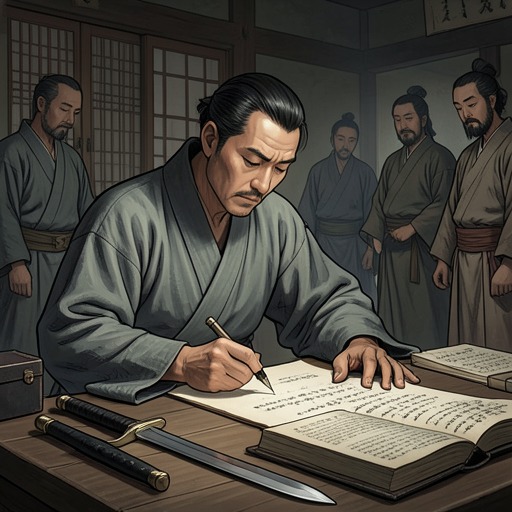
Musashi also rejects passing on the Way through written pledges and regulations. He says he teaches according to the perceived ability of his pupils, removes the harmful influence of other schools, and gradually introduces them to the true Way of the warrior, using a trustworthy spirit. This account makes instruction responsive to the learner, even as the book itself records an outline for study. His final insistence is diligence in training: the written account can identify tendencies and principles, but the Way must be realized through practice.