Companion sword
The Book of Five RingsThe Companion sword is the shorter sword carried at a warrior’s belt, but in the Ichi school’s strategy it is more than a backup to the long sword. Its distinct value emerges at close range and in confined spaces, while training with it belongs to a broader method that treats both hands, the whole body, and the circumstances of combat as parts of one adaptable practice.
Place in the Warrior’s Equipment
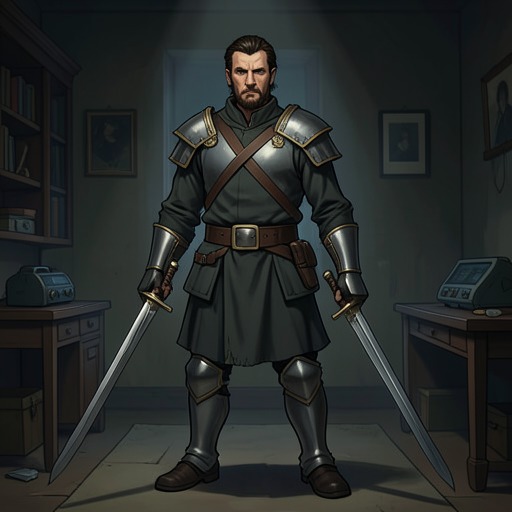
The text describes warriors, whether commanders or troopers, as carrying two swords at the belt: what had formerly been called the long sword and the sword, and what in the author’s time were known as the sword and the Companion sword. This paired equipment is presented as the customary Way of the warrior. The distinction between the two weapons matters, but neither is defined as simply dispensable: the Ichi school’s name and method point to the advantages of using both.
The Companion sword also figures in the recommended combat stance. The practitioner wedges it against the abdomen in the belt, tightening the belt rather than leaving it slack. This detail places the weapon within a complete bodily arrangement: stance is not an abstract pose, but a practiced readiness in which equipment is secured and the body held under control.
Use, Range, and Circumstance
The clearest tactical distinction is one of distance and setting. The Companion sword is best used in a confined space or when engaged closely with an opponent; the long sword, by contrast, can be used effectively in all situations. This is not a claim that the shorter weapon is universally superior at close quarters or that it replaces the long sword, but a practical allocation of weapons according to the conditions of an encounter.
The same attention to circumstance governs the advice to wield the long sword in one hand. Holding it in both hands restricts movement to the left and right and can be encumbering on horseback, on uneven roads, swampy ground, muddy rice fields, stony ground, or amid a crowd. A free hand may also be needed for a bow, spear, or other arms. Training with two long swords, one in each hand, makes one-handed use possible; when cutting down an enemy with one hand is difficult, both hands may still be used. The Companion sword thus belongs to a practical account of how a warrior manages weapons and movement, not to a rigid rule that every encounter must be fought in the same fashion.
The school distinguishes the weapons’ manner of use as well: the long sword should be wielded broadly, while the Companion sword should be used closely. This contrast gives the paired method a spatial logic. One weapon works at greater reach and in a wider action; the other is suited to proximity, where the space for broad movement narrows.
Training and the Two-Sword Method
The author recommends learning the sword in either hand from the beginning. A student may initially find one-handed use difficult, just as drawing a bow or wielding a halberd is difficult before practice makes the action familiar. Repeated training changes what the practitioner can do: as skill with the long sword grows, its use in one hand becomes effective. The two-sword method is therefore both a combat practice and a way of training adaptability.
The text also connects two-sword use to fighting a crowd, especially when the aim is to take a prisoner. That circumstance gives the paired weapons a particular practical consequence: their value is not confined to a formal duel between two evenly matched opponents. More broadly, the Ichi school says victory is possible with a long weapon or a short one; its governing spirit is to win whatever the weapon and whatever its size. The Companion sword’s significance lies partly in how it contributes to that principle without becoming the sole instrument of it.
Weapon choice remains conditional. The spear can take the initiative on a battlefield, while the halberd is characterized as defensive; both have uses in the field, but neither is very beneficial in confined spaces or suitable for taking a prisoner. The Companion sword, by contrast, is specifically associated with close engagement and confined space. The comparison cautions against turning any single weapon’s preferred use into a universal strategy: the setting and the task determine what the weapon can do.
Strategy Beyond the Weapon
The Companion sword’s treatment reflects a larger distinction between technical specialization and strategy. The book warns that an exclusive focus on indoor techniques narrows a student’s thinking and can obstruct performance in actual encounters. Likewise, small feats of dexterity do not by themselves answer the demands of combat, particularly when full armour is worn. The weapon matters, but its usefulness depends on judgment about conditions, an opponent, and the scale of the problem.
That judgment extends from individual combat to large-scale strategy. The text argues that the principle by which one person can defeat ten can be understood in relation to a thousand defeating ten thousand, even though such numbers cannot be assembled for everyday training. A student can train alone with a sword, learn to understand an enemy’s strategy, strength, and resources, and develop the ability to apply strategic principles on a larger scale. The Companion sword is one concrete part of this system, not a self-contained answer to it.
In that system, awareness and bodily discipline are inseparable from equipment. The practitioner is instructed to hold the head erect, keep the features composed, lower the shoulders, brace the abdomen, and secure the Companion sword at the waist. The gaze should take in distant things as if close and close things from a distance, while resisting distraction by insignificant movements of an opponent’s sword. The stance and gaze are to be practiced in everyday life, so that ordinary posture becomes combat posture. Read together, these instructions make the Companion sword a material element in a continuous discipline of perception, movement, and readiness.
Place in the Book’s Argument
The book’s five-part structure sets out different aspects of the Way through the Ground, Water, Fire, Wind, and Void books. Its treatment of weapons belongs to a method that moves between concrete technique and general principle: the Companion sword has a specified range and practical use, while the broader teaching insists that strategy must adapt rather than become fixed in one weapon, technique, or school.
The Wind Book makes the importance of comparison explicit. Understanding other schools helps clarify the essence of the Ichi school, but the author declines to name particular schools or prescribe their inner doctrines, noting that branches interpret teachings differently and that no single person’s conception can stand for every school. The Ichi school itself is described as having neither a gate nor an interior, and no hidden meaning in sword attitudes; its requirement is a true spirit. Against that background, the Companion sword is significant not as the badge of a closed technical system, but as one instrument whose use is learned through disciplined attention to range, circumstances, and the purpose of victory.