Composition of The Book of Five Rings
The Book of Five RingsComposition of The Book of Five Rings is Miyamoto Musashi’s transformation of a lifetime of martial experience into a written account of strategy whose reach extends from the duel to the governance and command of a realm. Composed in 1645 at age sixty, the work presents not merely a sword method but a connected Way: practical judgment, disciplined study, leadership, and responsiveness to nature.
The act of composition
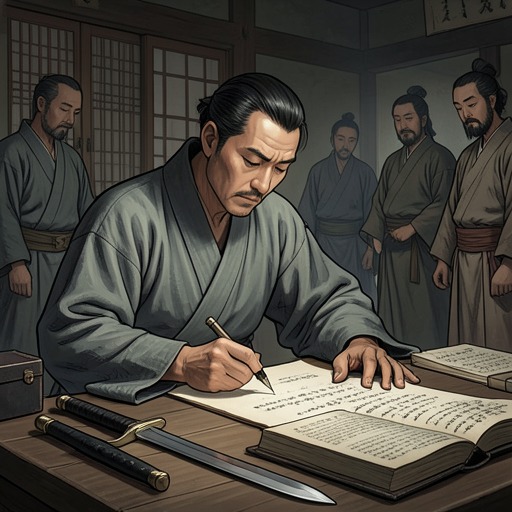
Miyamoto Musashi dates his writing to the first ten days of the tenth month in the twentieth year of the Kan’ei era. He locates the act on Mount Iwato in Higo Province, where he says he climbed to pay homage to heaven, pray to Kwannon, and kneel before Buddha. He identifies himself as a warrior from Harima Province, age sixty, whose heart had been inclined toward strategy since youth. The scene gives the book both a precise occasion and a declared standpoint: it is a veteran’s account, written after long practice rather than offered as an abstract system detached from experience.
The introduction turns backward over the life that the book distills. Musashi recounts defeating Arima Kihei in his first duel at thirteen, defeating Tadashima Akiyama at sixteen, and meeting strategists in the capital at twenty-one without losing. He says that, between thirteen and twenty-eight or twenty-nine, he fought as many as sixty encounters across different provinces and did not fail to win. Yet he refuses to treat that record as proof that he had already mastered strategy. Looking back at thirty, he considers natural ability, heaven’s ordering, or the inferiority of other schools as possible explanations for his earlier victories. The victories begin the story of his authority; his doubt about what they prove begins the intellectual work of the book.
Musashi says that he then searched morning and evening for the underlying principle and came to realize the Way of Strategy at fifty. Afterward, he says, he lived without following any particular Way and practiced many arts and abilities through strategy, without a teacher. He presents writing as another expression of that practice. Rather than grounding the account in the law of Buddha, Confucian teaching, old war chronicles, or books on martial tactics, he sets out to explain the spirit of his school as reflected in the Way of heaven and Kwannon.
A manual built as a whole
The work’s structure makes its claim to breadth visible. Musashi divides it into five books: Ground, Water, Fire, Wind, and Void. Ground lays out the foundation; Water presents the Ichi school’s methods through the long sword; Fire treats combat; Wind examines other traditions; and Void concerns what cannot be reduced to ordinary knowledge. The sequence moves from establishing a path, through methods and comparison, toward a principle that Musashi associates with nature and the limits of formal explanation.
The five-book arrangement also resists reducing strategy to sword-fencing. Musashi argues that the true Way is difficult to realize through technique alone and urges readers to understand small and large things, shallow and deep. In the Water book, he links the ability to defeat one person with the ability to defeat many: the strategist enlarges understanding from a small model to a great undertaking, and the principle is to know ten thousand things through one. The book therefore treats personal combat not as an isolated specialty but as a training ground for recognizing relations and applying principles at different scales.
That scaling is explicit in Musashi’s account of training. He says that small techniques offer little benefit in full armour, and contrasts narrow dexterity with the demands of a fight for survival. His strategy, he maintains, can serve a person fighting one against five or ten, while solitary sword training can teach the practitioner to assess an enemy’s strategy, strength, and resources and thereby understand how to contend with much larger forces. The leap from one fighter to armies is not presented as a matter of assembling equivalent practice numbers; it depends on learning to read the structure of opposition and apply judgment beyond the immediate contest.
From personal skill to command
Musashi places strategy within a social order of four Ways: those of the gentleman, farmer, artisan, and merchant. The farmer follows seasonal change; the merchant makes a living by putting ingredients to use and taking profit; the artisan becomes proficient with tools and carries out a measured plan. The warrior, in turn, must master the virtue of his weapons. Musashi argues that a warrior who dislikes strategy will fail to appreciate what weaponry is for, while also insisting that a man without natural ability can become a warrior through assiduous commitment to both divisions of the Way.
The carpenter becomes Musashi’s model for the strategist because carpentry joins a plan to the intelligent use of materials and people. A foreman must know natural rules, the rules of the country, and the rules of houses; the commander of a warrior house, he argues, faces a comparable task. In building, timber is assigned according to its qualities: good straight wood for exposed pillars, slightly flawed straight wood for inner pillars, attractive but weaker timber for thresholds and doors, and strong, knotted timber where it can be used discreetly. The analogy makes command an exercise in appraisal and allocation, not simply force. Like the carpenter whose joints must align and whose finished work must not be warped, the strategist must make separate parts cohere within a larger design.
At the scale of large strategy, the commander must manage subordinates deftly, conduct himself correctly, govern the country, foster the people, and preserve the ruler’s discipline. Victory is thus connected to responsibilities beyond defeating an opponent. Musashi frames strategy as a means to help oneself and gain honour, but also as a capacity to direct many people and sustain political order. This broadens the work’s central concern: the same strategic Way is tested in a duel, an army, and the exercise of rule.
Judgment, comparison, and instruction
A recurring concern of the book is the difference between display and genuine competence. Musashi criticizes practitioners who emphasize the visible flower of technique and seek profit through schools and performance while neglecting the underlying fruit. Against this narrowing, he defines the practical aim of strategy as defeating an enemy in a fight, but insists that such mastery requires more than decorative technique. His account of knowing the times makes that demand concrete: the strategist observes whether the enemy’s disposition is flourishing or waning, reads the spirit of the enemy’s men, seeks the better position, and moves accordingly. In a duel, the fighter must recognize an opponent’s school, quality, strengths, weaknesses, rhythm, and appropriate moment of attack.
The Wind book extends this discipline of judgment to rival schools. Musashi says that one cannot understand oneself fully without knowing others, so he records the general tendencies of other strategic traditions. He describes schools that favor extra-long swords, specialize in the short sword, or distinguish the surface of sword technique from an interior Way. He deliberately does not name the schools or assign particular doctrines to them: different branches interpret teachings differently, and no single person’s conception can stand for an entire school. Comparison is therefore used to sharpen discrimination, not to construct a catalogue that pretends every tradition is uniform.
His method of teaching follows the same practical emphasis. Musashi says he does not favor written pledges and regulations; he judges pupils’ abilities, teaches the direct Way, removes the bad influence of other schools, and gradually introduces them to the true Way of the warrior. He calls for a trustworthy spirit and diligent training. The book is consequently both an outline and an invitation to practice: its principles require sustained examination rather than loose reading, and its written form does not replace the work of instruction and training.
The Way and the Void
The final book brings the work’s practical and philosophical strands together. Musashi describes the void as what has no beginning or end and is not contained in human knowledge. He explains that by knowing what exists one may know what does not exist, and calls the Way of Strategy the Way of nature. To understand the power of nature is to recognize the rhythm of a situation so that action can follow naturally. The void is not offered as another collection of techniques; it names the point at which sound judgment is no longer bound by a fixed formula.
The surviving dating and signatures frame the work’s completion: the final notice gives the twelfth day of the fifth month in the second year of the Shōhō era, followed by the name Teruro Magonojo and the signature Shinmen Musashi. Beside the introduction’s account of writing on Mount Iwato in the tenth month of 1645, this closing record places composition within the same year while marking the text’s formal ending. The finished work preserves a movement from hard-won experience, through systematic instruction and comparison, toward a Way that Musashi ultimately associates with nature, disciplined perception, and the capacity to act without being trapped by technique.