Disrupt the enemy's rhythm
The Book of Five RingsTo Throw into Confusion is the strategy of unsettling an opponent until uncertainty breaks the opponent’s resolve. It applies both to armies on a field and to fighters in single combat: in either case, varied actions disrupt the enemy’s rhythm and make that disorientation a path to victory.
Definition and Purpose
The method is defined as making the enemy lose resolve. Its object is not simply to strike harder, but to unsettle the opponent’s ability to understand the situation and respond steadily. The text links confusion directly to victory when the enemy becomes caught in a rhythm that disturbs the spirit.
Battlefield Application
In large-scale strategy, troops can be used to confuse the enemy on the field. The commander observes the opponent’s spirit and creates uncertainty over where the attack will fall and how it will proceed: whether here or there, in one manner or another, slowly or quickly. These alternatives are not a fixed sequence of maneuvers; they describe the opponent’s inability to predict the course of action. Once the enemy is caught in that destabilizing rhythm, victory is presented as certain.
Single Combat
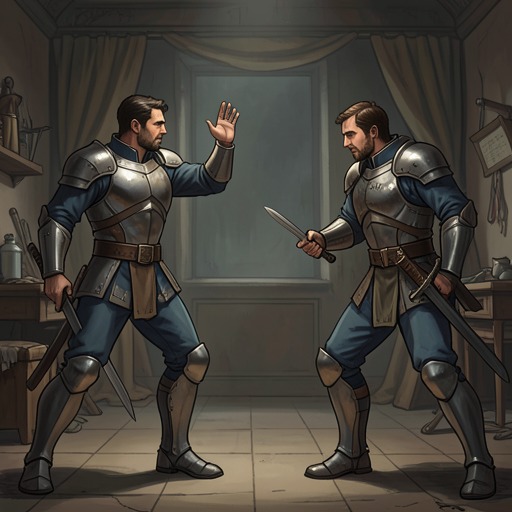
In single combat, the fighter varies techniques when an opportunity arises. A feint may suggest a thrust or cut, or make the opponent think the fighter is about to close in. The point is to prompt a mistaken expectation, then act while the enemy is confused. The text calls this the essence of fighting and insists that it requires deep study: the opening depends on perceiving when the opponent has lost composure, rather than applying a single maneuver mechanically.
Perception and Timing
Confusion works through a contrast between the fighter’s composure and the enemy’s unsettled attention. The broader instructions on strategy emphasize seeing distant things as close and close things from a distance, recognizing the enemy’s sword without being distracted by its insignificant movements, and maintaining a broad gaze. Those principles help explain why the method requires observation as well as variation: the fighter must distinguish meaningful opportunity from misleading motion, while preventing the opponent from doing the same.
The method also accords with the book’s insistence that strategy be embodied rather than reduced to a fixed pattern. A composed stance, a living and pliant grip, and footwork that alternates rather than privileges one foot support action that can change with circumstances. In close engagement, sticking firmly to the opponent rather than leaving a gap, or striking through an opening in the guard with the shoulder and body, shows how varied tactics may shift from deception to decisive physical pressure. These are related strategic principles, not additional definitions of confusion itself: they show the range of action within which an opponent can be denied a stable rhythm.
Strategic Significance
The rule connects mental disorientation with practical advantage. On the battlefield, troops make the enemy question the direction and pace of action; in single combat, feints distort the opponent’s expectation of the next attack. In both settings, the decisive change is a loss of resolve that exposes the enemy to effective action. Confusion is therefore not an end in itself but a way to create the conditions in which the opponent can be defeated.