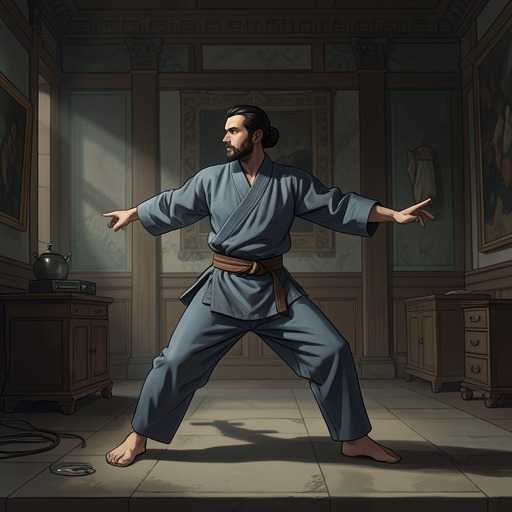
Five Attitudes
The Book of Five RingsThe Five Attitudes are the five basic positions of the long sword in Miyamoto Musashi’s strategy: Upper, Middle, Lower, Right Side, and Left Side. They are a practical repertoire rather than five ends in themselves: all serve the same purpose of cutting, and the Middle attitude provides the organizing center from which the others take their place.
The Five Positions
Upper, Middle, and Lower are decisive attitudes; Right Side and Left Side are fluid. The divisions describe a complete set of positions, but the instruction resists treating them as rigid forms. Whatever attitude the swordsman occupies, he should not become preoccupied with making or displaying it. His attention remains on cutting, and the attitude should expand or contract according to the situation.
The side attitudes answer to the surroundings. An obstruction overhead or to one side may make Left Side or Right Side appropriate, and the choice depends on the place. Position is therefore responsive: the same repertoire must accommodate both the opponent and the physical space in which the encounter occurs.
The Middle as Center
The Middle attitude is the heart of the system, and understanding the other attitudes depends on understanding it thoroughly. Musashi compares its role in large-scale strategy to the commander’s seat: the other four positions follow the center. This analogy makes the set more than a list of interchangeable stances. It has an internal order, with the Middle attitude establishing the point from which the others are coordinated.
That centrality does not mean that the swordsman should cling to the Middle position. The five attitudes remain tools for a common action, and their use changes with circumstance. Their structure joins a stable principle—the central role of the Middle—with flexibility in responding to the immediate conditions of a fight.
The Body Behind the Attitudes
The system belongs to a broader discipline of embodied readiness. The combat stance is to be maintained in everyday life, so that ordinary posture becomes combat posture. The head is held erect, the face composed, the shoulders lowered, and the body braced through the legs and abdomen. The companion sword is wedged against the abdomen in the belt, keeping the belt from slackening. Such details make readiness habitual rather than something assembled only after danger appears.
The gaze supports the same readiness. It should be broad, able to register distant things as though they were close and close things from a distance, while distinguishing the enemy’s sword from insignificant movements. The instruction applies this gaze both to single combat and to large-scale strategy. The Five Attitudes thus sit within a method that coordinates posture, attention, and action rather than isolating sword position as a purely visual form.
Movement, Grip, and Contact
The feet should move as in ordinary walking, with the toes somewhat floating and the heels treading firmly. Musashi rejects jumping-foot, floating-foot, and fixed-steps, and describes Yin-Yang foot as moving left-right and right-left rather than favoring one foot. These instructions reinforce the attitudes’ responsiveness: a position must remain connected to balanced movement, not become a static pose.
The grip likewise combines control with pliability. The thumb and forefinger hold the long sword with a floating feeling, the middle finger is neither tight nor slack, and the last two fingers are tight; play in the hands is bad. Yet fixedness is a dead hand, while pliability is a living hand. The distinction echoes the central principle of the Five Attitudes: the swordsman needs a definite method, but must not let method harden into immobility.
At close range, this responsive discipline becomes bodily contact. In the instruction called Glue and Lacquer Emulsion Body, the swordsman is to stick to the enemy with head, body, and legs, leaving no gap; the body must not lag behind the quicker head and legs. In the Body Strike, he closes through a gap in the guard, turns his face slightly aside, and drives his left shoulder into the enemy’s breast, timing the impact with his breathing. The Five Attitudes’ purpose is therefore not to preserve a pose, but to carry the swordsman from a chosen position into decisive action.