Miyamoto Musashi
The Book of Five RingsMiyamoto Musashi presents himself as a warrior who turned a record of victories into a question about what makes victory possible. In The Book of Five Rings, he traces his course from duels begun in adolescence to sustained study and a strategic method meant to hold across both individual combat and large-scale command. The book’s central movement is from personal success, which he refuses to treat as proof of mastery, toward a Way that can be practiced, examined, and applied more broadly.
Identity and Background
At sixty, Miyamoto Musashi identifies himself by the name Shinmen Musashi No Kami Fujiwara No Genshin and describes himself as a warrior of Harima Province. He dates the introduction to the first ten days of the tenth month in the twentieth year of the Kan’ei era, 1645, and places himself on Mount Iwato in Higo Province, in Kyushu. There he says he climbed the mountain to pay homage to heaven, pray to Kwannon, and kneel before Buddha. The setting makes the book’s beginning both personal and devotional: the strategist speaks from a particular place and age, at the end of a long career, while presenting his teaching as an account of the Way rather than simply a manual of technique.
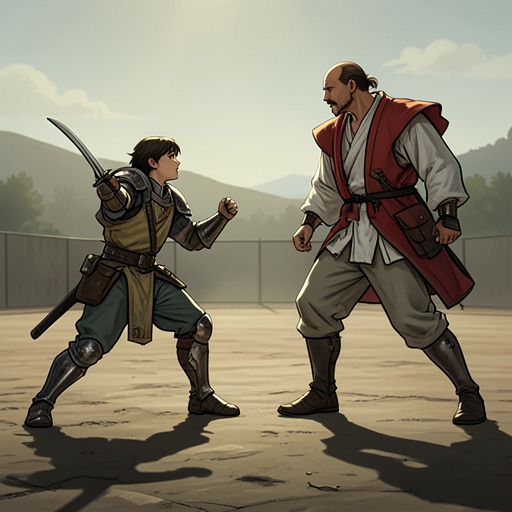
Musashi says his heart had been inclined toward strategy from youth. His first duel came at thirteen, when he struck down Arima Kihei, a strategist of the Shinto school. At sixteen he defeated Tadashima Akiyama, described as an able strategist. These early encounters establish combat not as a late calling but as the first arena in which he tested his understanding.
At twenty-one, Musashi went to the capital and met strategists from many schools, winning the contests he entered. He then travelled from province to province, duelling practitioners of different traditions. He reports as many as sixty encounters between the ages of thirteen and twenty-eight or twenty-nine, without a defeat. The scale of this record matters to his later account: his authority begins in repeated practical tests, but the book does not leave those victories uninterrogated.
From Victory to Study
When he reached thirty, Musashi looked back on his record and questioned its meaning. He could not conclude that victory proved he had mastered strategy. He considered instead whether natural ability, the order of heaven, or the inferiority of other schools might explain his success. This retrospective doubt is a decisive turn in his self-portrait: rather than make undefeatedness the final measure of his skill, he treats it as an insufficient answer that sends him back to study.
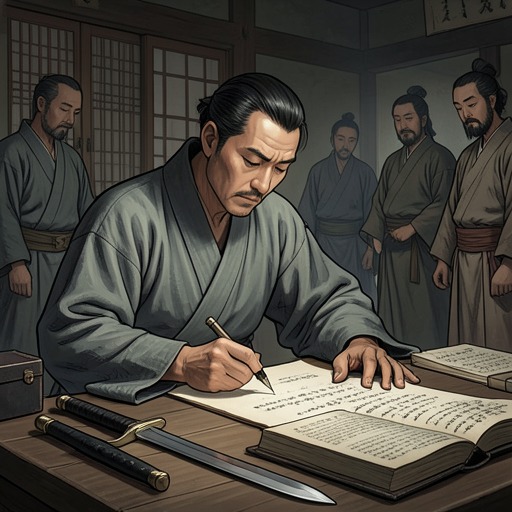
Musashi says he searched for the principle morning and evening and realized the Way of Strategy at fifty. He then lived without following any particular Way, while practising many arts and abilities through the virtue of strategy. He emphasizes that, in writing the book, he did not rely on Buddhist law, Confucian teachings, old war chronicles, or books on martial tactics. Instead, he says he takes up the brush to explain the spirit of the Ichi school as mirrored in the Way of heaven and Kwannon. The account joins disciplined inquiry to a claim of independent formulation, without presenting his method as a simple inheritance from texts.
A Way for Warrior and Commander
For Musashi, strategy is the warrior’s craft: commanders must enact it, while troops should know its Way. He describes the warrior’s path as a twofold discipline of pen and sword and argues that even a person without natural ability can become a warrior by assiduously pursuing both divisions. He gives the warrior’s defining commitment as resolute acceptance of death, but distinguishes this from the readiness to die that may also be found among priests, women, peasants, and other people acting from duty or shame. The warrior’s distinct task is to overcome others through strategy, whether in a duel or in battle against large numbers.
That distinction does not confine strategy to swordsmanship. Musashi presents the Way as useful in understanding victory across different scales: the same principle that lets one person defeat another can be extended to combat involving very large forces. In the Ground Book he sets out five books—Ground, Water, Fire, Wind, and Void—each addressing a different aspect of the Way. The structure signals an attempt to make strategy legible as a whole rather than reduce it to a catalogue of fighting movements.
His comparison between the commander and the master carpenter gives this broader ambition a practical form. As a foreman must understand natural rules, the rules of the country, and the rules of houses, so must a commander grasp the conditions governing the work and the people under his direction. Musashi links command to planning and sound judgment: a carpenter selects timber according to its qualities and uses it appropriately, while the commander must know how to employ different subordinates. Strategy, on this account, is not merely winning an encounter; it is arranging people and resources so that the larger undertaking holds together.
Musashi extends that responsibility to governance. In large-scale strategy, he says, a superior person manages many subordinates dextrously, bears himself correctly, governs the country, fosters the people, and preserves the ruler’s discipline. The move from duelling to political order is explicit: the Way that begins in contests becomes a means of helping oneself and gaining honour, but also of sustaining a ruler’s organization and care for the people.
Training, Judgment, and Instruction
Musashi’s strategic method requires continued research rather than confidence in a fixed repertoire. He warns that small techniques cannot be relied upon when full armour is worn, and describes his own Way as a sure method for fighting for one’s life, including the principle that one person’s victory over ten can be understood in relation to a thousand defeating ten thousand. Since no one can gather such forces for everyday practice, the student trains alone with a sword, learning to assess an enemy’s strategy, strength, and resources. Morning-and-evening training is meant to polish skill, loosen attachment to self, and develop the ability to act freely.
This training also depends on reading an opponent’s condition and the moment for action. Musashi defines knowing the times as recognizing whether the enemy’s disposition is flourishing or waning, observing the spirit of the enemy’s men, and choosing a position of advantage before moving one’s own forces. In a duel, the strategist identifies the opponent’s school, quality, strengths, and weaknesses, then attacks in a way that takes account of the opponent’s metre, modulation, and timing. Victory therefore rests not only on physical execution but on interpreting an opponent and acting before that interpretation becomes useless.
His instructions make the body part of this judgment. The strategist is told to keep the head erect, the face composed, the neck straight, and the shoulders lowered; strength is set through the legs, while the abdomen is braced so the hips do not bend. The companion sword is wedged in the belt against the abdomen so the belt remains taut. Musashi further insists that the combat stance be maintained in everyday life, turning ordinary posture into preparation rather than reserving discipline for the instant of conflict.
Musashi also describes teaching as a direct and adaptive relation. He rejects passing on his Way through written pledges and regulations; instead, he says he judges each pupil’s ability, removes the bad influence of other schools, and gradually introduces the student to the true Way of the warrior. The method depends on a trustworthy spirit. Although he records the general tendencies of other schools, he deliberately withholds their names and specific doctrines because different branches interpret teachings differently and no single person’s conception can stand for an entire school. He closes this comparison by asserting that his Ichi school’s long-sword Way has neither a gate nor an interior: its practice requires a true spirit, not a hidden doctrine of sword attitudes.
The Books and Their Ending
The five-book plan expresses the range of Musashi’s teaching. Ground supplies an outline of the Way; Water treats victory through the long-sword form of the Ichi school; Fire addresses combat; Wind examines other traditions; and Void concerns the illusory nature of worldly things. By setting these subjects beside one another, the book moves between embodied practice, comparison with rival methods, and reflection on the nature of understanding.
The surviving close turns from the study of strategy toward the Void. Musashi writes that the reader should come to see the Way as void, and distinguishes the existence of wisdom, principle, and the Way from spirit understood as nothingness. The ending does not replace practical training with abstraction: it follows a work that repeatedly insists on research, bodily discipline, judgment, and application. Instead, it places those practices within a final account of how the Way may be perceived.
The text’s concluding date is the twelfth day of the fifth month in the second year of the Shōhō era, 1645, followed by the signature SHINMEN MUSASHI and the name Teruro Magonojo. Together with the introduction’s account of Musashi writing on Mount Iwato at sixty, this closing record frames the work as a deliberate transmission of a lifetime’s inquiry. Its defining portrait is not simply of an undefeated duellist, but of a warrior who subjects victory to examination and presents strategy as a discipline extending from the trained body to the conduct of armies and the ordering of a realm.