Musashi’s duel with Tadashima Akiyama
The Book of Five RingsMiyamoto Musashi’s duel with Tadashima Akiyama is a briefly recorded early victory, remembered as part of the sequence that launched Musashi’s lifelong study of strategy. Musashi states that he struck down Akiyama at sixteen, but supplies no details of the contest; its importance emerges from how he later reinterprets his string of victories as insufficient proof that he had mastered the Way.
The Recorded Duel
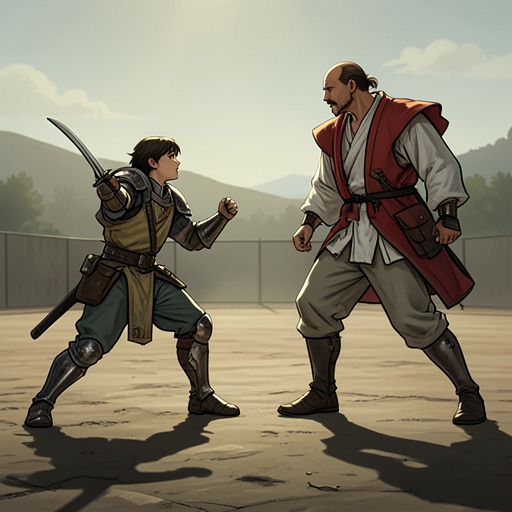
Musashi places the encounter in his account of his youth: at thirteen, he defeated Arima Kihei, a strategist of the Shinto school; at sixteen, he struck down the able strategist Tadashima Akiyama. The text identifies Akiyama as a strategist but does not name a school for him, describe the weapons or circumstances, or explain how the duel unfolded. It records the result, not a scene of combat.
The account then moves forward to Musashi’s journey to the capital at twenty-one, where he met strategists of various kinds and, by his report, did not fail in the contests. He later describes dueling across provinces and winning as many as sixty encounters between the ages of thirteen and twenty-eight or twenty-nine. The Akiyama duel thus belongs to a long series, but stands out as a specific milestone in its opening years: an early victory over a named opponent, recalled by the man who would eventually write a systematic account of strategy.
Victory and Retrospective Doubt
At thirty, Musashi looked back on his record and questioned what it proved. He considered that his victories might have come from natural ability, the order of heaven, or the inferiority of other schools’ strategy, rather than from his own mastery of strategy. The book does not single out the Akiyama encounter as an exception or explain what Musashi thought about it individually. Instead, the duel is absorbed into a larger record whose apparent certainty—victory after victory—Musashi himself refuses to treat as conclusive evidence of understanding.
This retrospective qualification gives the duel its chief significance. The event confirms an early capacity to prevail, while Musashi’s later reflection separates winning from knowing why one wins. After his reassessment, he says he studied morning and evening in search of the principle and came to realize the Way of Strategy at fifty. The youthful duel therefore belongs to the beginning of a development measured not only by victories, but by the difficult passage from success toward an articulated method.
From Individual Contest to Strategic Principle
Musashi presents strategy as more than the technique of sword-fencing. The warrior’s Way, in his account, concerns overcoming opponents, whether in a contest between individuals or in battle involving large numbers; he also links it to the twofold Way of pen and sword. A duel such as the one with Akiyama supplies experience of individual combat, but the book’s larger argument asks how such experience can be examined, practiced, and applied beyond a single encounter.
That enlargement appears in Musashi’s division of the work into five books: Ground, Water, Fire, Wind, and Void. The structure moves from laying out the Way to explaining its methods, large-scale conflict, other schools, and the nature of the Void. In the Water Book, Musashi argues that the principle by which one defeats a person can extend to many, while insisting that the underlying strategy must be studied rather than reduced to small technical tricks. The recorded duel is not presented as the source of any particular rule; rather, it is one of the early contests within the practical experience that Musashi later places under a broader strategic inquiry.
Reading the Enemy and the Scale of Command
The book’s treatment of strategy includes attention to an opponent’s disposition and the conditions of action. To know the times, Musashi says, is to judge whether the enemy’s spirit is flourishing or waning, observe the position that offers advantage, and move one’s forces accordingly. In a duel, the strategist must recognize an opponent’s school, qualities, strengths, weaknesses, rhythm, and appropriate moment of attack. These are general principles, not reported details of the Akiyama contest: the text does not claim that Musashi used any specific tactic against him.
Musashi also links individual training to large-scale command. He argues that diligent practice with a sword can teach a strategist to assess an enemy’s strength and resources and to understand how the principle of one defeating ten might extend to many thousands. The commander’s task, in turn, involves managing subordinates, governing the country, and preserving the ruler’s discipline. Against this wider conception, the duel with Akiyama remains a compact biographical fact rather than a narrated battle: its place in the book is at the personal scale from which Musashi’s reflections on strategy widen.
A Victory Within a Life’s Work
The duel is recalled in the introduction to a work composed by Musashi late in life. He identifies himself as a sixty-year-old warrior and dates the opening of his account to the first ten days of the tenth month in the twentieth year of Kanei, in 1645. At that point, he describes decades of training and says that, after realizing the Way at fifty, he lived without following any particular Way, practicing many arts and abilities through strategy. The distance between that mature account and the sixteen-year-old victor shapes the reader’s view of the event.
Musashi’s later prescriptions likewise resist treating victory as a self-sufficient end. He calls for diligent research and practice, criticizes small techniques as inadequate in the circumstances of full armor, and insists that the true craft of sword-fencing is defeating the enemy in a fight. He also warns against assuming that the opinions of one person can define every other school, choosing to record general tendencies without naming the schools he discusses. In this context, the Akiyama duel is both a remembered achievement and a limit on what the record can establish: it tells the reader that Musashi won, but leaves the means unreported and the principle to be sought in the lifelong study that followed.