Niten Ichi-ryū
The Book of Five RingsNiten Ichi-ryū is Miyamoto Musashi’s school of strategy, a Way that begins with the warrior’s two swords but reaches beyond sword technique into perception, command, and the disciplined reading of changing circumstances. Its decisive claim is that the principles tested in a duel can scale to armies: the trained strategist learns to recognize an opponent’s condition, act at the right time, and make one thing disclose many.
Identity and Foundations
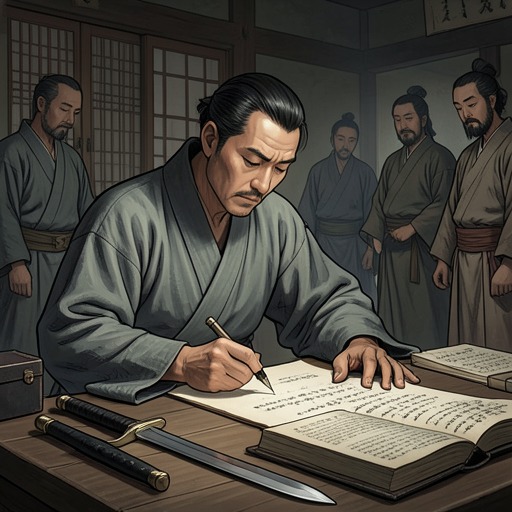
Miyamoto Musashi introduces the school as the strategy he has studied for many years and is setting down in writing for the first time. He presents himself as a warrior from Harima Province, writing at the age of sixty in 1645, after a life shaped by contests and reflection. His early victories, including encounters at thirteen and sixteen and many duels thereafter, do not serve as proof that natural success alone constitutes mastery. Looking back on them at thirty, he questions whether ability, fortune, or the weakness of rival schools explained his record. Niten Ichi-ryū is offered instead as a Way that can be examined, practiced, and transmitted.
The school belongs to a wider conception of the warrior’s work. Miyamoto Musashi calls strategy the craft of the warrior: commanders must enact it, while soldiers should know its Way. He places it alongside other Ways, including religious teaching, learning, medicine, poetry, tea, and archery, and invokes the warrior’s twofold Way of pen and sword. Strategy is distinguished not merely by readiness to die, which is shared by people in other stations, but by the study of overcoming opponents and gaining victory in individual combat or battle among large numbers. Its practical reach includes personal achievement and service to a lord.
The school’s teaching is organized through five books: Ground, Water, Fire, Wind, and Void. Ground lays out the body of the Way and asks the student to understand matters at every scale, from the smallest to the largest and from the shallowest to the deepest. Water gives the school’s spirit its governing image: it adapts to its receptacle, appearing as either a trickle or a wild sea. The image describes flexibility, but also a method of instruction. A principle grasped in sword-fencing should enable victory over one opponent and, by extension, understanding of vastly larger contests. Fire concerns fighting; Wind examines other traditions; Void concerns what has no beginning or end and the natural rhythm by which action can become appropriate to a situation.
The Two-Sword Method and Its Purpose
The name Niten Ichi-ryū announces the advantage of using both swords. Miyamoto Musashi starts from the familiar fact that warriors carry two swords at the belt, the long sword and the companion sword. He argues that students should train from the outset with a sword in either hand and make full use of their weapons when their lives are at stake. Leaving a weapon unused, he says, is not the true Way.
The method also challenges the assumption that the long sword must always be held in both hands. One-handed use leaves the other hand available for another weapon and is more practicable on horseback, while running over uneven or muddy ground, crossing stones, or moving through a crowd. Miyamoto Musashi does not make one-handed handling an inflexible rule: when a single hand cannot cut the enemy down, both hands should be used. The point is trained freedom of use, acquired by practicing with two long swords until a difficult action becomes familiar.
The two-sword method is therefore not a trick detached from the larger purpose of strategy. It puts a principle into the body: use the means available rather than surrendering to a habitual form. The same principle informs the school’s account of scale. A person who has learned how to defeat one opponent can grasp how the same strategic understanding applies to ten million, just as a small model can guide the construction of a great Buddha. The analogy does not claim that every battle is mechanically identical; it calls for research into how a principle expands and how a strategist turns knowledge of small things into judgment about large ones.
Training the Body and Perception
The Water Book treats technique as a coordinated discipline of posture, gaze, grip, and movement. The prescribed stance begins with the head erect, neither lowered nor tilted up or aside, and continues through the whole body: shoulders lowered, neck straight, legs strengthened from knees to toes, and abdomen braced so the hips do not bend. The companion sword is wedged against the abdomen by tightening the belt. This exact bodily arrangement is not reserved for a formal lesson. The combat stance should become the everyday stance, so that ordinary bearing and readiness for action do not divide into separate habits.
Attention is trained just as deliberately. The gaze must be broad, combining perception with sight rather than fixing on conspicuous movement. The strategist should regard distant things as close and close things from a distance, recognize the enemy’s sword without becoming distracted by its minor motions, and learn to look toward both sides without moving the eyes. The book presents this gaze as applicable in both single combat and large-scale strategy. It is a way of taking in the whole encounter while resisting the temptation to mistake a visible detail for the essential one.
The long-sword grip likewise avoids rigidity. The thumb and forefinger hold with a comparatively floating feeling, the middle finger neither tight nor slack, and the last two fingers firm. The hands must not have play, yet the grip must remain pliable: a fixed hand is a dead hand, while a living hand can adjust. The intention to cut should persist through the action, even as the feeling in the thumb and forefinger changes slightly when the sword is used to dash aside, ward off, or force down an enemy’s blade. Combat and sword-testing do not require different grips; what matters is a responsive hold directed toward action.
Footwork is grounded rather than theatrical. The toes remain somewhat light while the heels tread firmly, and movement should resemble ordinary walking whether the steps are fast or slow, large or small. Miyamoto Musashi rejects jumping-foot, floating-foot, and fixed-steps, and emphasizes Yin-Yang foot: the practitioner must not move only one foot but alternate left and right when cutting, withdrawing, or warding off a cut. Across stance, gaze, grip, and footwork, the school replaces isolated display with habits that remain usable under changing conditions.
Close Combat and Direct Transmission
At close quarters, Niten Ichi-ryū turns bodily contact into a means of denying the opponent space. In Glue and Lacquer Emulsion Body, the practitioner sticks to the enemy rather than separating, bringing head, body, and legs forward together so that no gap remains between the two bodies. The instruction corrects a common failure of timing: the head and legs may advance while the body lags behind. The method makes the whole body arrive as one committed action.
The Body Strike develops the same close-range logic through a specific entry. The practitioner approaches through an opening in the guard, turns the face slightly aside, and thrusts the left shoulder into the enemy’s breast. The strike is to be made strongly, in time with the breath, with the intention of bouncing the opponent away. Miyamoto Musashi says that a successful blow can send an enemy ten or twenty feet and can be repeated until he is dead. The description makes the method’s stakes unmistakable: bodily training is not ornamental, but a means of winning a fight for survival.
The school also defines itself by how it is taught. Its true Way is received and handed down through Direct Communication, with the oral instruction to teach the body strategy. Written explanation has a role—Miyamoto Musashi is composing the book precisely to set out an outline—but it cannot replace embodied practice. The Water Book warns that language cannot explain the Way in detail and asks the reader to ponder each word carefully rather than interpret it loosely. Reading, research, and training must work together; understanding is demonstrated in the trained body and in action.
Scale, Comparison, and the Way of Nature
For Miyamoto Musashi, individual combat is not a narrow specialty. He argues that fine techniques lose their advantage when full armor is worn, and defines his strategy as a reliable method for a fight in which one person faces five or ten. From there he extends the principle to armies: if one can defeat ten, a thousand can defeat ten thousand. He acknowledges that no one can assemble such forces for everyday practice. Instead, solitary sword training should teach the student to understand an enemy’s strategy, strength, and resources, and thereby to reason about the application of strategy on a vast scale. Morning-and-evening diligence is presented as the route by which skill is polished and the practitioner becomes free from self.
That expansion depends on reading conditions rather than applying a fixed response. To know the times is to determine whether an enemy’s disposition is flourishing or waning, observe the spirit of the enemy’s men, and secure the best position before moving one’s forces. In a duel, the strategist identifies the opponent’s school, quality, strengths, and weaknesses, then attacks unexpectedly in accordance with the opponent’s rhythm and the appropriate timing. The same work of observation governs both the individual encounter and command: knowledge of an opponent’s condition creates opportunities to act from advantage.
The Wind Book places this method in conversation with other schools. Miyamoto Musashi surveys traditions that favor extra-long swords, short swords, elaborate dexterity, strength, or distinctions between the surface and interior of technique. Knowing these Ways matters because ignorance of them makes it difficult to understand the essence of Niten Ichi-ryū. Yet the comparison does not lead him to codify rival schools in detail. He declines to name their schools or principal points, noting that branches interpret doctrines differently and that no single person’s conception can stand for every school. His account gives general tendencies rather than a definitive inventory.
The contrast clarifies Niten Ichi-ryū’s own position. Its long-sword Way has neither gate nor interior, and sword attitudes contain no hidden inner meaning. Miyamoto Musashi rejects written pledges and regulations as the means of passing on his Way; he says he assesses pupils’ ability, removes the bad influence of other schools, and gradually introduces them to the true Way of the warrior through trustworthy instruction. The school’s organizing principle is not secret knowledge concealed behind a formal threshold, but a spirit kept true through study and practice.
The five-book structure culminates in Void, where strategy is described as the Way of nature. Once the practitioner appreciates nature’s power and recognizes the rhythm of a situation, the action can arise naturally: the enemy is struck without forcing a rigid formula onto the moment. This is the furthest reach of the school’s teaching and its answer to fixed technique. Niten Ichi-ryū begins with the concrete handling of two swords, but its ideal is a strategic understanding flexible enough to move between body and army, detail and scale, disciplined practice and action that fits the circumstances.