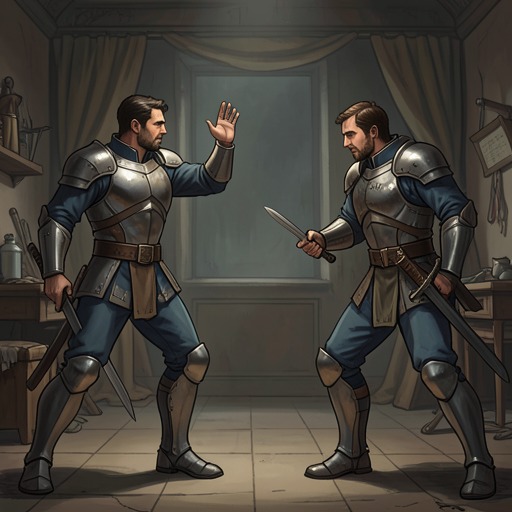
Pass spirit state
The Book of Five RingsTo Pass On is a principle of strategy in which one person’s state can be transmitted to another and turned into an advantage. It begins with commonplace examples—sleepiness, yawning, and even time—and develops into a practical method: remain calm when an opponent is agitated, or relax until the opponent relaxes, then attack at the change in his state. The principle makes influence itself part of combat, linking composure, timing, and action.
Definition and Scope
The text introduces transmission through familiar experiences. Sleepiness can be passed on, as can yawning; time, too, is described as transferable. These examples establish the principle broadly rather than limiting it to a particular weapon or maneuver: an opponent’s state may change through contact with the other person’s conduct.
The chapter then applies this idea to both large-scale strategy and single combat. In each, the strategist attends not only to an opponent’s movements but also to the condition of his spirit—whether he is agitated, relaxed, careless, or weak. The change in that condition matters because it can alter the opponent’s readiness and create a moment to act.
Composure in Large-Scale Strategy
When an enemy is agitated and inclined to rush, the advised response is not to mirror his urgency. The strategist is to show complete calmness and not be troubled by the enemy’s agitation. That visible composure may be taken up by the opponent, who then becomes relaxed; once this change has been passed on, the strategist attacks strongly with a Void spirit to bring about defeat.
The sequence depends on restraint before force. Calmness is not presented as withdrawal or passivity: it is a deliberate display that changes the opponent’s condition, followed by decisive action once the shift is apparent. The principle therefore joins a controlled outward manner to close attention to the resulting opportunity.
Relaxation and the Moment of Attack
In single combat, the strategist can relax both body and spirit, attend to the moment when the enemy relaxes, and then attack strongly and quickly, forestalling him. The instruction makes the transition itself decisive: the attack is timed not merely to an enemy’s movement, but to the instant his readiness gives way.
The text compares this method to getting someone drunk, and also says that the enemy can be infected with a bored, careless, or weak spirit. These variations extend the principle beyond calmness alone. The strategist may allow a condition to spread or encourage a change in the opponent’s attitude, then use the resulting vulnerability. The passage concludes by insisting that the method must be studied, underscoring that recognizing the moment of transmission is a learned strategic skill.