Terao Magonojo
The Book of Five RingsTerao Magonojo is identified in the closing lines of The Book of Five Rings, where his name appears beneath the date and immediately before the name of Miyamoto Musashi. The book does not describe his life, role, or relationship to Musashi; his significance in the surviving text is therefore limited but precise: he is named at the point where Musashi’s treatise reaches its final statement on the Void and closes under a dated attribution.
Appearance at the Close
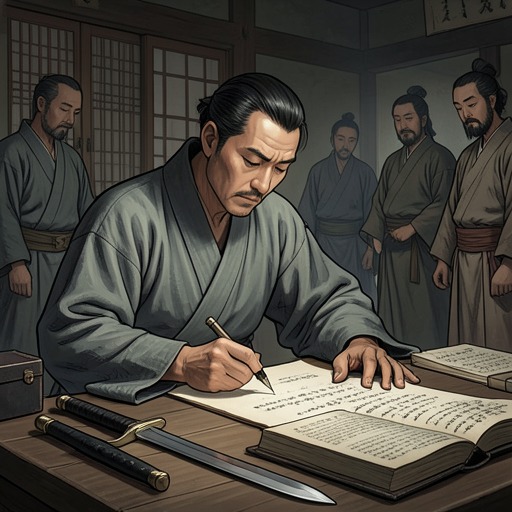
The book gives the date as the twelfth day of the fifth month in the second year of Shōhō, then prints Terao Magonojo’s name followed by SHINMEN MUSASHI. This placement associates him with the work’s closing record, but the text does not explain whether he is a recipient, witness, student, or participant in the writing. It supports his identification as a named person in the book’s final lines, not a more specific account of his connection to Musashi.
The Text He Appears Beside
The name follows the Book of the Void, the final book in a five-part structure comprising Ground, Water, Fire, Wind, and Void. The Void is not presented as mere ignorance: the text distinguishes genuine understanding from bewilderment and says that knowing what exists makes it possible to know what does not exist. Its final formulation joins virtue without evil to the existence of wisdom, principle, and the Way, while describing spirit as nothingness. Terao’s appearance at this endpoint places his name beside the book’s most concentrated statement of its governing principle, without establishing that he authored or endorsed it.
Limits of the Record
Elsewhere, Musashi dates his account of the Way of Strategy to 1645 and presents himself as a warrior whose practice began in youth, developed through study, and reached its realization later in life. He describes strategy not merely as sword technique but as a discipline extending to command, the management of people, and the cultivation of practical judgment. These statements establish the scope of the work associated with Terao’s name at its close; they do not supply facts about Terao himself. The text names him once and leaves his biography and function unstated.