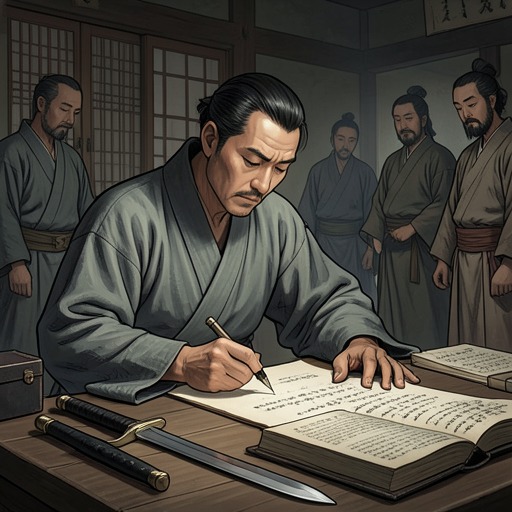
The Void
The Book of Five RingsThe Void is the fifth and final book of the strategy, and its decisive claim is that emptiness is not a name for what a practitioner has failed to understand. It is a condition of clear apprehension, reached by studying the Way fully until bewilderment falls away. The book places this teaching at the end of a five-part structure and makes it both a culmination and a discipline: the strategist must know what exists, recognize what does not, and act in accord with the natural rhythm of a situation.
Place in the Five Books
The five books address distinct aspects of the Way: Ground, Water, Fire, Wind, and Void. The Ground book lays out the body of strategy from the Ichi school’s viewpoint, comparing its purpose to a straight road mapped on the ground. Water explains the school’s principles through the adaptability of water, which takes the shape of its receptacle and may be a trickle or a wild sea. The Void follows these books as the final part of the structure, rather than as a substitute for the practical instruction that precedes it.
The order gives the Void a particular weight. The earlier books establish strategy through description and principles; the last book turns toward the understanding that makes such knowledge usable without confusion. Its subject is not a hidden technique or an additional set of sword attitudes. Instead, it addresses how a warrior should understand knowledge itself and how, after sustained study, the Way can be apprehended without a clouded spirit.
The book’s first formulation is deliberately paradoxical: the spirit of the void is where there is nothing, and the void is nothingness. Yet the text does not treat this as an invitation to stop learning. It says that by knowing things that exist, one can know that which does not exist. The void is therefore approached through knowledge, not through an unexamined blankness; the apparent contradiction marks the difference between disciplined understanding and a convenient name for ignorance.
Natural Rhythm and Strategy
The book’s account of the Void grows from an earlier description of its place in the five-part work. There, void has no beginning and no end, and attaining its principle is described as not attaining the principle. The Way of strategy is identified with the Way of nature: by appreciating nature’s power and knowing the rhythm of any situation, the strategist will hit and strike naturally. The Void is thus connected to action as well as thought. Its test is not a claim to abstract insight, but the ability to respond in accordance with the situation.
This account also distinguishes natural action from mere impulsiveness. The book’s emphasis falls on knowing a situation’s rhythm and on following the true Way according to nature. A strike that arises naturally is the consequence of understanding, rather than evidence that understanding is unnecessary. In this sense, the final book completes the practical instruction of strategy by describing a condition in which knowledge no longer produces bewilderment or obstructs action.
Bewilderment and Study
The text rejects a mistaken interpretation of emptiness in both ordinary understanding and martial practice. People may look at things incorrectly and decide that whatever they do not understand must be the void; the book calls this bewilderment, not true void. Warriors can make the same error within their craft, mistaking whatever they cannot understand in strategy for emptiness. In both cases, a gap in comprehension is being mislabeled as attainment.
The corrective is sustained and broad study. A warrior must study other martial arts fully and not deviate from the Way of the warrior. The book specifies practice accumulating day by day and hour by hour, rather than a sudden leap past instruction. It also describes the work as a twofold discipline of heart and mind, accompanied by a twofold gaze of perception and sight. When the spirit is not clouded and the clouds of bewilderment have cleared, the practitioner has reached the true void. The sequence matters: study and practice do not contradict emptiness but prepare the mind to discern it rightly.
The book extends this warning beyond martial technique. Until the true Way is realized, a person may believe that things are correct and in order, whether considered through Buddhism or common sense. Viewed objectively from the standpoint of the laws of the world, however, doctrines may be found to depart from the true Way. The instruction is to know this spirit, take forthrightness as the foundation and the true spirit as the Way, and enact strategy broadly, correctly, and openly. The test is therefore not simple confidence in a familiar doctrine; it is an objective and open examination of whether one’s understanding remains true to the Way.
The Void as the Way
The teaching culminates in a change of scale: the practitioner comes to think in a wide sense, takes the void as the Way, and sees the Way as void. This widening does not erase the distinctions built through study. It names a manner of understanding in which the learner is no longer confined to what is immediately grasped or clouded by what remains obscure. The void is both the final subject of the book and the perspective through which the Way becomes visible.
Its closing statement holds together existence and nothingness without collapsing one into the other: in the void there is virtue, and no evil; wisdom has existence, principle has existence, and the Way has existence, while spirit is nothingness. The formulation preserves a sharp distinction between what can be affirmed and the unclouded spirit through which it is apprehended. The Void therefore ends the five books not by offering an unexplained mystery, but by refusing to confuse mystery with ignorance. Its apparent blankness is earned through study, tested in clear perception, and expressed in action that follows nature.