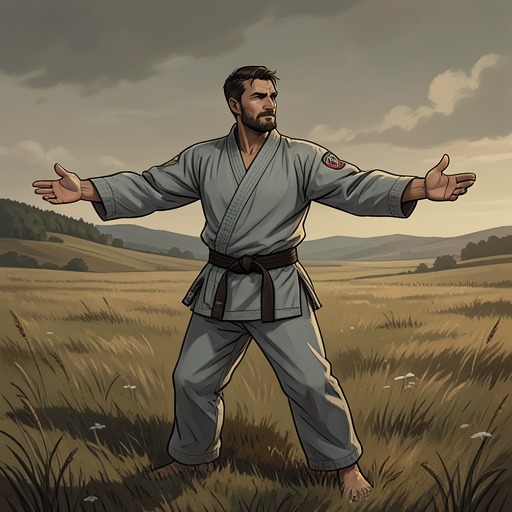
Timing in Strategy
The Book of Five RingsTiming in Strategy is the principle that victory depends on recognizing how circumstances are changing and acting at the moment suited to them. In Miyamoto Musashi’s account, timing is not simply speed, nor a single technical advantage: it is a practiced ability to read the opponent, the scale and background of a situation, and the opening created when one’s own action disrupts the enemy’s expectations.
A principle across the five books
Timing is introduced as a subject that cannot be mastered without extensive practice. The book places it among the rhythms of many activities: dancing, pipe and string music, archery, firearms, and riding. Good timing makes performance coherent in these different arts, while strategy requires the same kind of attunement under conditions of conflict. Musashi extends the idea even to the Void, making timing a principle that reaches beyond a discrete sword technique.
That breadth matches the structure of the book. Its five books are Ground, Water, Fire, Wind, and Void, and Musashi says all five are chiefly concerned with timing. The Ground book lays out the Way’s foundations; the other books develop its principles through different aspects of strategy. Timing therefore binds the work together: it is not an isolated lesson to be applied after learning the system, but a recurring concern through which the system is understood and practiced.
Reading change and context
The principle applies to the warrior’s whole life, including thriving and declining, harmony and discord. It also applies to the merchant’s changing capital. These examples make timing a way of discerning movement in a situation, rather than merely selecting an instant during a duel. The strategist must distinguish applicable from inapplicable timing, large-scale from small-scale considerations, and fast from slow rhythms. Musashi identifies distance timing and background timing as especially important; without grasping the background, strategy becomes uncertain.
This attention to context informs the instruction to know an enemy’s times. In a battle, the commander observes whether the enemy’s spirit is flourishing or waning, reads the disposition of the troops, and seeks the best position before moving his own forces. In a duel, the fighter first recognizes the opponent’s school and quality, weighs strengths and weaknesses, and learns the opponent’s metre and modulation. That reading makes it possible to attack unexpectedly, at a fitting moment, rather than treating every opening as equal. The ability to see into an opponent’s intentions creates more opportunities to win.
Three ways to forestall an attack
Musashi gives the principle a practical shape in three methods of forestalling the enemy: Ken No Sen, Tai No Sen, and Tai Tai No Sen. They distinguish not simply three movements, but three relations between one’s action and the opponent’s initiative. Timing can mean beginning the attack, meeting an attack as it unfolds, or joining an opponent’s movement and answering it with force.
In Tai No Sen, the fighter does not react in haste when the enemy attacks. One method is to remain undisturbed, feign weakness, and move away as if evading; when the opponent relaxes, the fighter dashes in with a strong attack. Another is to attack more strongly during the enemy’s attack, using the resulting disorder in the opponent’s timing to win. In both cases, the enemy’s action supplies the moment, but the fighter’s response changes its course.
Tai Tai No Sen also turns on reading the form and pace of the incoming attack. Against a quick attack, the fighter responds strongly and calmly, aims at the opponent’s weak point as he draws near, and defeats him. Against a calm attack, the fighter observes the opponent’s movement, joins it as the opponent approaches, then moves quickly and cuts strongly. The distinction is not a formula of always advancing or always waiting: it is the capacity to match the response to the enemy’s actual tempo.
Surprise, information, and renewed action
Timing also governs how a strategist acts when the enemy’s intentions are hidden. When the enemy’s spirit or position cannot be seen, Musashi advises provoking a response that reveals it. In large-scale strategy, indicating an impending strong attack can expose the enemy’s resources; once those resources are visible, a different method can defeat him. In single combat, a feint can induce an enemy holding the long sword in a rear or side position to reveal it. The fighter then uses what has been shown, but must not neglect the timing or the opportunity will be lost.
The principle also addresses deadlock. When an entangled contest offers no resolution, the fighter should abandon the failing effort, reconsider the situation with a fresh spirit, and win through a new rhythm. The circumstances need not change: what changes is the spirit brought to them and the technique selected. Musashi says this renewal applies to large-scale strategy as well as single combat. Thus timing includes knowing when a chosen course has ceased to work and when a changed approach can create a new opening.
Training and the scope of strategy
Because timing involves scale, background, rhythm, and the opponent’s expectations, it cannot be reduced to small, dexterous movements. Musashi contrasts his Way with narrow training in fingertip skill and bamboo-sword movements. He argues that small techniques are of little profit when full armour is worn, and describes his strategy as a method for survival in a fight against one or several opponents. A practitioner who trains alone with a sword can still learn to judge an enemy’s strategy, strength, and resources, and to understand how principles used in personal combat may apply against a much larger force.
The connection between individual contests and large-scale command is central to the rule. Musashi says the same principle that lets one man defeat another can be extended to the struggle of armies, while acknowledging that a thousand or ten thousand men cannot be assembled for everyday practice. Diligent training morning and evening is the means by which the practitioner polishes skill and becomes free from self. Timing is learned through repeated application, not secured by knowing the names of its categories.
The rule also belongs to a larger ethic of the warrior’s Way. Musashi describes that Way as resolute acceptance of death, while distinguishing the warrior’s study of strategy by its aim of overcoming opponents and gaining victory in contests or battles. In that setting, timing is consequential judgment: it determines when to commit, when to draw out an opponent, when to change course, and how to turn knowledge of another’s condition into action. Its reach from a duel to the rise and fall of a life or a merchant’s capital makes it one of the book’s organizing principles, joining disciplined perception to victory in changing circumstances.